'Apartments keep rising, but schools stay the same — Jamsil needs a new education map'
Student numbers grew after reconstruction, but school infrastructure did not keep pace
Overcrowding at Jamsil Middle School and unmet high school demand create an 'education bottleneck'
Seoul's education budget should be judged by student impact, not spending volume
AI education gap and out-of-school youth must be brought into the support system

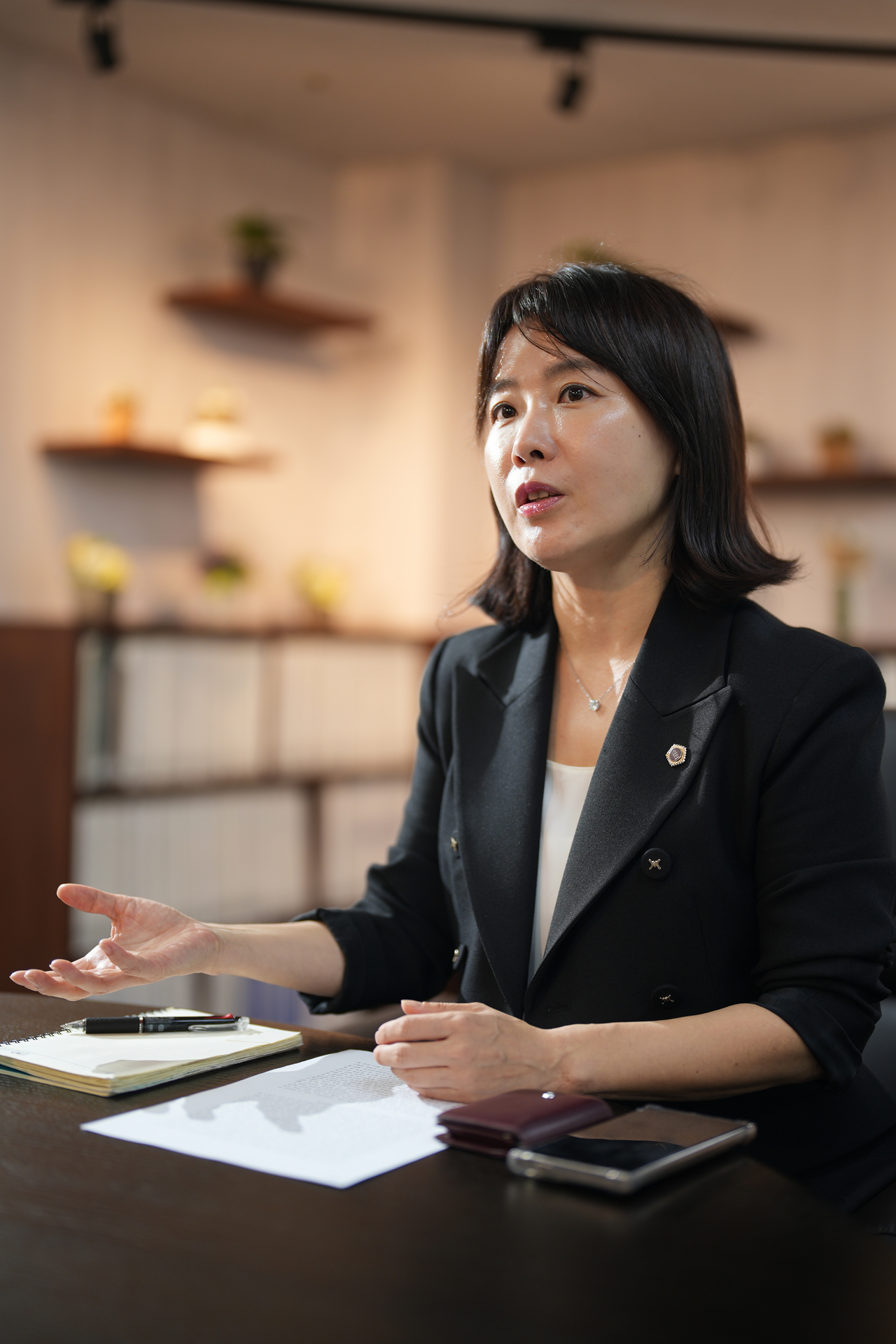
Large-scale reconstruction has transformed the face of the neighborhood, but the schools children attend have not kept up with the change. That is where Seoul Metropolitan Council member Yoon Yu-jin (People Power Party, Songpa District 1) sees the Jamsil education problem beginning.
In an interview Wednesday, Yoon raised two concerns at once: overcrowding at Jamsil's middle school and unmet demand for high school places. With the area already converted into a high-density residential district, she argued that simply searching for land to build new schools is not enough — what is needed is a comprehensive new plan for school supply that includes expanding existing schools, making use of available sites and adjusting student placement.
She said future reconstruction projects must take a fundamentally different approach: rather than scrambling to fix school shortages after residents have already moved in, projected student numbers and school demand should be built into urban planning from the very start of each project.
It is also notable that Yoon, who spent years working in tax administration, chose to join the education committee after entering the Seoul Metropolitan Council. She had initially considered the planning and economy committee, where she could draw on her experience at the National Tax Service and in the financial and tax sectors, but changed her mind after visiting local schools in person.
The problems she found in those schools were more serious than she had expected. Since then, her legislative focus has expanded to cover school supply, education finance and the AI education gap.
The 'school bottleneck' exposed by reconstruction — from middle school to high school
The area she identified as the most urgent local education issue is the Jamsil-dong neighborhoods 4 and 6.
Between the two neighborhoods, there is only one middle school: Jamsil Middle School. According to Yoon, the school has up to 14 classes per grade, reflecting a heavy concentration of students. She visited the school recently and saw firsthand the conditions students face in the limited space available.
The problem carries over into the high school stage as well.
Jamsil High School, formerly an all-boys school, converted to coeducation, but the total number of classes per grade did not increase. The existing seven classes were simply divided into four for boys and three for girls, meaning the options available to local students did not meaningfully improve, Yoon said. Some students are now having to apply to schools in other districts, including Gangdong-gu.
"Jamsil Middle School has up to 14 classes per grade, yet even after Jamsil High School went coeducational, the number of classes per grade did not increase," Yoon said. "The most pressing problem to solve is that middle schools in the same area are overcrowded while there are not enough high school seats to go around."
She does not see this as a problem confined to individual schools. She believes that a failure to properly align education facility planning with large-scale reconstruction and demographic change has allowed school supply problems to pile up and surface all at once.
During reconstruction, securing school sites tends to be deprioritized because it can affect floor-area ratios and project viability. The result, she said, is a recurring pattern in which existing schools are left to absorb the surge in students after move-in.
In Jamsil, where development is already largely complete, finding land for new schools is not easy either. In response, Yoon is exploring several alternatives simultaneously — among them a concept called "J Campus," which would place dedicated education facilities on available spaces such as retention basins, alongside expanding existing schools and adjusting student placement.
She said future reconstruction projects must adopt a fundamentally different approach from the outset: at the planning stage, developers should be required to assess not only the expected number of households but also the projected student population and school capacity, so that decisions about securing education facilities can be made before construction begins.
'What matters is not how much was spent, but where it went'
Visiting schools on the ground has led Yoon to apply her tax expertise to education finance.
The Seoul Metropolitan Office of Education operates a budget exceeding 10 trillion won ($7.39 billion), yet individual schools continue to raise urgent problems — overcrowded classrooms, aging facilities — that still await solutions, she said.
Since taking office, Yoon has been visiting schools in her district and meeting directly with principals and parents to hear their concerns. In the process, she said, she has found cases where school requests were not being passed smoothly through the district education support office and the Seoul Metropolitan Office of Education.
Even when parents raise an issue, they are sometimes bounced between departments before reaching the right contact, and problems between schools and education authorities can drag on unresolved for long periods, she said.
To change that communication structure, she has set up messaging channels with parents at individual schools and collects their concerns and questions before holding meetings. Rather than simply receiving complaints and forwarding them to the education office — the conventional role of a council member — her focus is on connecting schools, parents and education authorities so they can share problems and work toward solutions together.
She also argued that the standard for evaluating education budgets must shift from "how much was spent" to "what effect it had on the ground."
"What matters in the education budget is not the size but whether the money was spent where it was actually needed," Yoon said. "I will look at whether funds are sitting unspent or tied up in low-priority projects, and make sure the budget goes first to problems students are facing right now — overcrowded classrooms and poor learning environments."
At the upcoming administrative audit, she plans to go beyond simply checking the execution rate for each project, and instead examine whether funds were used in line with each project's stated purpose and whether students and parents actually felt the benefit of the policies.
The AI gap reaches beyond the classroom: 'We have to look at who is being left out'
Her attention is also turning to the rapidly shifting education landscape beyond school buildings and budgets.
The number of students using AI is growing fast, but school education and support systems are not keeping pace with the speed of technological change, Yoon said. She taught university students on the morning of the interview and said AI is already transforming the very way students learn.
She is particularly focused on the risk that as generative AI services become more advanced and move behind paywalls, students' access to those services and their hands-on experience with them will diverge along economic lines.
Simply distributing new digital devices to schools or introducing AI programs is not enough, she said. Policy must also ask whether some students are being left unable to make full use of new technology because of cost.
The same concern applies to out-of-school youth. If AI education and digital device support policies are designed around schools as the delivery point, young people who are not enrolled will fall outside the support system entirely.
Yoon said the scope of AI education policy should be broadened beyond enrolled students to include out-of-school youth and any young people at risk of being left behind by technological change.
Ultimately, the direction she envisions for education policy comes down to one principle: find the answers in the field first. Her plan is to factor school demand into reconstruction projects from the planning stage, direct education budgets toward the most urgent student needs, and bring the new inequalities of the AI era within the reach of policy.
"Becoming a council member made me realize there is so much more I can do than when I was just a resident," Yoon said. "I want to be a diligent politician who keeps studying, keeps doing research, keeps meeting people, and turns the problems I find on the ground into real change."
7toy7@heraldcorp.com