Behind every public figure's appearance lies a personal regimen. This series examines the diets, workouts, procedures, and beauty and fashion routines of people in the spotlight.
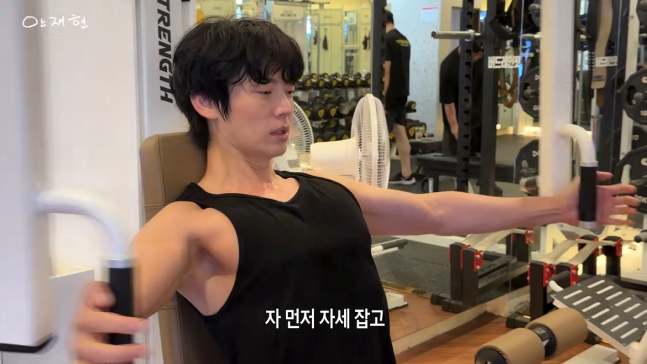
Actor An Jae-hyun has shared an update on his daily gym routine as he prepares for his next project, revealing he does 1,000 ab reps a day alongside weight training and about an hour of cardio. He has also bulked up from 60 kilograms to 77 kilograms through a combination of exercise and diet.
An visited the gym at around 8:40 a.m. Monday, as shown in a video titled "An Jae-hyun's latest update — totally hooked on working out" posted to his YouTube channel.
He started his session with ab exercises before moving on to weight training. "I do 1,000 a day," he said. When the production crew asked why, he said, "Because I need abs to show. It's a simple principle."
His workout frequency was equally striking. Asked how many days a week he goes to the gym, he said, "Every day of the week." He said that starting in the morning, completing weight training and about an hour of cardio, then showering and eating, takes him until 2:30 p.m.
His lifestyle has also changed since he started working out. An, who said he used to enjoy beer, said, "My favorite thing was falling asleep watching my favorite channel with a cold beer." Now, he said, "There's no room for beer anymore. Honestly, I'm just full."
Will 1,000 ab reps a day give you a defined six-pack?
Like any other muscle group, the abdominals can be developed through repeated resistance training. Exercises such as crunches and leg raises stimulate the rectus abdominis and surrounding core muscles, helping build the strength needed to stabilize the torso.
However, doing large volumes of ab exercises does not selectively burn fat from the stomach. The so-called "spot reduction" effect — the idea that repeatedly working a specific area burns fat concentrated in that area — is limited.
Achieving visible abs depends not only on the thickness of the abdominal muscles themselves but also on overall body fat levels. That means weight training for the whole body, cardio, and diet management must all work together alongside ab exercises.
More repetitions are not always better, either. Even 1,000 reps may not provide enough stimulus for muscle growth if the movement becomes too familiar and the intensity too low. Conversely, piling on repetitions while fatigued and with poor form can put strain on the lower back and neck.
What matters is maintaining proper form while adjusting intensity and repetition count to match your training goals.
Working out every day — rest days count as training, too
Even if you go to the gym every day like An, it is best to avoid training the same muscle groups hard on consecutive days.
Strength training causes microscopic damage to muscle fibers, and muscles recover and grow during the rest and nutrition that follow. Repeatedly stressing the same muscles without adequate rest can reduce performance and raise the risk of pain or injury.
Working out seven days a week does not necessarily mean overtraining. Adjusting intensity, splitting sessions by muscle group — chest, back, lower body — and scheduling days with only light activity such as walking or easy cardio can still allow adequate recovery time.
What matters more than the number of sessions is your own fitness level and recovery state. If your performance consistently drops despite getting enough sleep, muscle soreness lingers for an extended period, your resting heart rate rises, or severe fatigue persists, it may be time to scale back your training volume.
From 60 kg to 77 kg — what you gain matters as much as how much
An said he began serious training and bulking up as he prepared for a bed scene in his next project. His weight, which had dropped to 60 kilograms at one point, has since climbed to 77 kilograms.
When bulking to build muscle, what matters more than quickly pushing the number on the scale higher is increasing muscle mass while keeping excess body fat gain to a minimum.
To do that, strength training must be paired with sufficient energy and protein intake. Rather than focusing exclusively on high-protein foods such as chicken breast, it is important to also eat carbohydrates — rice, whole grains, potatoes — and healthy fats found in nuts and fish, so the body has the energy it needs to train.
Consuming large amounts of high-calorie foods or alcohol in an attempt to gain weight quickly is more likely to increase body fat than muscle.
An's mention that his beer consumption dropped naturally once he became absorbed in training could also work in his favor for body composition. Alcohol itself contains calories, and heavy drinking can affect sleep quality and post-workout recovery.
Brad Pitt's lean physique in 'Fight Club' — balance is the key
The body An said he is aiming for is Brad Pitt's in "Fight Club." His trainer also said the goal is "muscles that aren't excessive but look beautifully balanced to anyone who sees them."
Building a physique that is both defined and well-proportioned requires training the back, chest, shoulders, lower body, and core evenly, rather than simply doing more work on one area.
Adequate sleep and rest, along with a diet that can be consistently maintained, are equally essential. Muscles receive the stimulus during exercise, but recovery and growth continue even during the hours away from the gym.
Getting in shape does not come down to a single number — how many reps a day or how many sessions a week. What matters most is building a routine you can sustain over the long term: gradually increasing intensity to match your goals and fitness level, eating enough, and resting enough.
rainbow@heraldcorp.com