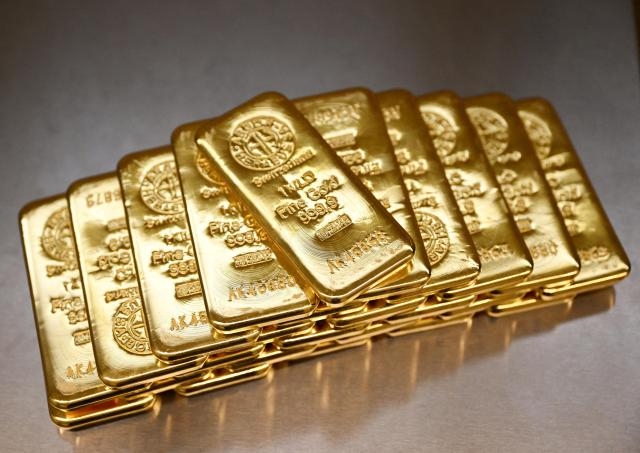
Domestic pure gold prices, which crossed 1 million won ($751) per don for the first time earlier this year, have fallen into the 600,000-won range. International gold prices have dropped nearly 37% from the all-time high set last January, hitting their lowest level in 14 months. The Federal Reserve's signals of further rate hikes and a strengthening dollar are weighing on gold, while global investment banks are closely watching the direction of interest rates beyond next year.
According to the precious metals industry on Saturday, the buying price of pure gold per don (3.75 grams) at the Korea Gold Exchange stood at 669,000 won on Friday, including value-added tax — down 32,000 won, or 4.6%, from the previous day. The selling price for consumers also fell 30,000 won, or 4.9%, to 578,000 won.
Compared with the buying price of 845,000 won a year ago, the per-don price has dropped 176,000 won, or 20.8%. Against the level above 1 million won seen last January, the price has shed more than 300,000 won in just 10 months.
The decline in international gold prices has been equally steep. According to market data provider Investing.com, the spot price of gold stood at $3,533.25 per ounce as of 11:30 a.m. Friday (Korean Standard Time), down 2.5% from Thursday. During trading, the price briefly touched $3,532.22, its lowest since early September last year — a span of roughly 14 months.
Gold was trading at $4,139.84 per ounce on Nov. 9 but fell for five consecutive sessions starting Monday, widening its decline to 14.7%. The price is also 18.1% below where it ended last year.
Gold hit an all-time high of $5,595.46 per ounce on Jan. 29, only to drop 9.8% the very next day, reflecting the sharp volatility seen throughout this year. With the recent slide continuing, the gap from that record now exceeds $2,000 per ounce.
The primary driver behind the recent decline is a shift in the Federal Reserve's monetary policy stance. The Fed signaled the possibility of further rate hikes in the minutes of its October FOMC meeting, and Fed Governor Christopher Waller went further, raising the prospect of a 0.5 percentage-point increase in the benchmark interest rate in December.
Financial markets now expect the Fed to raise rates next month and to follow with two additional hikes next year. As rate-hike expectations have grown, the US Dollar Index (DXY), which measures the dollar against a basket of six major currencies, climbed to 103.97 on Thursday — its highest level in 19 months since April last year.
The yield on the 10-year US Treasury note is also hovering around 5.05 percent annually. The number of trading days this year on which the 10-year yield closed above 5 percent is expected to approach the 2007 record of 29 sessions.
Unlike stocks or bonds, gold generates no dividends or interest income. When interest rates rise, yield-bearing assets such as deposits and bonds become more attractive, which can reduce investment demand for gold.
The fact that international gold trading is conducted primarily in dollars adds another layer of pressure. When the dollar strengthens, investors using other currencies must pay more to purchase the same amount of gold.
Analysts also point to forced selling — investors liquidating gold positions to cover losses in other assets — as a factor behind the price decline, as volatility has widened across global financial markets. Rising oil prices driven by Middle East conflicts and the resulting inflationary pressure are also seen as factors that could prolong the high-rate environment.
Global investment banks have lowered their gold price forecasts for this year but expect the high-rate environment to weigh on prices only for now. Over the medium to long term, they see a potential recovery as rate hikes wind down and demand from central banks and private investors picks up.
Goldman Sachs cut its year-end gold price forecast earlier this month to $4,150 per ounce from $4,650, and also trimmed its end-of-next-year target to $4,800 from $5,400, before lowering it again to $4,650 in mid-November.
The revisions reflect the possibility that the Fed could continue raising rates through March next year. Goldman said it expects private investment demand, which has been suppressed by high rates, to gradually recover once rate cuts begin.
JPMorgan Private Bank said gold prices could fall further through early next year, but forecast a recovery to $4,500 per ounce by mid-next year and $5,000 by year-end as the US rate-hike cycle comes to a close.
UBS also recently cut its year-end gold price forecast to $4,500 per ounce while keeping its end-of-next-year target at $5,000. Morgan Stanley projected gold would reach $5,250 per ounce in the fourth quarter of next year, citing central bank buying and demand for gold ETFs.
According to the World Gold Council, global central bank gold purchases in the third quarter of this year totaled about 321 metric tons, up 42% from the same period a year earlier. Even as private investment demand has been dampened by high interest rates, central banks around the world have continued buying gold to diversify their foreign exchange reserves.
As major investment banks point to a medium- to long-term price recovery, market attention is turning to the Fed's benchmark interest rate decision next month and the direction of US monetary policy in the year ahead.
rainbow@heraldcorp.com