
2,968 recipients through July — 77.7% of last year's full-year total
Business closures surge 14.7% in first half to 624,000
Next year's minimum wage set at 10,700 won; small business groups file suit
![More than 970,000 businesses in the food service and other service industries shut down last year, with a closure rate of 9 percent. Some 68.5 percent carried debt at the time of closure, with average liabilities of 85.31 million won. The most commonly cited reason for closing was deteriorating profitability and sluggish sales due to declining customer numbers. Pictured is a row of restaurant supply stores in Hwanghak-dong, Jung-gu, Seoul. [Yonhap]](https://wimg.heraldcorp.com/news/cms/2026/09/15/rcv.YNA.20260630.PYH2026063009840001300_P1.jpg)
The number of self-employed workers who closed their businesses and collected unemployment benefits has approached 3,000 in just seven months this year, setting an all-time high for the same period. Analysts say the increase reflects not only a growing number of self-employed workers enrolled in employment insurance, but also the harsh reality facing more small business owners squeezed by weak domestic demand and rising food and labor costs.
According to the Ministry of Employment and Labor, 2,968 self-employed workers received unemployment benefits from January through July this year. Total payouts reached 13.3 billion won ($9.88 million). Both the number of recipients and the total amount disbursed are the highest on record for the January-to-July period since the self-employed employment insurance system was introduced.
The 2,968 recipients in the first seven months of this year already represent 77.7 percent of the 3,820 self-employed workers who received benefits throughout all of last year. Payouts over the same stretch also reached 64.8 percent of last year's full-year total of 20.53 billion won.
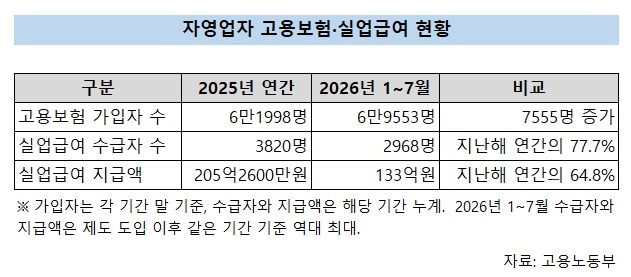
A rise in the number of self-employed workers enrolled in employment insurance has also contributed to the increase in recipients. As of July, enrollment stood at 69,553 — up 7,555, or 12.2 percent, from 61,998 at the end of last year. A Ministry of Employment and Labor official said enrollment has been climbing partly due to premium subsidy programs run by the Small Enterprise and Market Service, adding that the number of unemployment benefit recipients tends to grow in step with enrollment each year.
The self-employed employment insurance scheme is a voluntary program open to business owners with fewer than 50 employees. Those who have paid premiums for at least one year during the 24 months before closing their business, and who shut down for unavoidable reasons such as falling sales or sustained losses, can receive unemployment benefits if they are actively seeking re-employment or planning to start a new business.
Even so, business closures are rising as operating conditions for the self-employed deteriorate. Data from the Korea Federation of Small and Medium Business and the National Tax Service show that 624,000 businesses filed for closure in the first half of this year, up 80,000, or 14.7 percent, from 544,000 in the same period last year.
Restaurants, one of the most common self-employed sectors, are seeing profitability erode as food ingredient and labor costs mount. A survey by the Ministry of Agriculture, Food and Rural Affairs and the Korea Rural Economic Institute found that food and labor costs as a share of restaurant sales rose from 58.8 percent in 2015 to 71.6 percent in 2024 — the first time the combined share has exceeded 70 percent since the survey began. Over the same period, the average operating profit margin fell from 25.4 percent to 8.7 percent.
Next year's minimum wage increase is expected to add further pressure on small business owners. The Ministry of Employment and Labor has finalized the minimum wage for 2027 at 10,700 won per hour, up 380 won, or 3.7 percent, from this year's 10,320 won. Based on 209 working hours a month, that translates to a monthly wage of 2.24 million won. When weekly holiday pay, four major social insurance premiums and severance pay are factored in, the actual burden on employers is even higher.
In response, the Korea Federation of Small and Medium Business filed an administrative lawsuit against the Ministry of Employment and Labor last month seeking to cancel the ministry's official notice of the 2027 minimum wage. The suit challenges the level of the wage, the failure to apply differentiated rates by industry, and the adequacy of small business representation in the decision-making process.
The number of solo self-employed workers — those who hire no staff to keep labor costs down — is also on the rise. According to the Ministry of Statistics, the number of self-employed workers with employees fell from about 1.587 million in July 2017 to about 1.499 million in July this year, a drop of 88,000. Meanwhile, the number of self-employed workers without employees grew by 164,000 over the same period, from about 4.144 million to about 4.308 million.
Despite the growth in insurance enrollment, only a tiny fraction of the self-employed are covered by unemployment benefits. Insurance enrollees account for roughly 1.2 percent of the approximately 5.807 million self-employed workers counted in July this year. That means the vast majority who close their businesses due to financial hardship have no access to unemployment benefits.
Legislation to lower the eligibility threshold for self-employed unemployment benefits is also moving through the National Assembly. People Power Party lawmaker Kim Jae-seop on Aug. 13 introduced a bill to amend the Employment Insurance Act that would expand the criteria for benefit eligibility — currently centered on declining sales — to include drops in operating profit, changes in output and inventory levels, fixed costs such as rent, and shifts in commercial district conditions and retail distribution structures.
fact0514@heraldcorp.com




