Dual Brain combines AI with engineer expertise
'AI predicts outcomes as variables change'
Five Dual Brain projects underway at SK Innovation's Ulsan CLX
AI also deployed for equipment anomaly detection and site patrols
Robot dogs and drones to be introduced to advance Dual Brain
SK Innovation's Ulsan CLX (Complex) expects to achieve annual productivity gains of around 100 billion won ($74.3 million) starting in 2030 through its "Dual Brain" system.
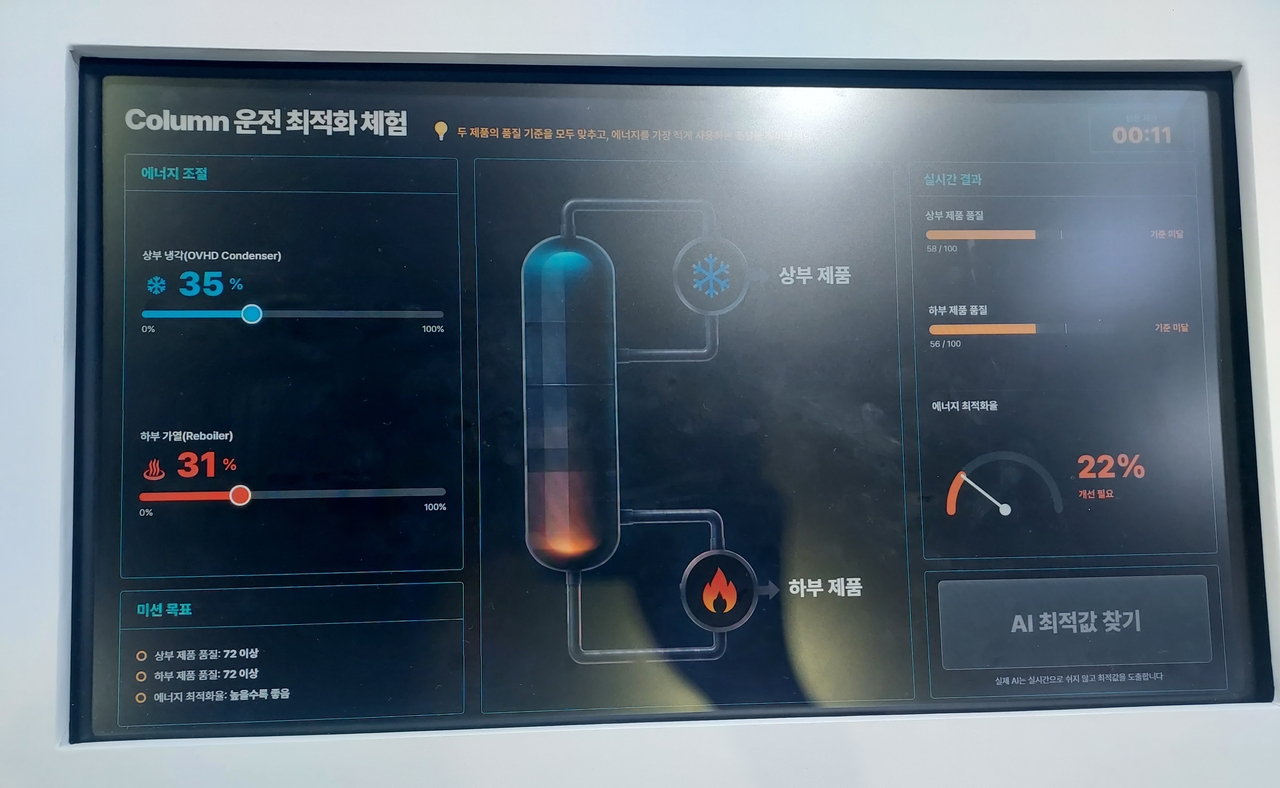
At the SK Group booth inside the Ulsan World Future Industry Expo 2026 (WAVE), held Thursday at the Ulsan Exhibition and Convention Center in Ulju-gun, the production-optimization AI experience zone drew the most attention. When a visitor entered the cooling energy temperature for an upper refinery product and the heating energy temperature for a lower product into a display terminal, the system automatically calculated the optimal temperature values for managing both products, drawing on big data accumulated by SK Innovation.
The AI technology is not merely for exhibition purposes. The same system is already in use at the heavy oil upgrading (HOU) control room of SK Innovation's Ulsan CLX, the country's largest crude oil processing facility. The control room operates around the clock on rotating shifts, monitoring process conditions and adjusting operating parameters. Workers there use simple inputs and AI to calculate optimal process values — meaning the production-optimization AI, one of SK Innovation's Dual Brain projects, is already deployed on the ground.
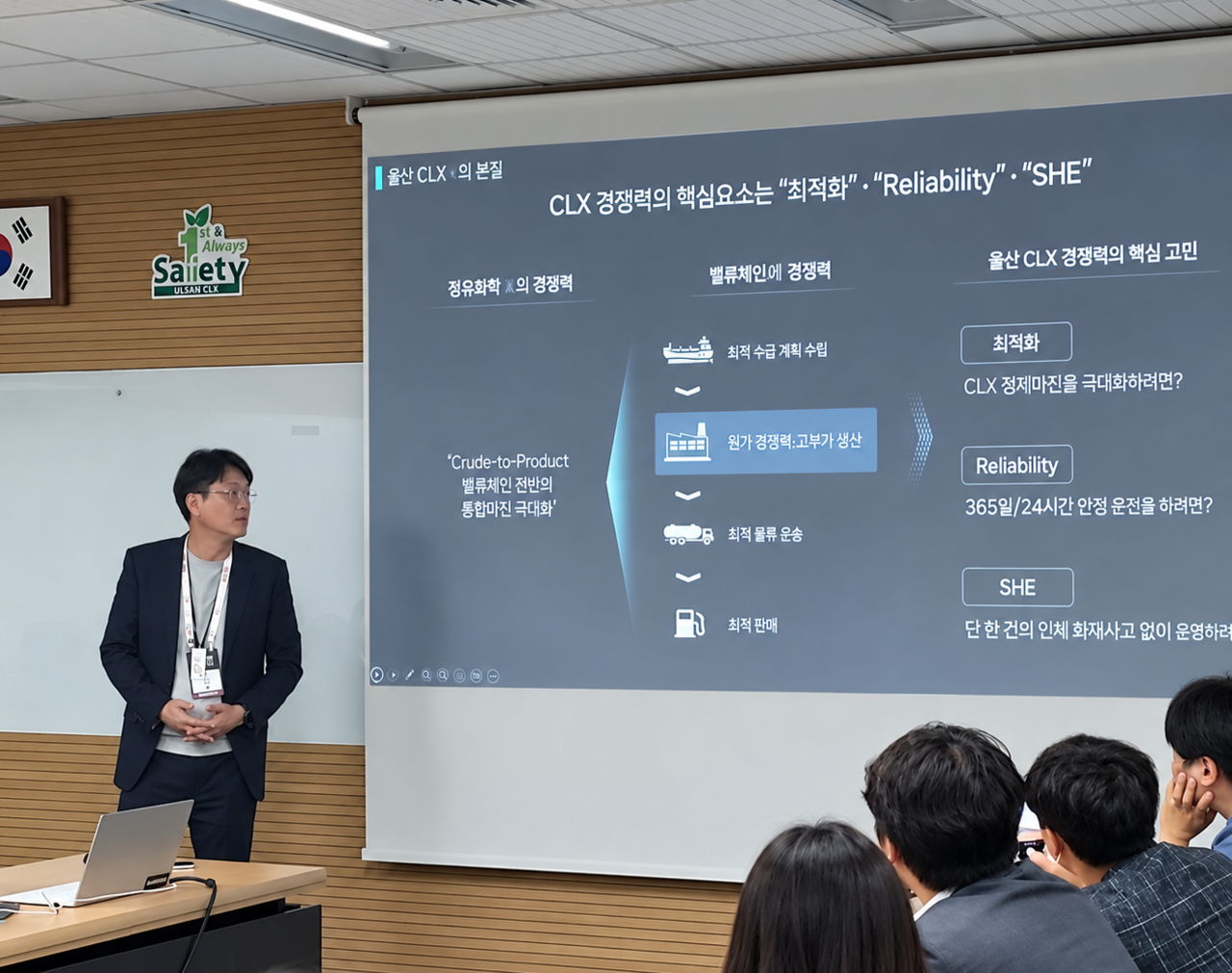
"In the past, workers on the floor had to manually fine-tune a wide range of variables — temperatures, feed volumes and more — to refine crude oil," said Jung Chang-hoon, head of SK Innovation's manufacturing AI promotion team. "But with the AI system, they can predict outcomes as variables change and receive guidance on the optimal variable settings needed to achieve the desired result."
The Dual Brain system SK Innovation is developing integrates Brain AI — an AI that participates directly in human decision-making — with the accumulated engineering expertise of Ulsan CLX's workforce. "Equipment management requires workers' experience to be embedded in the process, so AI cannot fully replace that," Jung said. "Dual Brain is ultimately about humans and AI coexisting."
![A robot dog deployed at SK Innovation's Ulsan CLX. [Provided by SK Innovation]](https://wimg.heraldcorp.com/news/cms/2026/09/15/news-p.v1.20260914.93bef49fe51e4dbca80d5708d73aaf1a_P1.jpg)
SK Innovation is pursuing Dual Brain to maximize production efficiency. Ulsan CLX spans 8.25 million square meters — roughly three times the size of Yeouido — making it impractical for workers to inspect every piece of production equipment individually. Compounding the challenge, the average age of CLX facilities has reached 33.6 years, aging infrastructure is a serious concern, and about 50 percent of veteran baby boomer employees are set to retire by 2030.
"It is difficult for workers to monitor and analyze every piece of equipment and anticipate problems," Jung said. "We are using AI to overcome the constraints of time and physical reach."
SK Innovation is running five Dual Brain-related projects to drive the AI transformation of CLX. In addition to the production-optimization AI already mentioned, the projects include a utility-optimization AI, an equipment anomaly prediction AI, a maintenance planning AI and SHIELD.
The utility-optimization AI adjusts consumption of electricity, water and other resources needed for process operations in real time. SKADI, the flagship application of the equipment anomaly prediction AI, is a rotating-equipment monitoring platform that reads vibration and temperature changes in real time to identify abnormal signs and their causes. The maintenance planning AI uses information from the equipment anomaly prediction AI to recommend the optimal timing for repairs. SHIELD advances human-led site patrols into an AI-based, around-the-clock facility monitoring system.
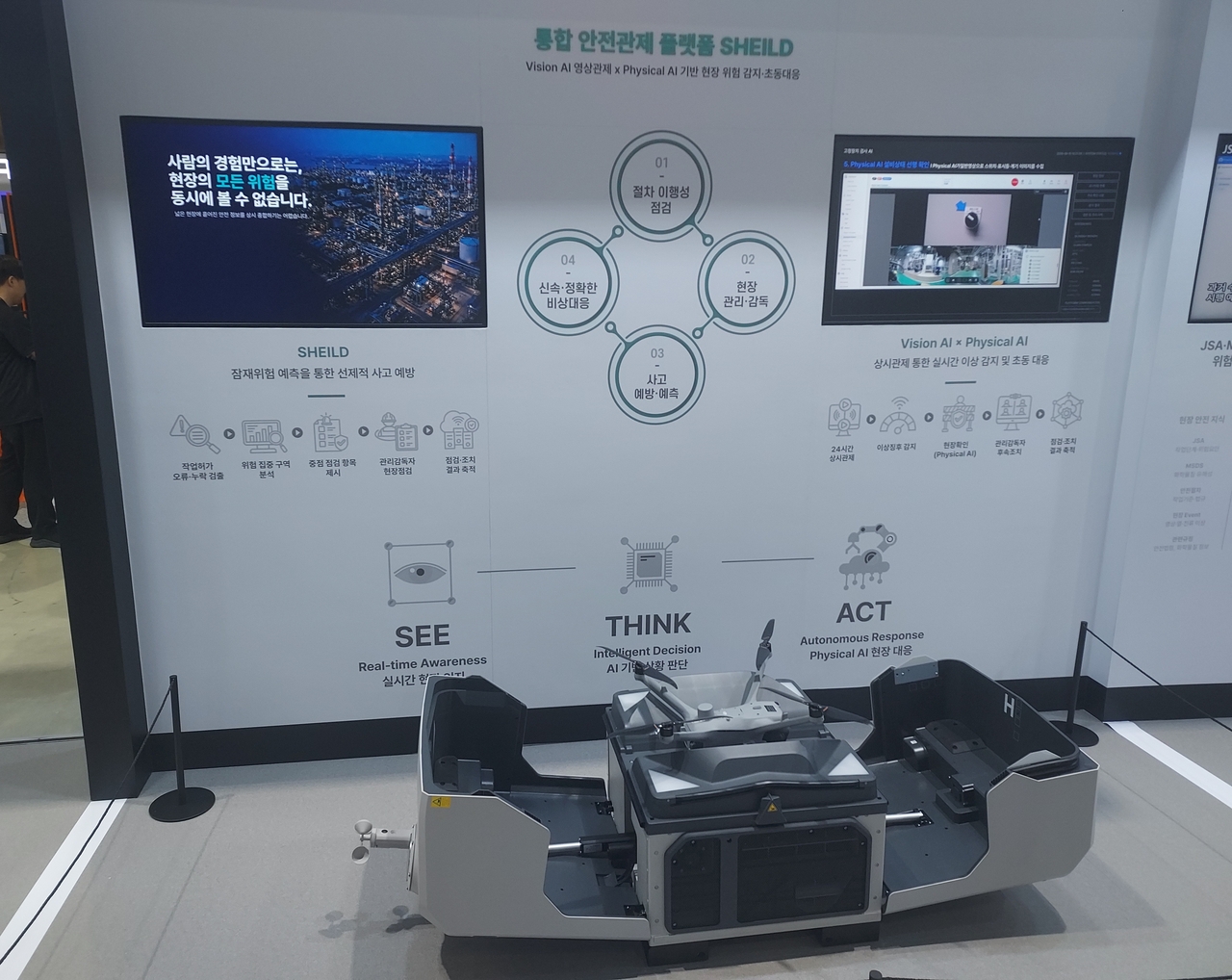
SK Innovation plans to fully embed the Dual Brain operating system across all 98 processes at CLX by 2030 at the earliest. The company intends to make active use of robot dogs and drones to sharpen the system's capabilities, maximizing the volume of operational data collected from the factory floor. Ulsan CLX currently operates one robot dog and plans to expand the fleet to as many as 10.
"Until now, we lacked a platform capable of operating robots," Jung said. "But we have recently built a platform that can control them, which has made it possible to expand the deployment of robot dogs." On the use of drones, he added, "We will focus our efforts on using AI to conduct precise analysis of field data gathered by drones, with the goal of advancing the maintenance system itself."
Jung also said the company aims to transform Ulsan CLX — which started 60 years ago as South Korea's first oil refinery — into a factory operated 60 years from now by a Dual Brain system in which humans and AI work together.
![An aerial view of SK Innovation's Ulsan CLX (Complex). [Provided by SK Innovation]](https://wimg.heraldcorp.com/news/cms/2026/09/15/news-p.v1.20260914.44e1a03cf2a84485ba112c3bd7552443_P1.jpg)
yeongdai@heraldcorp.com