Agreement aims to strengthen aerospace technology competitiveness
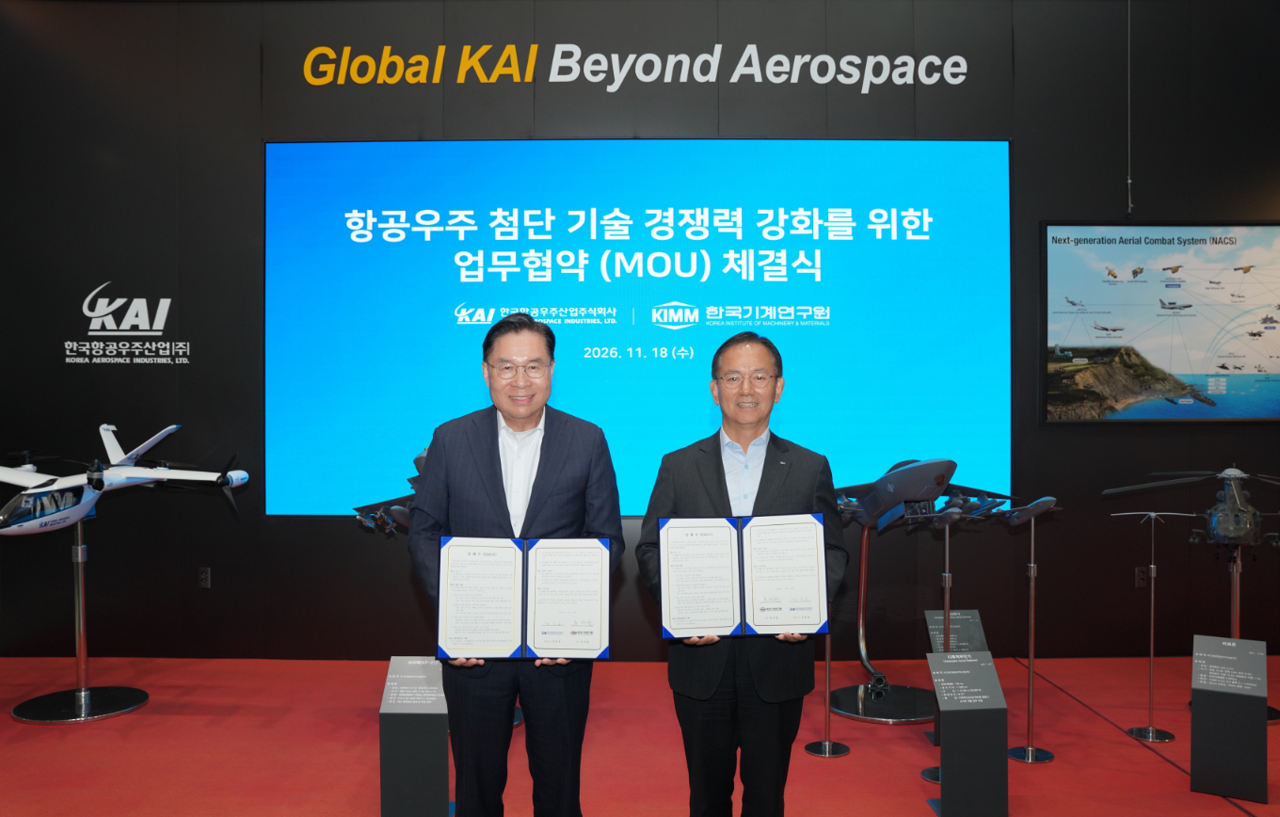
Korea Aerospace Industries signed a memorandum of understanding with the Korea Institute of Machinery and Materials on Wednesday at KAI's headquarters in Sacheon to strengthen aerospace technology competitiveness and held a technology exchange forum the same day, the company announced Thursday.
KAI President and CEO Kim Jong-chul, Korea Institute of Machinery and Materials President Ryu Seok-hyun and other senior officials from both institutions attended the event.
The agreement is designed to combine KAI's aerospace systems development capabilities with the institute's foundational technologies and research infrastructure to secure core technologies needed for the future aerospace industry.
KAI is expected to leverage the institute's foundational technologies and specialized research expertise to sharpen its competitiveness in aircraft development, production and performance enhancement. The institute, in turn, is expected to find new opportunities to apply its research outcomes in industrial settings and identify fresh research demands in the aerospace sector.
Under the agreement, the two institutions plan to pursue joint research aimed at advancing key future aerospace technologies, including low-observable surface technology and intelligent metal additive manufacturing. They also intend to explore technical cooperation applicable to aircraft development and production.
Key areas of cooperation include core technology and expert personnel exchange, identification of joint research projects and coordinated responses to national research programs, shared use of testing and evaluation infrastructure, and advancement of advanced materials, manufacturing and AI-based technologies.
At the technology exchange forum held after the signing, presentations were made on four technology areas aimed at strengthening KAI's future aerospace competitiveness.
The technologies covered were reliability evaluation of aviation and defense components to improve the dependability of aircraft fastening parts, transparent meta displays for stealth applications, metal additive process technology to enhance AI-based intelligent production and maintenance capabilities, and active control of aircraft radiated energy to improve low-observable performance.
Based on the presentations and discussions, the two institutions plan to identify detailed cooperation tasks and gradually formalize follow-up collaboration, including joint research and participation in government research and development programs.
"Proactively securing new technologies and internalizing core capabilities are paramount to preparing for future business," Kim said. "Through this partnership, we will work to strengthen our aerospace technology competitiveness and secure new engines of growth."
yeongdai@heraldcorp.com