
Retail investors who collectively sold more than 10 trillion won ($7.43 billion) worth of Samsung Electronics and SK hynix shares turned around and net-bought more than 800 billion won of Samsung Electronics preferred stock over the same period. The divergence in buying behavior between common and preferred shares emerged after Samsung Electronics unveiled its shareholder-return plan.
According to Korea Exchange and Koscom data, retail investors net-sold more than 10 trillion won of Samsung Electronics common shares (3.26 trillion won) and SK hynix (7.37 trillion won) combined from Aug. 24 — the first trading day after the shareholder-return announcement — through Friday. Over the same stretch, they net-bought 803.5 billion won of Samsung Electronics preferred stock, making it the top retail net-buy on the Kospi.
The surge in retail buying of the preferred shares was most pronounced immediately after Samsung Electronics announced a sweeping shareholder-return plan. The company held a board meeting after the close of trading on Aug. 21 and said it expects remaining shareholder-return resources this year to reach between 90 trillion and 110 trillion won ($81.7 billion). Of that, about 30 trillion won will be paid out as a cash dividend in the third quarter, with the allocation of the remaining 60 trillion to 80 trillion won to be finalized early next year.
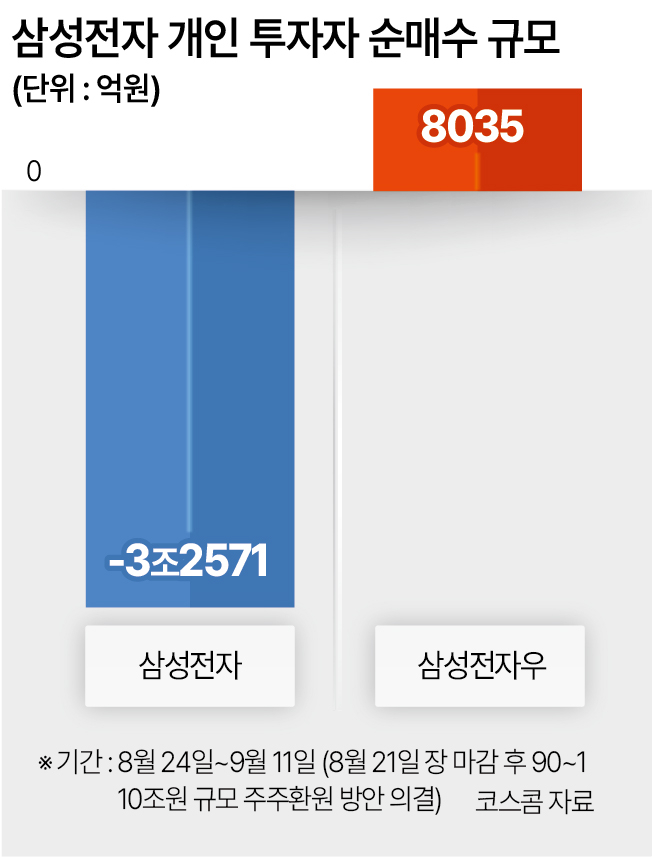
The tilt toward preferred shares reflects expectations that preferred stock could fare relatively better in any future share buyback and cancellation program. Samsung Life Insurance and Samsung Fire hold Samsung Electronics common shares at levels approaching 10 percent, meaning that canceling common shares would push their ownership stakes higher. Under the Financial Industry Capital Act, if the stakes of affiliated financial subsidiaries exceed 10 percent, those companies would be required to sell some of their holdings. Preferred shares, which carry no voting rights, are largely exempt from such ownership restrictions — leading some observers to suggest they could serve as an alternative vehicle for shareholder returns in place of common shares.
Domestic preferred shares have long traded at a discount to common shares, penalized not only for their lack of voting rights but also for being sidelined in buyback, cancellation and tender-offer processes. Industry watchers believe that if Samsung Electronics raises the proportion of preferred shares in its buyback and cancellation program, the discount historically applied to preferred stock would narrow.
"Domestic preferred shares have in effect been treated as non-voting common shares," said Kim Gyu-sik, a portfolio manager and attorney at Vista Global Asset Management. "The discount factors that have weighed on preferred shares can be substantially removed only if preferred shares are actively utilized in buyback and cancellation programs."
Industry observers expect preferred shares to account for a larger-than-anticipated portion of Samsung Electronics' shareholder-return program next year. With constraints on canceling common shares, buyback and cancellation of preferred shares is emerging as an alternative — and could serve as a catalyst for a revaluation of preferred stock, which has long traded at a discount to common shares.
Kim Su-hyeon, head of research at DS Investment Securities, estimated that Samsung Electronics' buyback and cancellation program to be executed early next year would total between 10 trillion and 20 trillion won, with a growing share allocated to preferred stock. "Given the Financial Industry Capital Act complications that arise when canceling common shares, the possibility that preferred shares will account for a larger portion of the buyback and cancellation budget cannot be ruled out," he said.
Whether preferred share buybacks and cancellations expand will depend on how Samsung Electronics allocates its remaining shareholder-return resources. Kim said he expects the company to direct some of those resources toward buybacks and cancellations rather than channeling everything into dividends — a move that would help its financial subsidiaries avoid having to sell down their stakes. "If 100 percent of shareholder-return resources were funneled into dividends out of concern that a block deal by financial subsidiaries would weaken control, the market could discount the quality of the shareholder return," he said.
Samsung Electronics has precedent for raising the proportion of preferred shares in its buyback programs when the price gap between common and preferred shares widens. Of all shares canceled since the company's founding, about 16.9 percent have been preferred shares, and in its first buyback program in 2015, the company allocated 30 percent of the total purchase amount to preferred stock.
With the dividend ex-date approaching at the end of September, preferred shares also look attractive on a yield basis. Samsung Electronics preferred shares closed most recently at 193,300 won, a 25.5 percent discount to the common shares at 259,500 won. Because both share classes receive the same dividend per share, the dividend yield relative to the amount invested is higher for preferred shareholders.
kacew@heraldcorp.com