
Procedures stalled six months after Yellow Envelope Law took effect
Posco filed for injunction and administrative lawsuit four days after first meeting
Experts propose provisional bargaining once basic facts are established
Multi-tiered bargaining structure with joint negotiating teams also suggested
![Participants discuss ways to improve the primary contractor bargaining system at a forum held Monday at the National Assembly Members' Office Building in Yeouido, Seoul. From center left: Kim Tae-wook, attorney at the Korean Confederation of Trade Unions' legal center; Kwon Oh-sung, professor at Yonsei University School of Law; Kim Sun-su, distinguished professor at the Judicial Research and Training Institute; and Kim Sang-eun, chair of the labor committee of the Minbyun lawyers' group. [Provided by Rep. Lee Yong-woo's office]](https://wimg.heraldcorp.com/news/cms/2026/09/14/news-p.v1.20260914.63bb8625219c41a7afb54e50d1b5edab_P1.jpg)
Experts are calling for provisional bargaining — covering information exchange and agenda confirmation — to begin even while labor commission proceedings and administrative lawsuits over a primary contractor's employer status remain ongoing. They warn that suspending negotiations until a final ruling is issued could in effect extinguish subcontracted workers' right to bargain.
According to materials presented Monday at a forum jointly hosted by the Korean Confederation of Trade Unions, Democratic Party of Korea lawmaker Lee Yong-woo and Progressive Party lawmaker Jeong Hye-gyeong, 77 chapters of the Korean Metal Workers' Union had demanded bargaining with 25 primary contractors as of August.
Yet actual negotiations were under way at only three workplaces — CTR, Seojin Industry and Posco. Four others — HD Hyundai Heavy Industries, HD Hyundai Samho, Hyundai Steel and Hankook Tire — were in preliminary working-level consultations ahead of full bargaining. Labor groups say the remaining workplaces have been unable to start negotiations due to primary contractors' refusal to bargain, ongoing labor commission or court proceedings, or disputes over bargaining agenda and participating parties.
The revised Trade Union Act, promulgated last year and in effect since March 10, recognizes as an employer any party that holds a position enabling it to substantially and specifically control or determine working conditions — even without a direct employment contract. The intent is that if a primary contractor effectively governs the working conditions of subcontracted workers, it must bear bargaining obligations on related agenda items.
However, when a primary contractor denies employer status and refuses to post notice of a bargaining demand, the union must file a correction request with the relevant regional labor relations commission. If the contractor appeals the initial ruling, the case can proceed to a National Labor Relations Commission review, an administrative lawsuit and an application for a stay of execution. Bargaining channel unification procedures are also suspended while bargaining unit separation or consolidation proceedings are ongoing.
Lawsuits follow even after labor commission rulings, leaving bargaining a distant goal
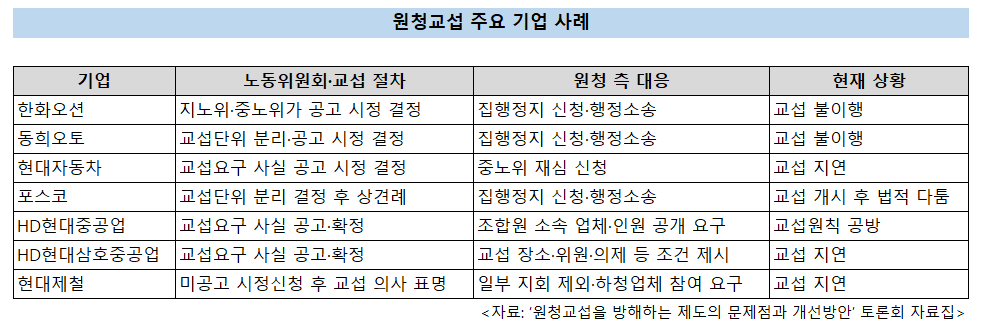
The Posco case stands out among the company-by-company bargaining updates released by the KCTU. The North Gyeongsang Province Labor Relations Commission ruled on April 8 to separate the bargaining unit. Posco appealed, but the National Labor Relations Commission rejected the appeal on June 17. Proceedings then moved forward — a labor dispute mediation suspension ruling on July 14 and a first meeting between Posco and the union on Aug. 14 — but Posco filed for a stay of execution and an administrative lawsuit four days later.
Hanwha Ocean posted notice of a bargaining demand on March 18 but listed only the Geoje-Tongyeong-Goseong Shipbuilding Subcontractors' Branch, omitting the Welliv Branch. The South Gyeongsang Province Labor Relations Commission ordered a correction to the confirmed notice on March 27, and the National Labor Relations Commission upheld that decision on June 15, but Hanwha Ocean filed for a stay of execution and an administrative lawsuit, arguing it cannot recognize employer status with respect to the Welliv Branch.
Donghee Auto also challenged the South Chungcheong Province Labor Relations Commission's rulings on bargaining unit separation and correction of the bargaining demand notice, pursuing a National Labor Relations Commission review before filing for a stay of execution and an administrative lawsuit. The National Labor Relations Commission upheld the initial ruling on bargaining unit separation on Aug. 13.
Disputes over preconditions for full bargaining have continued at some workplaces even after the notice procedure was completed. HD Hyundai Heavy Industries posted and confirmed notice of a bargaining demand on March 21, but disagreements have persisted over disclosing the names of companies employing union members and the number of members per company, the bargaining venue, paid leave for bargaining representatives and the bargaining agenda.
HD Hyundai Samho completed the notice procedure on March 28 but set agreement on basic bargaining principles, agenda coordination, and disclosure of the companies and headcount of union members as preconditions for full bargaining. At Hyundai Steel, procedural delays have continued over which branch chapters and subcontractors may participate, even after the union withdrew its correction request over the failure to post notice of the bargaining demand.
'Start provisional bargaining once basic facts are established' — multi-tiered structure also proposed
Experts said the procedure for finally determining a primary contractor's employer status and the procedure for actually starting bargaining should be separated. Waiting until reviews and administrative lawsuits are concluded means that even when employer status is recognized, so much time will have passed that exercising the right to bargain in any meaningful way becomes difficult.
Park Myung-jun, a senior research fellow at the Korea Labor Institute, proposed that once a subcontractor union establishes a prima facie case of the primary contractor's substantive control, labor commissions should recognize "procedural employer status" sufficient to trigger notice posting and provisional bargaining. Because key materials — including subcontracting agreements, cost calculations, budget planning and workforce plans — are concentrated with the primary contractor, he argued the contractor should be required to submit relevant documents to rebut any claim that it lacks control or decision-making authority.
Provisional bargaining would begin with information exchange and confirmation of the agenda and participating parties. If the primary contractor demonstrates it has no control over a particular agenda item, that item would be excluded from the bargaining scope; if it fails to submit relevant materials or cannot rebut the claim, bargaining would continue. Participation in provisional bargaining would not in itself constitute a final determination of the primary contractor's employer status or compel the conclusion of a collective agreement.
Kwon Oh-sung, a professor at Yonsei University School of Law, said unions should not be required to meet a full merits-level burden of proof at the notice correction stage. Because materials relevant to determining employer status — including work instructions, internal approval systems, facility management authority and budget authority — are concentrated with the primary contractor, he said bargaining should begin once the union establishes a prima facie case of the contractor's control and decision-making authority, with the specific scope of employer status and bargaining obligations to be determined later in full proceedings.
The forum also identified the method of defining bargaining units and participating parties as an area needing reform. The government's manual treats the "entire group of subcontracted workers" subject to the primary contractor's common control and decision-making authority as the starting point for determining the bargaining unit. Critics said, however, that grouping workers from different companies and workplaces into a single bargaining unit could give the bargaining representative authority exceeding the primary contractor's actual scope of control.
As an alternative, participants proposed a multi-tiered structure in which multiple subcontractor unions form a joint bargaining delegation and the primary contractor and relevant subcontractors also participate as a joint negotiating team. Common matters determined by the primary contractor — such as subcontracting unit prices, work volume, appropriate staffing levels, processes and equipment, and safety standards — would be addressed in basic bargaining, while wage distribution and work scheduling and personnel management at individual subcontractors would be settled in supplementary bargaining.
Kim Tae-wook, an attorney at the KCTU's legal center, criticized the Ministry of Employment and Labor's interpretive guidelines for using "structural control" as a criterion for determining primary contractor employer status, calling it an abstract concept absent from the law itself. He argued that rather than looking only at whether the primary contractor directly set wages or working hours, the analysis should examine who substantively controls the factors that govern working conditions — including subcontracting unit prices, work volume, workforce size and work methods.
Forum participants also called for the Ministry of Employment and Labor to strengthen compliance guidance and unfair labor practice investigations against primary contractors that fail to comply with labor commission correction orders. The ministry's manual on primary-subcontractor cooperative bargaining procedures requires regional employment and labor offices to guide compliance when a primary contractor does not follow a correction order, and to pursue criminal action for refusal or neglect of bargaining as an unfair labor practice if the contractor still does not comply.
fact0514@heraldcorp.com




