
Delinquency ceiling rises from 0.53%, 0.47% to 0.75%, 0.69% respectively
Double burden of rising raw material costs and loan rates cited
Experts call for preemptive capital buildup as signs of broader distress emerge
![A bank loan counter in Seoul [Herald DB]](https://wimg.heraldcorp.com/news/cms/2026/09/11/news-p.v1.20260331.846801ebb96b4be9a4735acf0d250520_P1.png)
The number of small businesses and self-employed borrowers falling behind on bank loans has risen sharply in the second half of the year. Analysts attribute the trend to higher borrowing costs stemming from the Bank of Korea's benchmark interest rate hikes this year and a surge in long-term rates that originated in the United States.
The rise in corporate loan delinquency rates comes even as nominal GDP hit a 47-year high in the second quarter, prompting some analysts to describe the divergence as evidence of "K-shaped polarization." Experts are also calling on banks — which have been posting record profits — to proactively build up their loss-absorption capacity before asset quality deteriorates further.
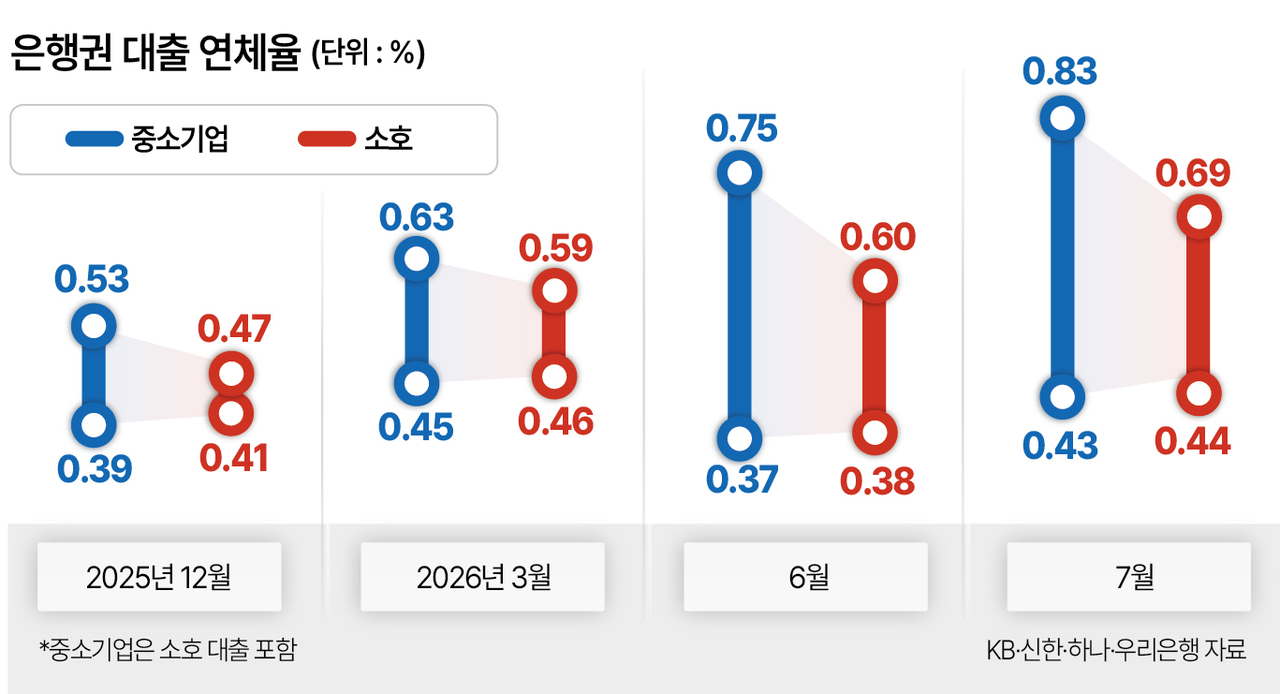
According to financial industry data released Friday, the small and medium-sized enterprise loan delinquency rates at the four major commercial banks — KB, Shinhan, Hana and Woori — stood between 0.43 percent and 0.83 percent as of the end of July. The range has climbed consistently from 0.39–0.53 percent at the end of last year, to 0.45–0.63 percent at the end of March, and 0.37–0.75 percent at the end of the second quarter.
Delinquency rates on loans to self-employed borrowers and other small-office, home-office clients have also trended upward, rising from 0.41–0.47 percent at the end of last year to 0.38–0.60 percent at the end of June and 0.44–0.69 percent at the end of July.
Analysts say the growing number of businesses unable to service their debt on time reflects rising market interest rates driven by oil price increases tied to the US-Iran conflict in the Middle East and the resulting inflation concerns.
"Based on the trajectory up to now, market rates should have come down this year, but unexpected events have prolonged the high-rate environment," a commercial bank official said. "Businesses are now facing a double burden of rising raw material costs and higher loan rates at the same time."
According to the Bank of Korea's financial stability report, the interest coverage ratio of financially vulnerable companies — those with a ratio below 1 — stood at minus 3.8 times in 2023, worsened to minus 4.2 times the following year, and recovered slightly to minus 3.7 times in 2025, remaining in negative territory for an extended period. The interest coverage ratio is calculated by dividing operating profit by interest expenses; a reading below 1 means a company cannot cover even its interest payments from operating profit.
The Bank of Korea warned in its report that "the sustained decline in profitability since 2021 has weighed on interest coverage ratios," adding that "if the profitability of small and medium-sized enterprises continues to deteriorate, rising market rates could further increase their debt-servicing burden."
Experts say the recent uptick in SME loan delinquency rates is a sign of K-shaped polarization taking hold in the broader economy.
Headline figures suggest robust economic growth — nominal GDP rose 9.2 percent quarter-on-quarter in the second quarter and nominal gross national income climbed 8.8 percent — but analysts say the numbers create a misleading picture driven by strong semiconductor exports.
"K-shaped polarization is showing up across every sector of the Korean economy," said Shin Yong-sang, a senior research fellow at the Korea Institute of Finance. "The trickle-down effect from semiconductor exports is not feeding through to consumption, leaving other self-employed workers and small businesses in difficulty."
A breakdown of non-performing loans at each bank also reveals wide variation by industry. Non-performing loans — debt on which even interest is no longer being repaid, sometimes called "hollow loans" — totaled 3.02 trillion won ($2.26 billion) across the four major banks as of the end of the first quarter, according to data People Power Party lawmaker Kim Sang-hoon obtained from the Financial Supervisory Service. Manufacturing accounted for 26.1 percent of the total, real estate for 23 percent and wholesale and retail trade for 15.7 percent.
The delinquency rate on SME loans at banks is likely to climb further. Under the Lee Jae Myung administration, "productive finance" — a policy push to redirect bank lending away from home mortgage loans and toward companies with growth potential — has become a key priority, and outstanding SME loan balances at the four major banks have grown as a result. The combined balance rose from 550.21 trillion won at the end of last year to 563.43 trillion won on Tuesday.
"The delinquencies appearing now stem from loans extended before the productive finance push was fully rolled out," a financial industry official said. "With the Bank of Korea leaving open the possibility of further benchmark interest rate hikes, there is room for delinquency rates to rise further."
hyuk@heraldcorp.com




