FSC postpones Wednesday selection announcement
Incident response, security review cited
Pilot participants among breach victims
Regulators weigh next steps
Core deregulation policy to remain intact
![ATM machines at commercial banks in Seoul. [Herald DB]](https://wimg.heraldcorp.com/news/cms/2026/10/06/news-p.v1.20261006.e0ff8a03094843deba49e20f6d27c24a_P1.jpg)
The Financial Services Commission has shelved the announcement — originally scheduled for Wednesday — of institutions selected for the second round of emergency network-separation deregulation. The FSC said it needs to focus on incident response with the Financial Supervisory Service and other agencies amid a wave of hacking attacks across the financial sector, and that the related agenda items require additional security review.
The urgency has grown further after investigators confirmed that ARTEX AI, an AI-based penetration-testing platform, was used in the attacks, making the strengthening of defenses against AI-driven hacking the financial sector's top priority.
Financial authorities said Tuesday the FSC decided to delay the selection of institutions eligible for network-separation deregulation while it conducts additional review with the FSS on matters related to the recent incidents.
The core purpose of network-separation deregulation is to allow financial firms to use high-powered external AI and security software-as-a-service to detect vulnerabilities faster and more broadly than traditional methods permit. Under the existing network-separation framework, firms face restrictions on using external AI and security services, but regulators believe that easing those rules would enable AI to analyze vast amounts of source code and proactively identify and patch weaknesses. In the first round of testing, frontier AI models demonstrated a clear advantage in broad vulnerability scanning, analyzing millions to tens of millions of lines of source code within hours. Regulators had accordingly announced a policy of countering AI-based attacks with AI-based defenses.
Last month, the FSC finalized its second-round emergency network-separation deregulation plan, under which it would assess applicants' security capabilities and AI proficiency during September, report to the FSC on Wednesday and then issue one-year interim no-action letters to selected firms.
The string of hacking incidents, however, has redirected regulators' attention to incident response and emergency inspections. The FSC, FSS and Korea Financial Security Institute have been conducting on-site investigations at affected institutions including Shinhan Bank, while also ordering emergency self-assessments at roughly 500 financial firms across the sector. Banks and credit card companies faced a Tuesday deadline, while securities firms, insurers, savings banks and electronic financial service providers must complete their reviews by Thursday. With both the investigation into the causes of the breaches and the sector-wide inspection running simultaneously, regulators concluded it was not feasible to review and finalize the second-round selection as planned on Wednesday.
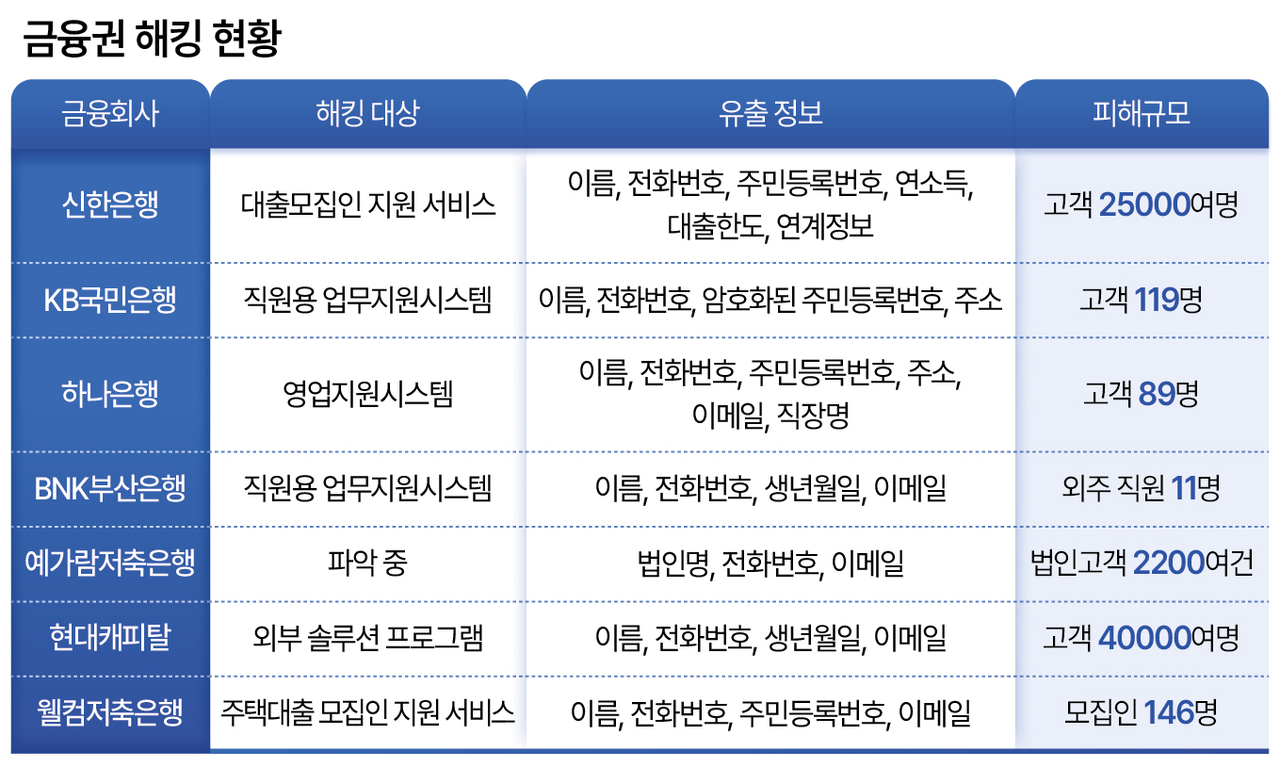
The delay was compounded by the fact that some institutions believed to have been included in the first round of network-separation deregulation were among those hit in the recent attacks, heightening the need to reassess security frameworks before expanding the program. Among the major commercial banks that participated in the first-round testing were Shinhan Bank, Hana Bank and Woori Bank. Of those, Woori Bank confirmed an attempted intrusion but said no data leak has been verified so far, while Shinhan Bank reported the exposure of roughly 25,000 customers' personal information and Hana Bank reported 89 customers affected.
In selecting the 10 financial institutions for the first-round test, regulators focused on security capability and AI proficiency as the primary criteria. The intent was to allow firms that could safely operate under relaxed network-separation rules — using external high-powered AI for vulnerability detection and remediation — to participate first.
The fact that breaches occurred even at institutions deemed to have relatively strong security and cleared for the first round has deepened the FSC's dilemma. The FSC had planned from the second round onward to lower eligibility requirements, expanding the pool of eligible applicants from 49 to 75 — comprising 59 financial companies and 16 electronic financial service providers — and increasing the number of selected firms from 10 to up to 15.
Regulators said, however, that the incidents will not prompt a reversal of the broader network-separation deregulation policy. Because the vulnerabilities exposed in the recent attacks were concentrated in authentication and access-control processes in externally facing business-support systems, regulators said the key question is not whether network separation is maintained but how thoroughly financial firms apply basic security controls all the way to their external touchpoints.
![[Getty Images Bank]](https://wimg.heraldcorp.com/news/cms/2026/10/06/news-p.v1.20250424.7533a68ef4984b1d9b1a39a0c4d0a703_P1.jpg)
Kwon Tae-kyung, a professor at Yonsei University's Graduate School of Information, described the incidents as a case where "basic security controls such as authentication and session management were weak at external touchpoints — systems like the operations support system and loan-agent services — meaning the front door was well-guarded but the side door was left open." He added that "network separation alone does not guarantee complete security." He said what matters more is "applying fundamental principles such as multi-factor authentication and least-privilege access across the board, and building a system that uses high-powered AI to continuously find and patch vulnerabilities."
The same AI-based vulnerability-scanning technology used defensively was also weaponized in the attacks. An investigation by the Korea Financial Security Institute found traces of ARTEX AI — an AI-based penetration-testing platform that automatically identifies security vulnerabilities in systems — in the recent attacks on financial institutions. ARTEX was originally developed as an open-source tool for simulating hacking attempts to find vulnerabilities during security assessments, but attackers can exploit it to probe target systems for weaknesses. ARTEX AI is an autonomous LLM-based penetration-testing system published as open-source on GitHub, primarily within Chinese-language developer communities.
An official at the Korea Financial Security Institute said that by tracing the logs and attacker IP addresses reported first by Shinhan Bank, investigators found evidence of ARTEX being used. "It is correct that AI was used in the attack, but the AI did not act autonomously without human involvement — a hacker used the AI as a tool," the official said.
rim@heraldcorp.com
hyuk@heraldcorp.com