
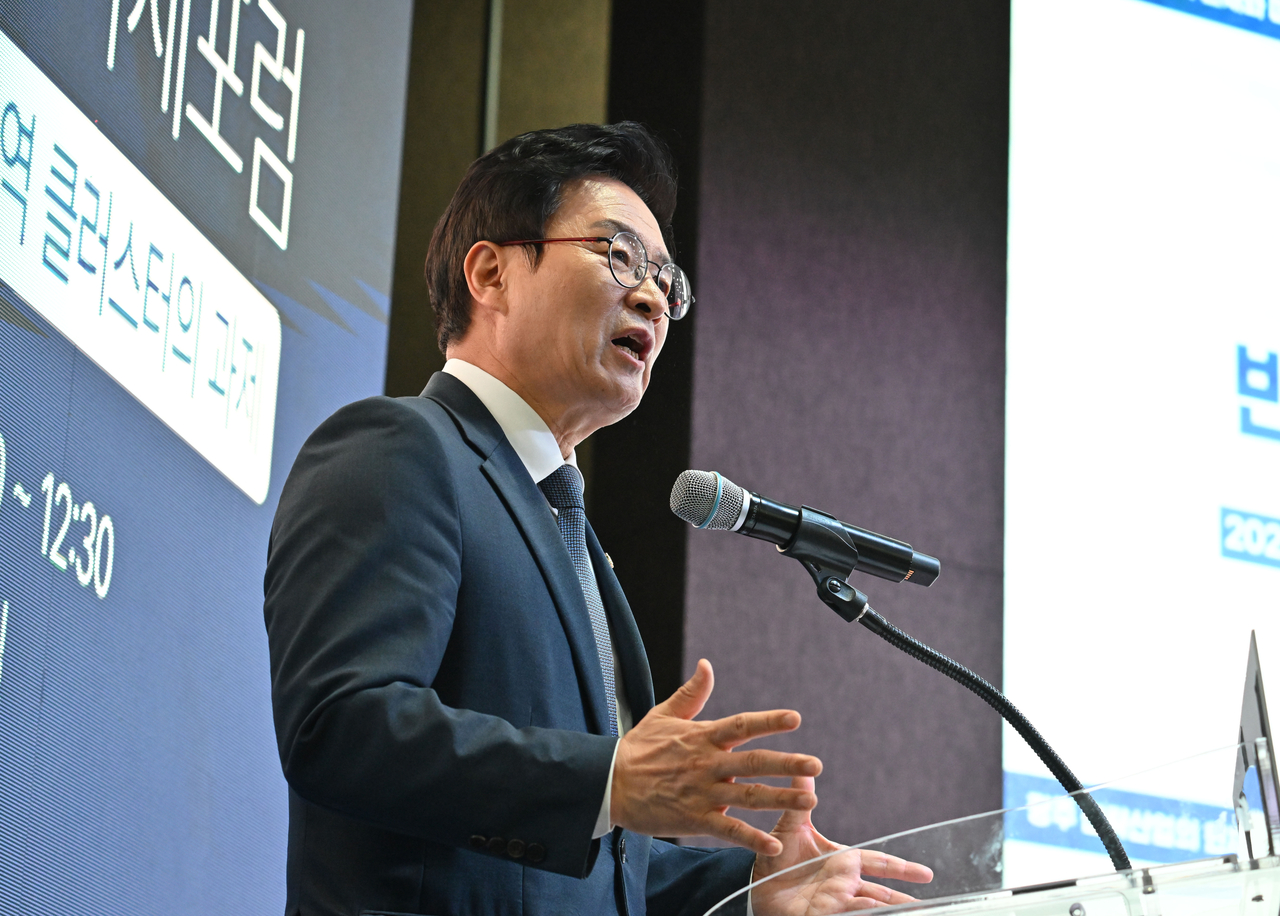
Rep. Jeong Jin-uk of the Democratic Party of Korea said he aims to shorten the timeline for relocating the Gwangju air base, whose site has been designated for a semiconductor factory. He said the move would speed up development of the southwestern semiconductor cluster. He also pledged to take the lead in improving long-term living conditions to sustain the cluster's expansion.
Jeong spoke at a general discussion session during the Semiconductor and AI Transformation International Forum at the Gwangju Chamber of Commerce and Industry on Thursday. He said, "The air base's relocation was expected to be completed by mid-2028, and I have been concerned about this ever since the investment decision was made." He added, "I will do everything I can, including forming a task force within the party dedicated to the immediate relocation of the air base, so that it can be moved by 2027 and semiconductor production can begin by the end of 2029."
Jeong said improving living conditions is the top priority for the southwestern semiconductor cluster to take root successfully. "The semiconductor industry started in Giheung in 1983, moved to Dongtan in Hwaseong and then to Pyeongtaek, and now it is coming to Gwangju," he said. "For Jeonnam-Gwangju to endure as a semiconductor city, it needs urban planning suited to that role."
He stressed, "We must not repeat what happened with innovation cities, where houses were built without any support for living conditions. We must ensure three essential elements -- housing, education and culture." Jeong is also pushing to bring a Gwangju branch of the National Assembly Library to the site of the Gwangju Veterans Hospital.
Jeong argued that long-term infrastructure planning is necessary given the scale of semiconductor investment. "When planning power, water and sites, we should not focus only on the current four fabs -- we need a long-term plan for where a ninth or tenth factory might be built," he said. "We need to move forward with that perspective in mind."
jeongwan@heraldcorp.com




