Says detection and alert time for a missile launched from Pyongyang toward Seoul area possible 'within minutes'
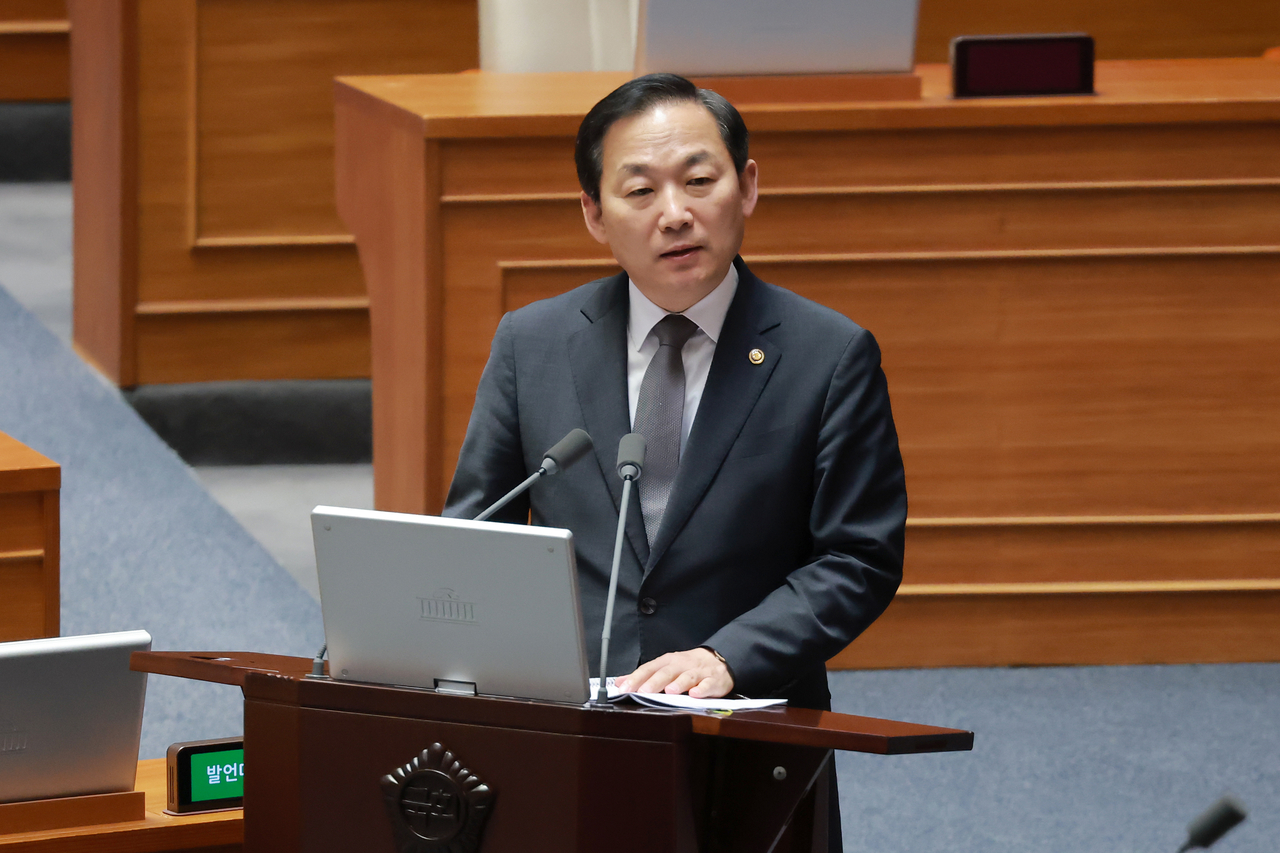
Vice Minister of National Defense Lee Du-hee said Thursday that the government is not considering bringing tactical nuclear weapons onto the Korean Peninsula, pursuing nuclear armament or nuclear sharing. His remarks came in response to a proposal by People Power Party floor leader Jeong Jeom-sik to redeploy tactical nuclear weapons to the peninsula.
Lee was responding to a question from Democratic Party of Korea lawmaker Park Sun-won during a National Assembly question-and-answer session that day.
Jeong had made the proposal in a floor speech representing his parliamentary group on Tuesday. He said he would "seek ways to secure nuclear deterrence, including nuclear sharing between South Korea and the United States, the redeployment of tactical nuclear weapons to the Korean Peninsula, and training for F-35 fighter jets to carry tactical nuclear weapons." This came in response to North Korean provocations.
"Matters related to nuclear weapons require an extremely cautious approach," Lee said. "Of course, as North Korea's nuclear and missile capabilities advance, we should address this from the standpoint of extended deterrence under the South Korea-US alliance." He added, "Realistically, deploying or introducing nuclear weapons in our vicinity is a national issue that requires the utmost caution."
Asked by People Power Party lawmaker Yoo Young-ha whether the United States has been restricting the sharing of intelligence on North Korea's nuclear program because of Unification Minister Jeong Dong-young's remarks about a uranium enrichment facility in Kusong, North Korea, Lee avoided a direct answer, saying, "I cannot confirm the specifics of intelligence exchanges between South Korea and the United States."
Asked how long it would take for South Korea's independent reconnaissance assets to detect a missile launched from Pyongyang toward the Seoul metropolitan area and relay that information to units on the ground, Lee said it would be possible "within minutes." When Yoo pointed out, "As far as I know, it takes 30 minutes from detection to relaying the information to units on the ground," Lee rebuffed the claim, saying, "That is not the case. Real-time sharing is possible."
On the discrepancy between US President Donald Trump's estimate that North Korea possesses 57 nuclear weapons and Defense Minister Ahn Gyu-back's estimate of 80 to 120, Lee said, "The figures cited by the two are presumed to be based on research from academic institutions, and the difference likely stems from where each drew the data."
He added, "The South Korean government does not officially recognize North Korea as a nuclear weapons state," but acknowledged that "North Korea's nuclear capabilities are advancing day by day and are considerable. We are continuously strengthening our military preparedness."
yckim6452@heraldcorp.com