Box size to be shown at checkout starting late this year
Empty space cut 10 percent, box types expand from 9 to 14
Anseong center handles 16,000 orders a day on average
Box-matching time for 10,000 orders drops from 20-25 minutes to 0.004 seconds per box
Order-to-shipment in 30 minutes, one box every three seconds
Worker travel distance cut from 18 kilometers to under 10 kilometers
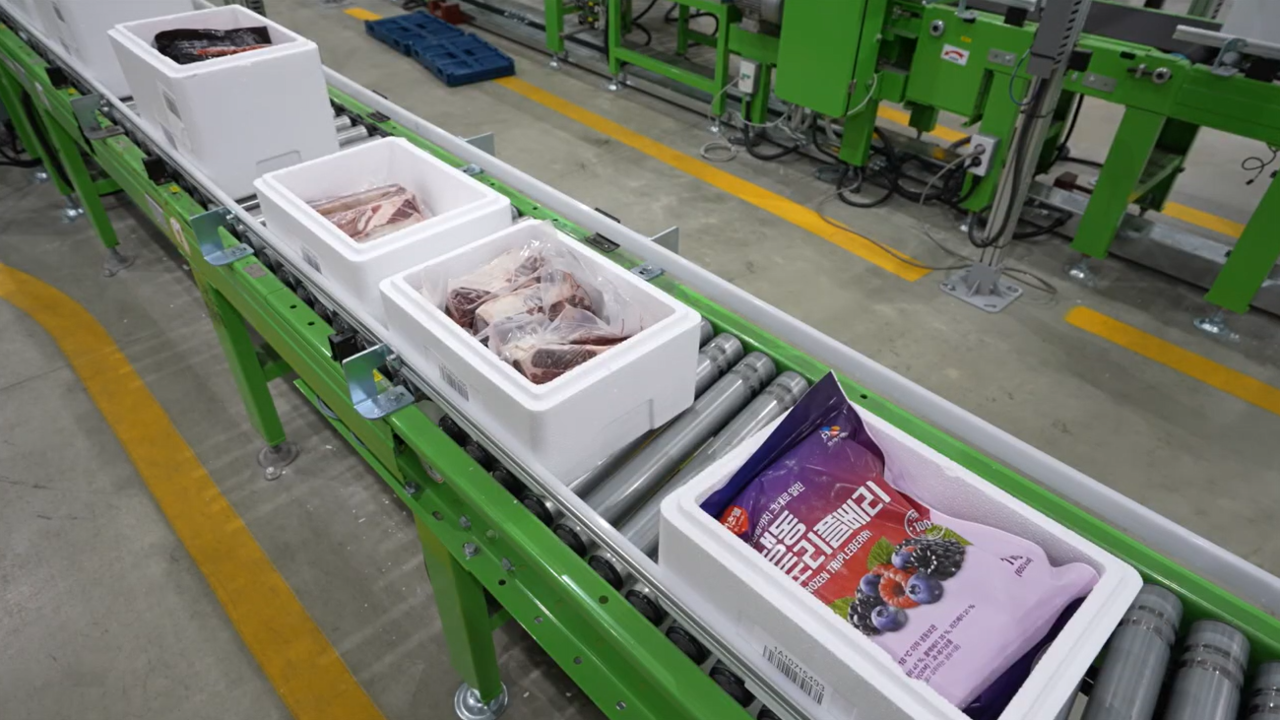
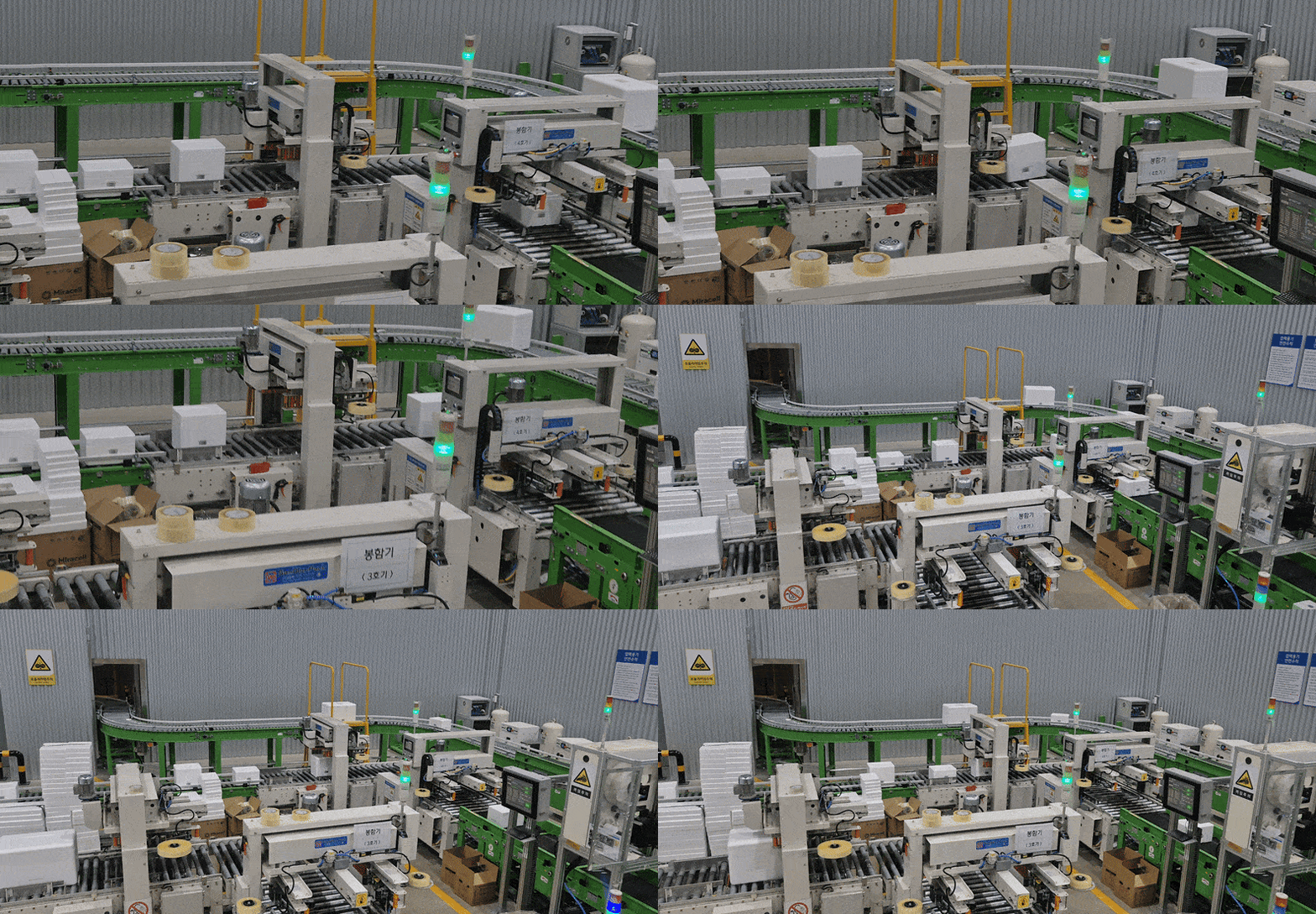
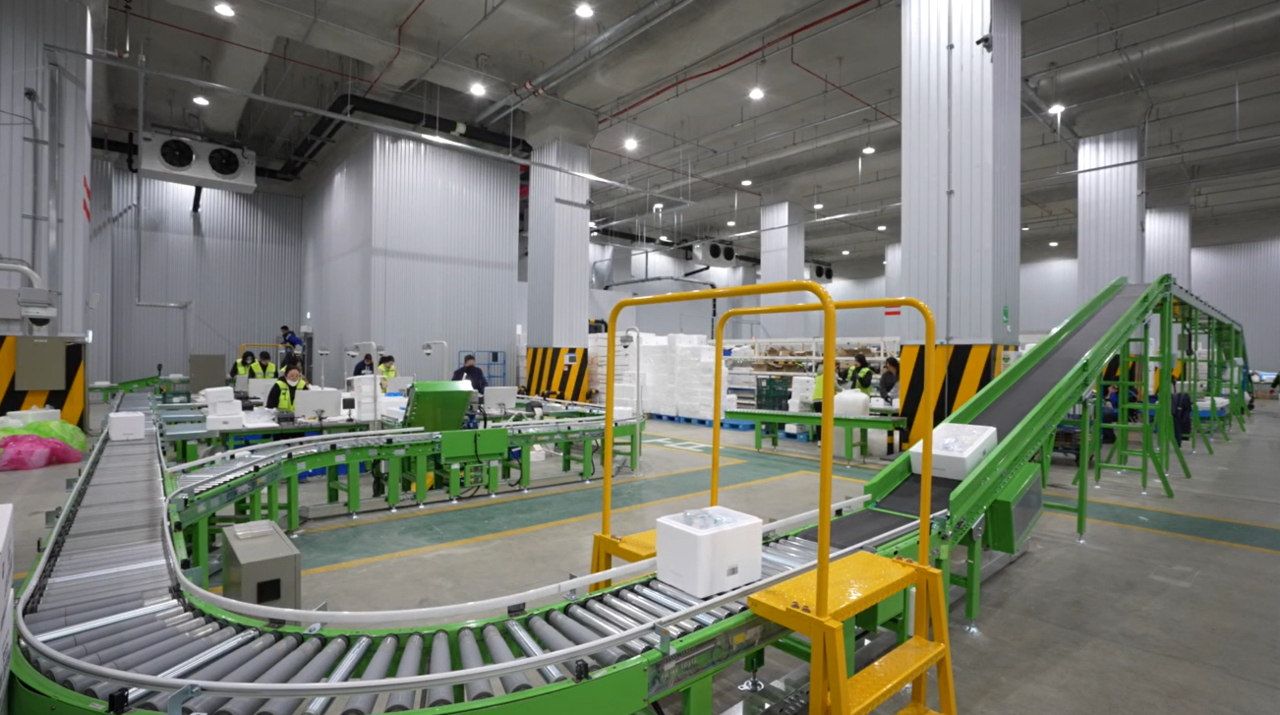
White foam boxes filled with frozen food move without pause along the conveyor belt. As each box passes through a weight inspector, automatic taping and label attachment follow, and roughly every three seconds another box exits the shipping line.
At CJ Logistics' B2C cold-chain center in Anseong, Gyeonggi Province, visited on Tuesday, workers were busy packing items for delivery to customers. When an order comes in, artificial intelligence calculates the width, length and height of each product and stacks them virtually in different combinations like a game of Tetris to select the box with the least leftover space. The system also factors in room for dry ice, ice packs and cushioning material.
This box-selection process, until now confined to the logistics floor, is expected to expand into the consumer realm as early as late this year. Under the new approach, when a customer adds items to an online shopping cart, the platform will show the size of the box in advance. It will also show how much empty space will remain inside. Customers can then add or remove an item to determine the final box size.
For example, if the items in a cart fill only half a box, a customer could add another item to reduce the empty space. Conversely, removing a single item could shift the order down to a smaller box size.
CJ Logistics is working to extend the AI-based packaging optimization technology currently used inside its warehouses to e-commerce platforms as well. "By the second half of this year or the first half of next year, customers will be able to know in advance roughly what size box will arrive based on the combination of items they bought, and how much empty space it will contain," said Yoon Chul-joo, head of CJ Logistics' Fulfillment and Terminal (FT) Division. "We are considering proposing this to client companies such as Naver and SSG and working together on it."

AI stacks products like Tetris, cutting empty space 10 percent
Reducing the empty space left inside a box lowers both packaging material use and logistics costs, while also increasing how much can be loaded onto a single delivery vehicle.
"Empty space is essentially the enemy of logistics," Yoon said. "The more empty space there is, the lower the loading rate, and a lower loading rate means wasted fuel and higher overall logistics costs."
The tool addressing this is an AI-based box recommendation system called Rois OPACK. The system has volume data -- width, length and height -- for thousands of products already loaded in. When an order comes in, the AI stacks multiple items in a virtual space in various combinations, Tetris-style, to find the box with the least remaining empty space.
Since Rois OPACK was introduced, the empty space inside boxes has fallen by about 10 percent.
Work efficiency has also improved as workers spend less time manually deciding which box to use. The previous system took about 20 to 25 minutes to recommend suitable boxes for 10,000 orders, but Rois OPACK, which combines AI with an optimization algorithm, has cut that to roughly 0.004 seconds per box recommendation.
Keeping empty space under 50 percent -- and constantly redesigning box sizes
Optimizing box sizes goes beyond boosting productivity -- it also serves as a tool for complying with excessive-packaging regulations. Rois OPACK records data for every order, including the actual box specifications used, the size of the items, and the amount of empty space.
This allows the company to check whether packaging deviates from standards before shipment, and to verify afterward how closely each package complied with the relevant standards, according to the company.
The company also expects environmental benefits. With less empty space in each box, more boxes can be loaded onto the same vehicle, which could help reduce the number of delivery runs and fuel use.
In fact, the Anseong center continues to optimize its packaging specifications based on order data, redesigning the width, length and height of its boxes to match changing consumption patterns. As a result, the Anseong cold-chain center has expanded its lineup of EPS (foam) boxes from nine types to 14, better matching packaging to product size and reducing unnecessary empty space.
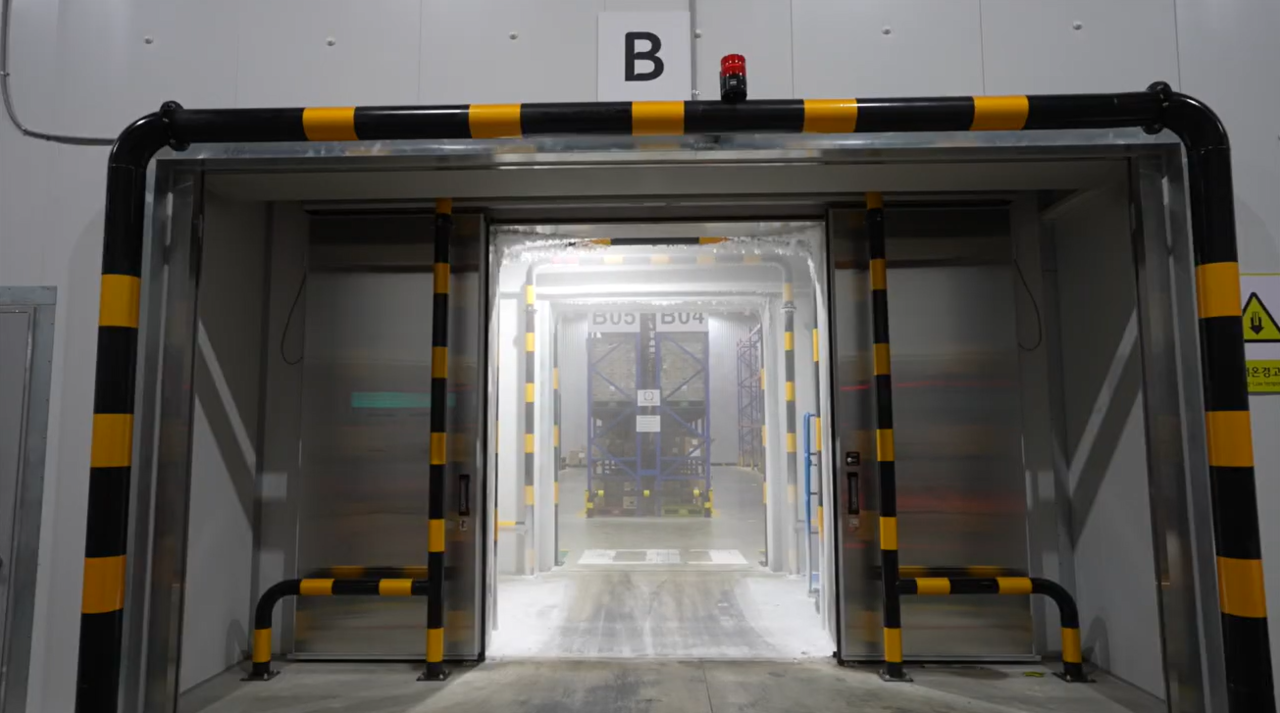
Open the door and your breath turns to fog: 28 degrees outside, minus 18 inside
At the Anseong B2C cold-chain center visited that day, these logistics technologies were already running on the ground.
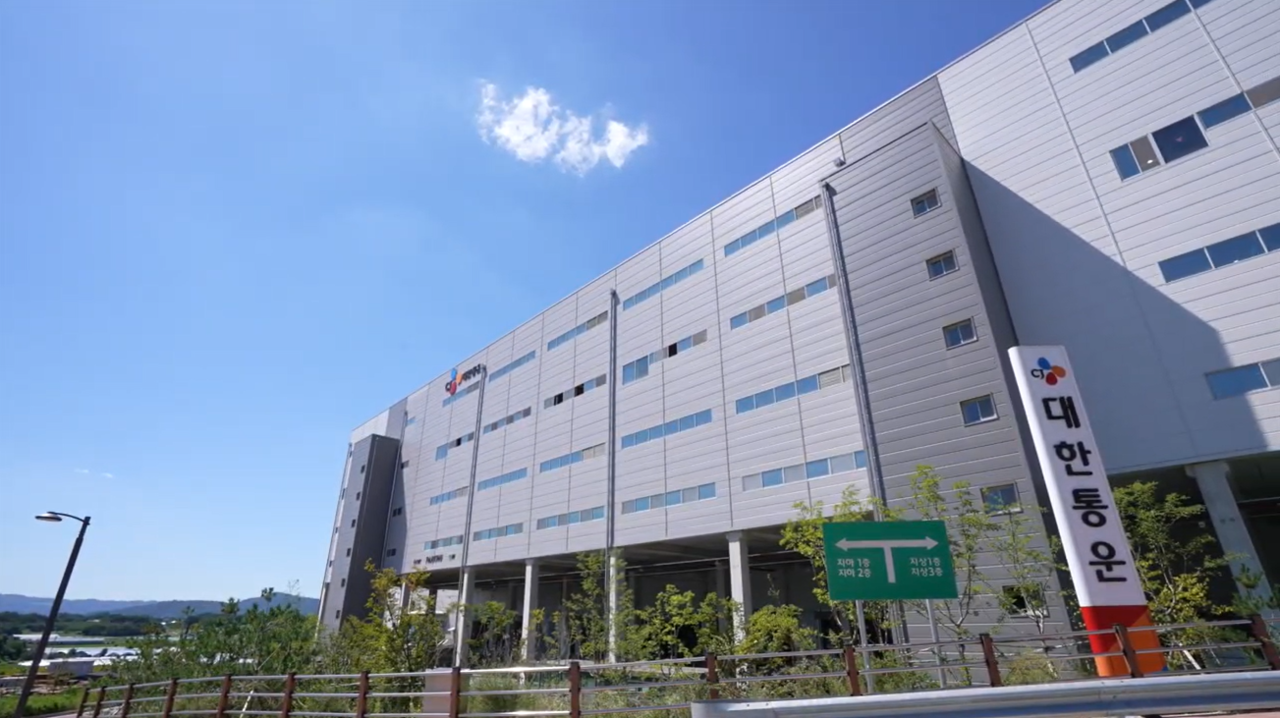
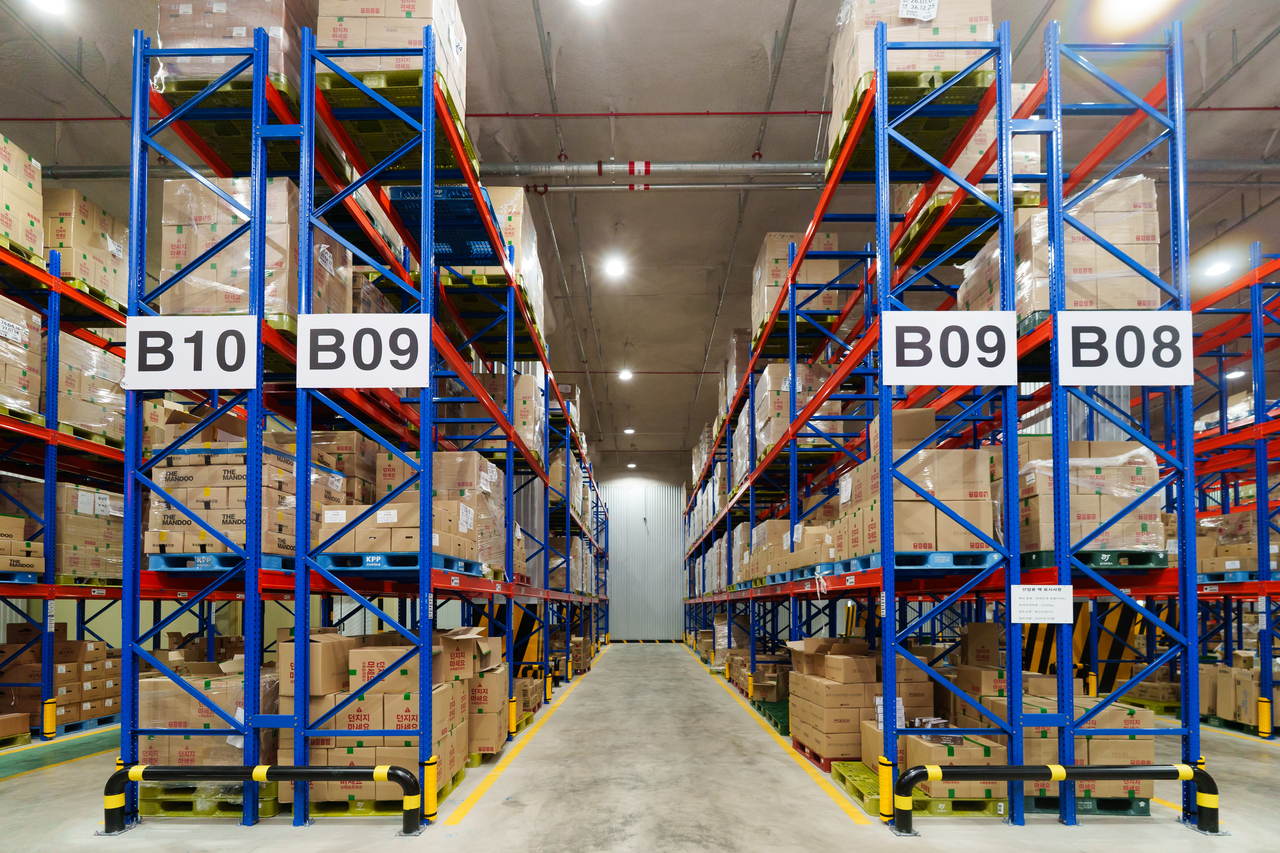
The Anseong center, covering about 18,939 square meters, has six zones in total -- four frozen, one refrigerated and one shipping area. It handles 2,040 types of refrigerated and frozen products for 112 e-commerce sellers and can ship up to 25,000 orders a day. On site, an average of 110 workers process about 16,000 orders daily.

The center relocated from its former base in Baegam, Yongin, to Anseong in June, growing roughly fivefold in the process. While the previous center was a four-story building of about 3,960 square meters, the Anseong center spreads about 18,810 square meters across a single floor -- a design meant to accommodate greater volume while improving work-flow efficiency.
Small temperature-and-humidity sensors, each smaller than a palm, were visible throughout the freezer areas. This is the company's own system, called Rois Ondo. Instead of relying on workers checking temperatures at set intervals, it monitors temperature and humidity across the center in real time, sending an immediate alert to center operators if readings fall outside the set range.
Slip in a smartphone, and a red light flashes instantly
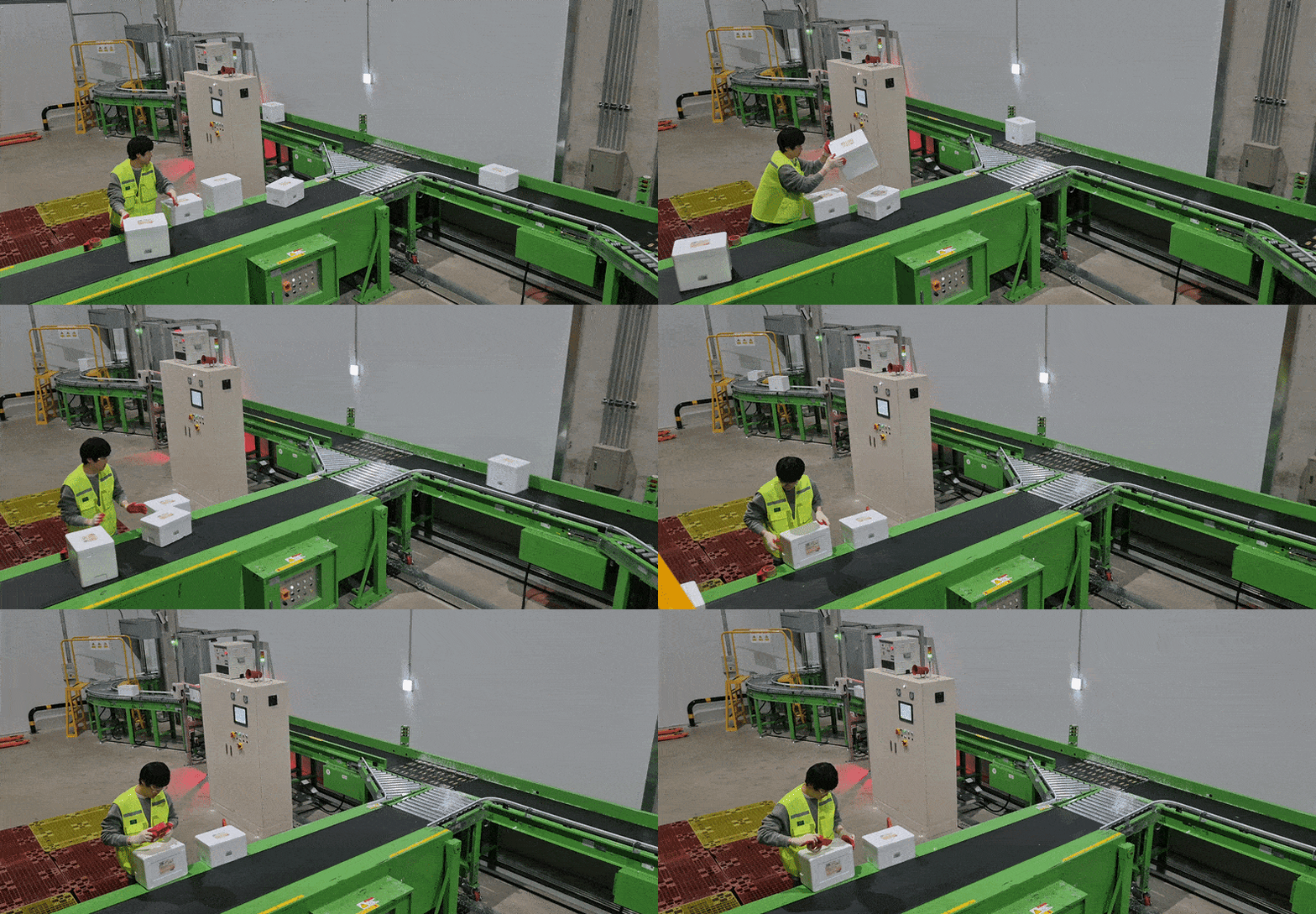
In the refrigerated zone, workers in cold-weather gear pushed screen-equipped carts between shelves. The screens displayed, in sequence, which location to go to, which product to retrieve, and how many units to take. Rather than workers deciding their own routes, the system guides the work in the most efficient order.
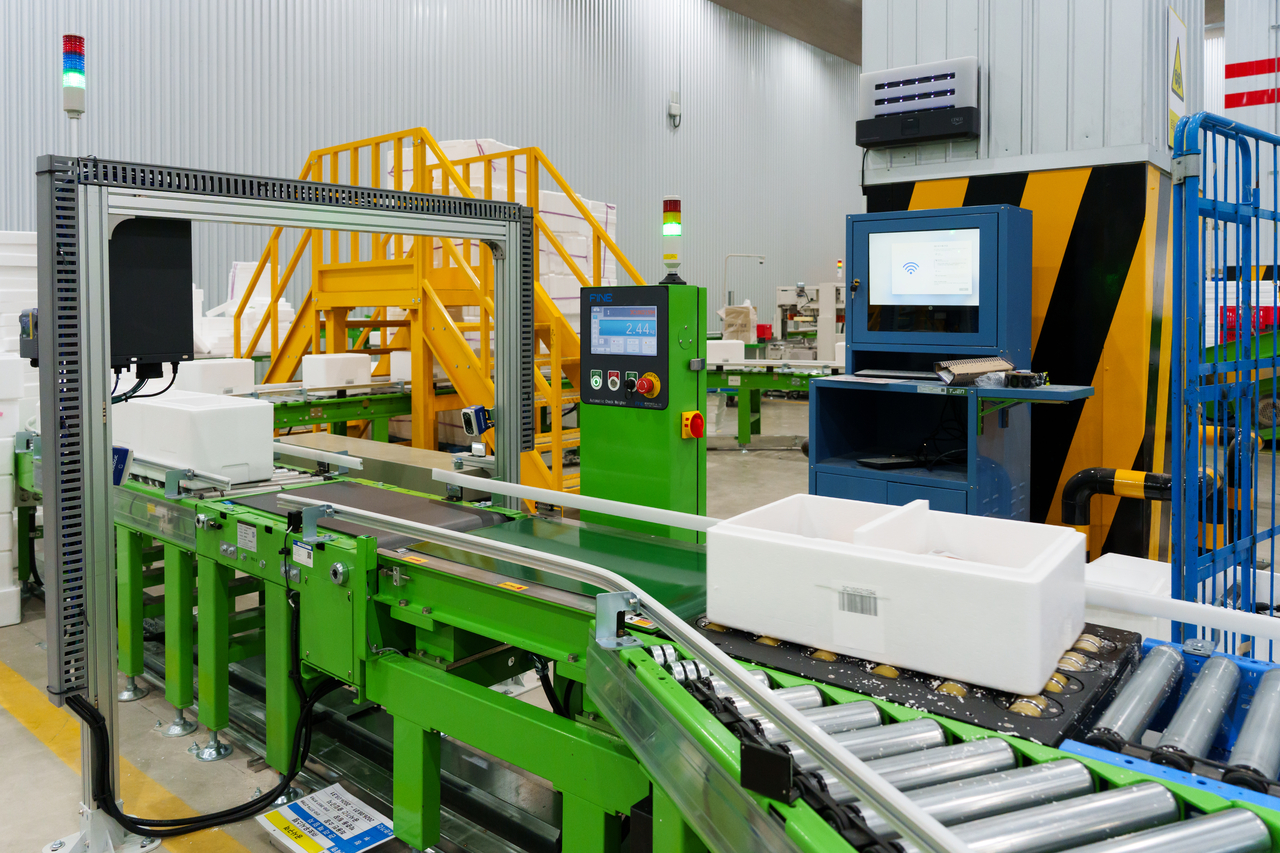
After a worker checks a box, it moves onto the conveyor belt and passes through a weight inspector. If the difference between the expected weight stored in the order data and the actual weight exceeds a set threshold, the box is automatically pulled from the normal shipping line.
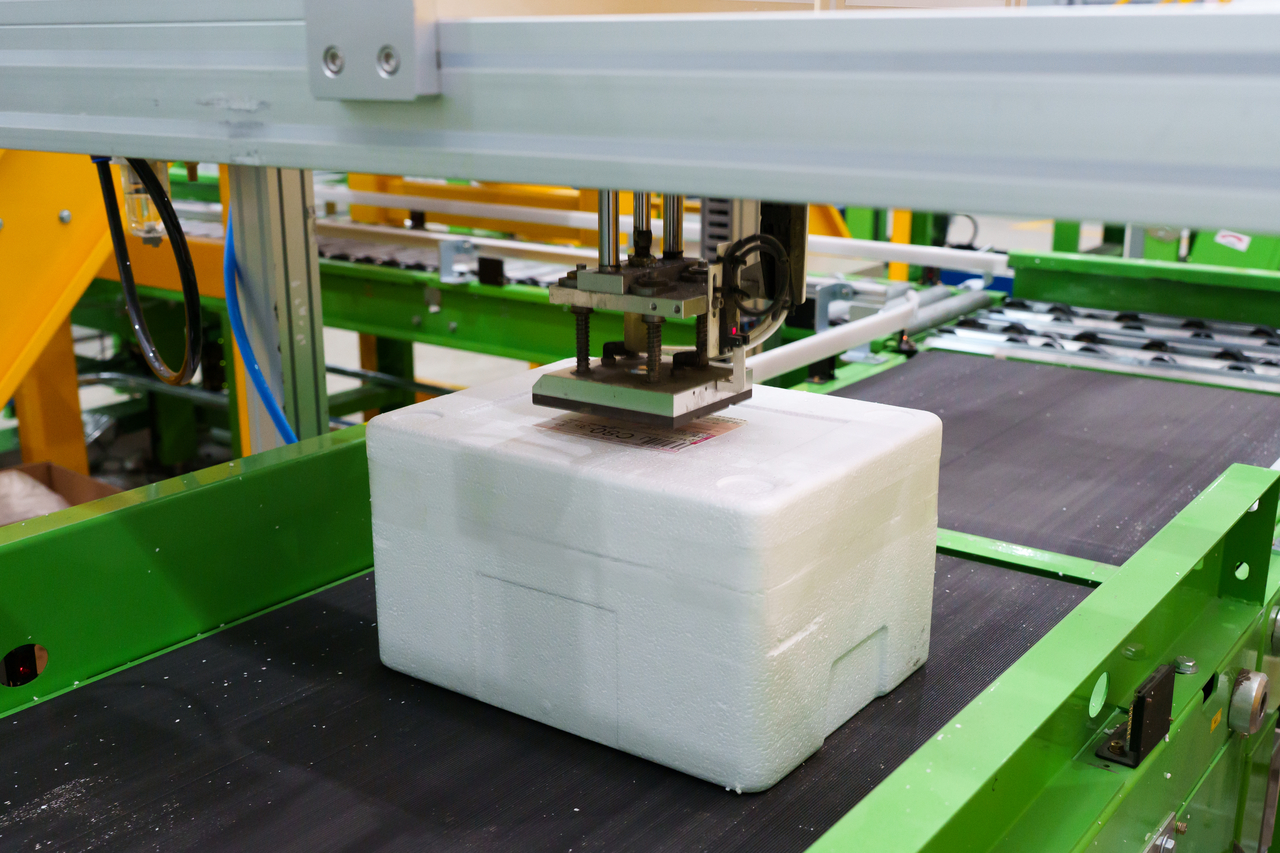
To test this on site, a 167-gram smartphone was slipped into a box already containing an item. As soon as the box passed through the inspector, a red light immediately switched on. The box, which had been moving along the conveyor, was diverted off the normal line and pushed toward the "NG box" area reserved for irregular items. The system is designed to flag any discrepancy of just 3 percent from the standard weight.
Boxes that pass inspection receive refrigerant, and automatic taping equipment seals the foam box. An auto-labeling machine then reads the box information and attaches a shipping label. The entire sequence runs seamlessly along the conveyor.
"At the Anseong center, we process orders from receipt through picking, packing and shipment within 30 minutes, shipping one box roughly every three seconds," said Pyo Su-hyun, head of the Anseong B2C cold-chain center.
Workers once walked 18km a day -- AI is cutting that below 10km
AI also factors in how workers move, for safety. For instance, if 15 to 20 orders are randomly assigned to a single picking cart, a worker would have to crisscross the center repeatedly. CJ Logistics uses AI to group orders for items located near one another and recommend the shortest possible route.
"In the past, at a typical B2C logistics center, a worker on an eight-hour shift would have to walk about 16 to 18 kilometers," Yoon said. "Applying algorithms brought that down to 12 to 13 kilometers, and with the recent introduction of AI agents, we are bringing it below 10 kilometers."
'Still growing': cold-chain, beauty and fashion set for expansion
The Anseong center is part of CJ Logistics' broader strategy to make cold-chain logistics a new growth engine within its fulfillment business. As of the end of July, CJ Logistics operated 235 fulfillment centers nationwide with a combined floor area of 2.899 million square meters. It serves about 2,200 client companies, a figure that has grown by nearly 400 this year alone. The company runs 67 cold-chain logistics hubs nationwide.
"As products and retail channels diversify, fulfillment is no longer just about storage and shipment -- how precisely logistics can be tailored to a product's characteristics has become a key competitive edge," Yoon said. "Drawing on the operational know-how we have built across various industries and our nationwide infrastructure, we will keep providing optimal fulfillment services that improve our clients' logistics efficiency and business competitiveness."
kwater@heraldcorp.com