Challenges discussed across growth stages, from R&D to commercialization
Voices of startups such as Ionearth and Newton reflected
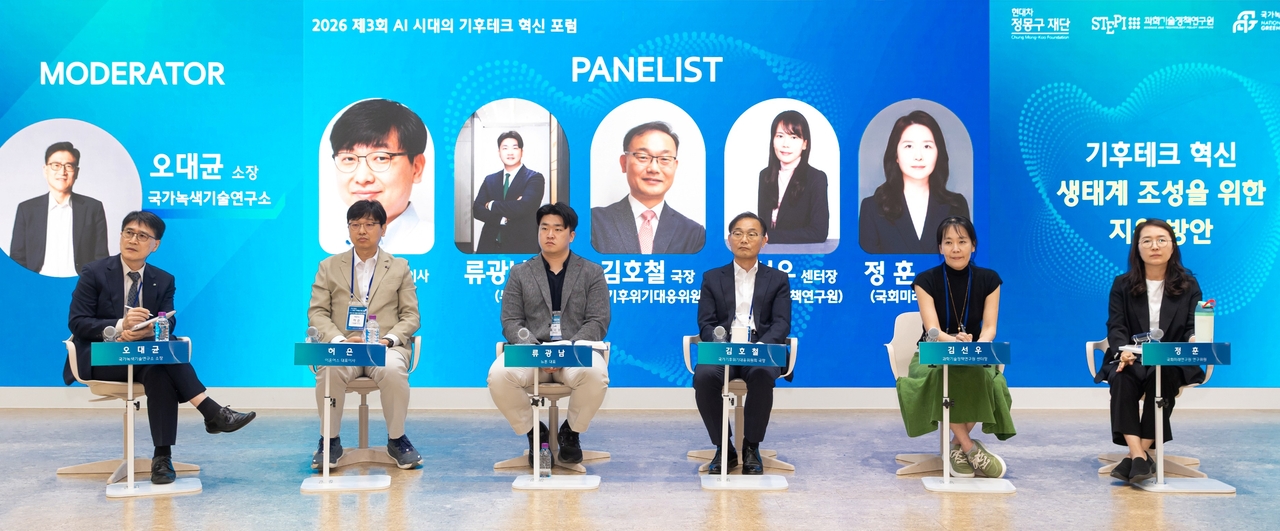
The Hyundai Motor Chung Mong-koo Foundation said Thursday that it held the third AI-era Climate Tech Innovation Forum on Wednesday in partnership with the Science and Technology Policy Institute and the National Institute of Green Technology at Ondream Society in Myeong-dong, Seoul.
About 60 people, including government officials, researchers and climate tech startup representatives, attended the forum to discuss the difficulties early-stage companies face in research and development, field testing, talent acquisition, market entry and fundraising, as well as ways to address them.
The institutional framework supporting the climate tech industry has been expanding recently. In June, a special bill on fostering the climate tech industry and building an innovation ecosystem — which includes climate value assessments, early-stage commercialization grants, professional investment associations and regulatory sandboxes — was submitted to the National Assembly. The government has also been pushing related support policies, including the Net-Zero Challenge X, the Climate Tech Innovation Alliance and the National Growth Fund.
However, observers say early-stage climate tech companies still face gaps in support as they move from technology development to field testing, commercialization and fundraising. They argue that simply increasing the scale of support is not enough — assistance must be organically linked across each stage, from research and development to commercialization.
This forum focused on that issue. Following the first two forums, which addressed public-private cooperation and financing and investment, respectively, the third forum discussed support measures tailored to each growth stage of early-stage companies, including research and development, talent acquisition and commercialization.
Kim Jong-kyu, chairman of the Korea Climate Tech Association, gave a presentation titled "Support Measures for Building a Climate Tech Innovation Ecosystem." A panel discussion followed, moderated by Oh Dae-kyun, director of the National Institute of Green Technology, with Heo Eun, CEO of Ionearth; Ryu Gwang-nam, CEO of Newton; Kim Ho-cheol, director general of the National Climate Crisis Response Committee; Jeong Hoon, research fellow at the National Assembly Futures Institute; and Kim Seon-woo, center director at the Science and Technology Policy Institute, taking part.
The panel discussion centered on the cases of Ionearth, which makes mobile energy storage systems using electric vehicle batteries, and Newton, an AI-based carbon reduction measurement, reporting and verification company. Panelists discussed linking R&D outcomes to field testing, securing specialized talent, and gaps in support during the commercialization and scale-up stages.
The panel also discussed why technologies that succeed in field testing often fail to translate into actual sales and investment, as well as the support early-stage companies need to secure their first major customer.
Jung Moo-sung, chairman of the Hyundai Motor Chung Mong-koo Foundation, said, "As support for climate tech companies expands, we now need to look not just at the scale of support but at how organically it is connected across the stages companies need as they grow." He added, "I hope the voices from the field that we confirmed through three forums will translate into institutional frameworks and policies, contributing to building an ecosystem where climate tech companies can genuinely grow."
With this session, the Hyundai Motor Chung Mong-koo Foundation, the Science and Technology Policy Institute and the National Institute of Green Technology concluded the AI-era Climate Tech Innovation Forum series, which had run since July. The three organizations plan to compile the discussions on public-private cooperation, financing and investment, and support for company growth into a joint forum brief, and to continue offering policy recommendations for building a climate tech innovation ecosystem.
Meanwhile, the Hyundai Motor Chung Mong-koo Foundation has recently launched a local education support project in Laos, holding a scholarship ceremony for its first 60 scholarship recipients at the National University of Laos, as part of ongoing social contribution activities that carry forward Honorary Chairman Chung Mong-koo's philosophy of nurturing talent.
eyre@heraldcorp.com