KAIDA policy seminar
Professor calls for LCA-based subsidies
Korea tightens carbon standards as US, EU ease theirs
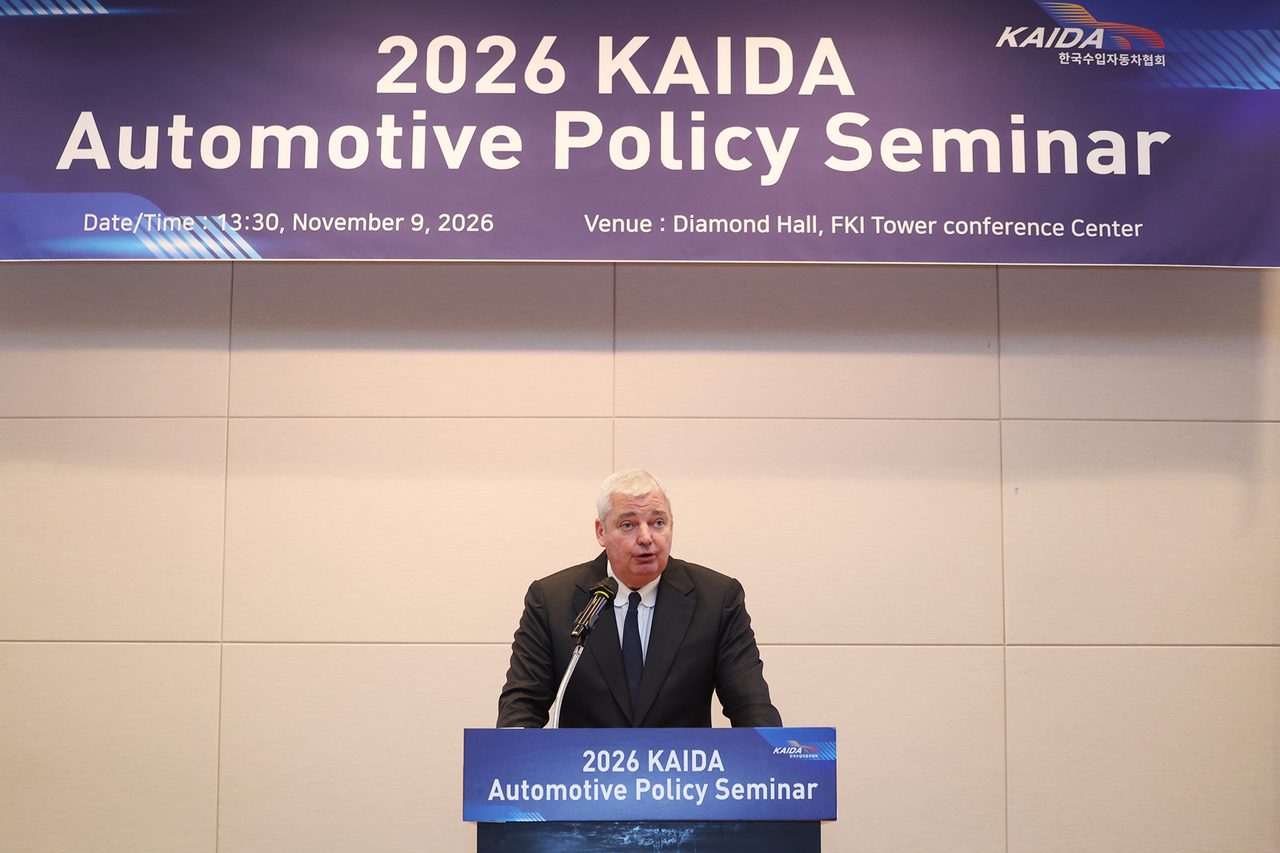
Experts at an automotive industry seminar Monday called for South Korea to overhaul its vehicle emissions regulations — moving away from tailpipe-only standards toward a life-cycle assessment (LCA) framework that accounts for greenhouse gas emissions from raw material extraction through end-of-life disposal. While the government has begun laying the groundwork for LCA adoption, analysts say the country still has a long way to go before it has the data infrastructure needed to put such a system into practice.
The Korea Automobile Importers & Distributors Association (KAIDA) held the 2026 KAIDA Automotive Policy Seminar at the FKI Tower Conference Center in Yeongdeungpo-gu, Seoul, on Monday. The event featured four presentations on vehicle environmental policy and autonomous driving regulation.
In his welcoming address, KAIDA Chairman Till Scheer said he hoped government regulations in both areas would be "managed in an integrated and systematic way," adding that "the joint journey of government and industry toward decarbonization and advanced mobility must not be delayed."
'Combustion engines will last at least 20 to 30 more years' — powertrain diversity emphasized
Min Kyung-deok, a mechanical engineering professor at Seoul National University, opened the presentations by arguing that South Korea's current policies, regulations and incentives are all determined by whether CO₂ and other emissions come out of a tailpipe — a framework he said must shift to an LCA perspective.
Min cited life-cycle data published by Hyundai Motor to support the argument. Greenhouse gas emissions from production through disposal totaled 39.9 metric tons for the Kona internal combustion engine model and 33.2 metric tons for the Kona electric vehicle. The ST1 electric vehicle came in at 42.3 metric tons. "People assume electric vehicles emit zero," Min said, "but from an LCA perspective, EVs produce nearly as much as combustion-engine vehicles."
Europe has already incorporated LCA concepts into its subsidy regimes. France determines subsidy eligibility based on the carbon footprint of a vehicle's production and transport stages. The United Kingdom factors in the carbon intensity of electricity used in battery cell production and vehicle assembly, awarding subsidies of either 3,750 pounds ($4,740) or 1,500 pounds — or excluding vehicles from support altogether.
In South Korea, the Ministry of Climate, Environment and Energy pre-announced a draft notice on methods for life-cycle assessment of vehicle greenhouse gas emissions on Oct. 7. However, submission of results by manufacturers was left voluntary. Min said domestic systems, including subsidies, should be gradually shifted to an LCA basis over the long term.
Min also stressed the importance of diverse powertrains, saying "combustion engines will last at least 20 to 30 more years" and that "multiple powertrain types must be used together, not just one technology." He put forward three policy priorities: support for the transition of internal combustion engine parts suppliers, a system to improve electric vehicle energy efficiency, and the introduction of a Korea-specific plug-in hybrid electric vehicle (PHEV) utility factor based on real-world driving data.
'Cars no longer the main source of fine dust' — calls for expanded support for mid-tier parts suppliers
Park Jun-hong, director of the Mobility Environment Research Center at the National Institute of Environmental Research, presented the results of years of emissions regulation. Compared with peak levels in the 2000s, road mobile sources' share of fine dust (PM10) fell from 46 percent to 2 percent by 2023, while volatile organic compounds (VOCs) dropped from 17 percent to 3 percent. Nitrogen oxides (NOx) declined from 42 percent to 28 percent.
"The claim that automobiles are the main source of fine dust in South Korea is no longer valid," Park said. He outlined plans to pursue a shift to zero-emission vehicles alongside the establishment of final permissible limits for exhaust pollutants and the introduction of regulations on brake and tire wear particles.
Greenhouse gas regulations are moving in different directions across countries. The Trump administration has scrapped vehicle greenhouse gas standards in the United States, and the EU is discussing lowering its 2035 target for CO₂ reductions in new cars from 100 percent to 90 percent. South Korea, by contrast, has decided to tighten its 2030 passenger vehicle greenhouse gas standard from 70 grams per kilometer to 54 grams per kilometer.
"Although greenhouse gas standards appear to regulate CO₂ from the tailpipe, they are in practice a regime that demands a shift in vehicle powertrains," Park said. "To comfortably meet the current standards, manufacturers need to include plug-in hybrid or higher electrification models in their lineups."
Manufacturers must keep the average greenhouse gas emissions of vehicles they sell below the applicable standard. According to Park, the last year that standard could be met using only internal combustion engine vehicles was 2015. Hybrids became necessary in the 2020s, and the current 2030 target of 70 grams per kilometer requires a mix that includes plug-in hybrids.
Park described LCA as a long-term challenge. "There is still a very long road ahead for LCA," he said, adding that the system must reach a level where emissions are calculated by accumulating actual component-level data before it can be used in policy. Tier-2 and tier-3 suppliers in particular are struggling to build that data capacity.
The government plans to expand support for small and mid-sized parts suppliers. Park said a pilot project running in 2025 and 2026 at 1.2 billion won ($884,000) per year would be scaled up. "We intend to increase the budget and scope to calculate and verify emissions more systematically," he said. The specific scale will be announced after the National Assembly completes its budget review.
eyre@heraldcorp.com