- KIST develops method producing two hydrogen peroxide molecules from a single light particle
- High-speed experiments and AI help create optimal reaction solution
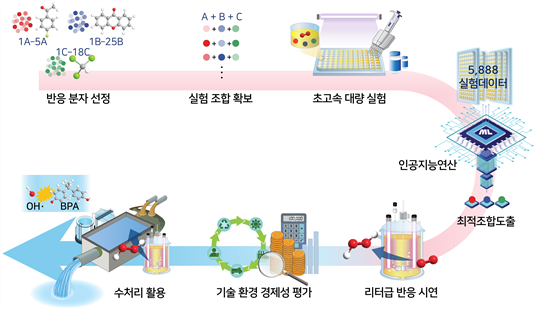
South Korean researchers have developed an eco-friendly technology that allows hydrogen peroxide — a chemical used in water treatment, sterilization and semiconductor cleaning — to be produced on-site using light.
A research team led by Byun Ji-hye and Jung Jae-sik at the Water Cycle Research Center of the Korea Institute of Science and Technology's Climate and Environmental Research Institute announced Wednesday that it had developed a new reaction solution capable of efficiently producing hydrogen peroxide on-site using light, by combining high-speed experimentation with AI.
In the conventional photocatalytic method of producing hydrogen peroxide, electrons generated in a light-exposed catalyst react with oxygen to form the compound. Because a single light particle, or photon, can trigger only one reaction, producing one hydrogen peroxide molecule per photon — effectively 100 percent efficiency — has long been the practical ceiling, limiting further gains in production.
To break through that limit, the research team focused on a "chain reaction" in which a single burst of light sets off a continuous sequence of reactions. Much like dominoes falling in sequence, the first reaction triggers the next, allowing a single photon to generate multiple hydrogen peroxide molecules.
The team created a solution combining a light-absorbing substance that initiates the reaction, a hydrogen-donating substance and a solvent that helps the two react efficiently. By pairing large-scale, high-speed experiments — 5,888 trials across 184 conditions — with AI-driven big data analysis, the team identified an "organic reaction solution" that optimally induces the chain radical reaction. The solution activates a chain photochemical pathway in which reactions cascade like dominoes upon absorbing light energy, breaking through the limits of conventional photocatalysts to achieve a world-leading quantum efficiency of 219.1 percent — meaning more than two hydrogen peroxide molecules are generated from a single photon.
The team also proved the technology's industrial scalability by continuously producing high-purity hydrogen peroxide (about 1 percent, or 291 millimolar) for more than 30 hours in a liter-scale reactor. The method demonstrated strong water treatment performance, breaking down more than 99.95 percent of the endocrine disruptor bisphenol A within six hours, and cut toxicity by more than 90 percent compared with existing processes.

While conventional solar catalyst research relies on high-power light sources of around 300 watts, the new technology runs on just 4 to 8 watts — about one-fortieth as much, comparable to a smartphone charger. That opens the door to decentralized, on-site production at facilities that need hydrogen peroxide, such as water purification plants and sewage treatment facilities, reducing dependence on large-scale factory production and the transport and storage of high-concentration solutions. An environmental impact assessment found that the new method, which uses fewer chemicals and simpler equipment than existing approaches, reduced freshwater ecological toxicity by 90.9 percent and human toxicity by 93.2 percent. The reduced transport and storage burden is expected to bring cost and safety benefits for small and midsize water treatment facilities.
"The initial applications we envision include disinfection and oxidative pretreatment of hard-to-decompose pollutants at water purification and sewage treatment plants, sterilization of irrigation water and growing media at smart farms, and supplying cleaning water for semiconductor and display processes," Byun said. "The decentralized production structure itself, which eliminates the need for long-distance transport, is expected to reduce carbon emissions, while removing hard-to-decompose pollutants directly on-site should simultaneously improve discharge water quality and the health of water systems."
The findings were published in a recent issue of the international journal Joule.
nbgkoo@heraldcorp.com