UNIST energy and chemical engineering professor Ko Hyun-hyub's team
Harnesses cation concentration gradient for long-lasting voltage
Seen as self-powered source for wearables and other devices

A moisture-powered generator smaller than a fingernail that can run on nothing more than a few drops of sweat for up to 45 hours has drawn attention from researchers.
The Ulsan National Institute of Science and Technology said Wednesday that a research team led by Ko Hyun-hyub, a professor in the university's Department of Energy and Chemical Engineering, along with Na Sang-yun and Jung Gun-young, developed an ultrathin film-based moisture generator that produces direct current electricity over a long period by exploiting differences in cation concentration in water.
The technology guides ion movement through a nanochannel structure inside the thin film, minimizing the influence of the surrounding environment and enabling stable, long-term electricity generation. Experts have hailed the breakthrough for solving a persistent problem in earlier devices, which relied on evaporation or moisture absorption and saw their output fluctuate with ambient humidity and airflow.
The generator draws its power from differences in cation concentration within water. To create that gradient, the team designed a water channel inside the thin film that narrows progressively toward one end.
The channel walls are made of MXene and cellulose nanofibers, both of which carry a negative charge in water. As the channel narrows, cations are pulled more strongly toward the walls, raising their concentration in the narrower section relative to the wider one.
One end of the channel is lined with cellulose nanofibers that swell as they absorb water, while the opposite end is pressed with tape to prevent swelling. This setup produces a capillary effect that rapidly spreads water through the nanochannels inside the film, filling the channel sequentially and sustaining ion movement over time.
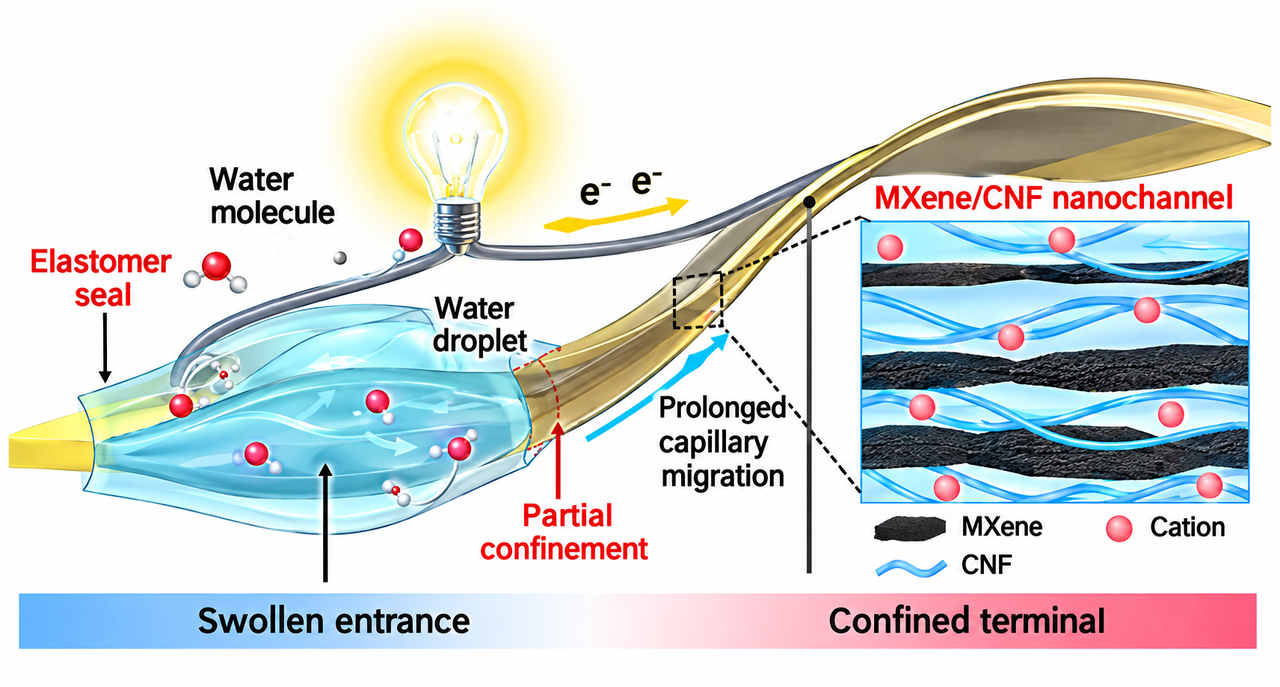
Each thin-film generator measures 5 millimeters by 7 millimeters — smaller than a fingernail — with a film thickness of just 15 micrometers. Even so, it maintained voltage for more than 20 hours using only 3 microliters of water and generated voltage for up to 45 hours.
Because the structure is flexible and thin, the generators can be stacked in multiple layers to boost power output. The team connected 48 unit devices, each stacked in two layers, in series to power a digital clock. They also confirmed that the device can generate electricity using tap water, seawater and sweat.
"Because it can maintain voltage for a long time and produce as much power as needed by stacking multiple layers, this technology can be extended beyond wearable electronics to small sensors, distributed electronic devices and a variety of other self-powered energy source applications," Professor Ko said.
The research was supported by the Ministry of Science and ICT's National Research Foundation of Korea through its basic research project in science and technology, the National Research Council of Science and Technology's creative convergence research project, and the InnoCORE program — a joint initiative of the Ministry of Science and ICT and the Gwangju Institute of Science and Technology to cultivate innovative talent in AI and science and technology.
The findings were published online Aug. 12 in Advanced Materials, a leading international journal in materials science.
cityblue@heraldcorp.com