
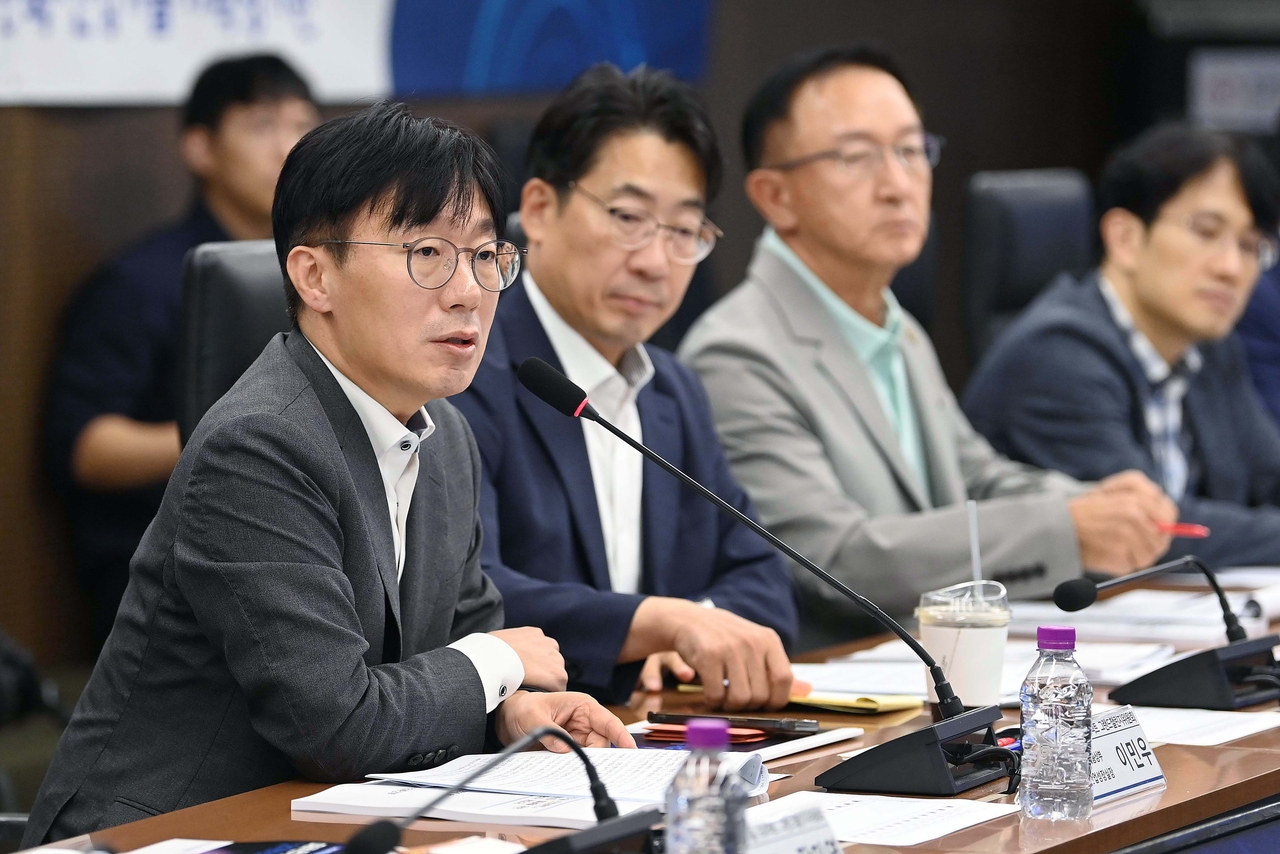
The government will invest about 300 billion won in innovative research targeting extremely challenging technologies expected to reshape future industries over the next decade.
The Ministry of Trade, Industry and Energy said Tuesday it held the launch ceremony of the Grand Challenge Committee at the Korea Chamber of Commerce and Industry in Jung-gu, Seoul. The event seeks to identify new themes for the 2027 cycle of the Future Game-Changing Technology Project.
The Future Game-Changing Technology Project is a challenge-driven research and development initiative that targets extremely difficult technologies carrying a high risk of failure but capable of reshaping future industries if successful. From 2025 to 2035, a total of 302.6 billion won ($225 million) will be invested, including 272.6 billion won in state funding.
The committee is chaired by Hong Soon-kook, standing vice chairman of the National Academy of Engineering of Korea, and comprises 22 experts from industry, academia and research institutes.
Drawing on an analysis of more than 600 science fiction works from Korea and abroad along with an AI-based theme-discovery system, the ministry identified 26 candidate themes. These include nanorobots, X-Brain neuromorphic semiconductors, self-healing and self-adapting smart materials, and ultra-low-power space computing.
The committee plans to comprehensively review the candidates' potential to create new industries and markets, as well as their potential to lead globally. It aims to finalize three themes by the end of the year.
The government previously selected three first-round themes last year: robots driven entirely by artificial muscles; the "PFAS-Free Transformation" initiative; and "End-to-End 3D Spatial Intelligence." The PFAS-Free Transformation initiative develops materials and processes to replace PFAS (perfluoroalkyl substances) needed in advanced industries such as batteries and semiconductors. End-to-End 3D Spatial Intelligence uses AI to comprehensively recognize, judge and control various types of spatial information.
Min Woo Lee, director general of the Industrial Growth Bureau at the Ministry of Trade, Industry and Energy, said, "The Future Game-Changing Technology Project is not about technologies we are already good at, but about proactively identifying and challenging the technologies that will determine the competitiveness of our industries a decade from now." He added, "We will identify technologies that can reshape the global industrial landscape and boldly support them."
oskymoon@heraldcorp.com



