
Gumi BaaS test and demonstration center completed, covering battery development through second-life evaluation
Korea Testing & Research Institute (KTR) has completed a secondary battery test and demonstration center in Gumi, North Gyeongsang Province. KTR plans to link the new facility with its existing testing and certification infrastructure to offer full-lifecycle testing and certification services — from battery development through recycling and second-life evaluation of used batteries.
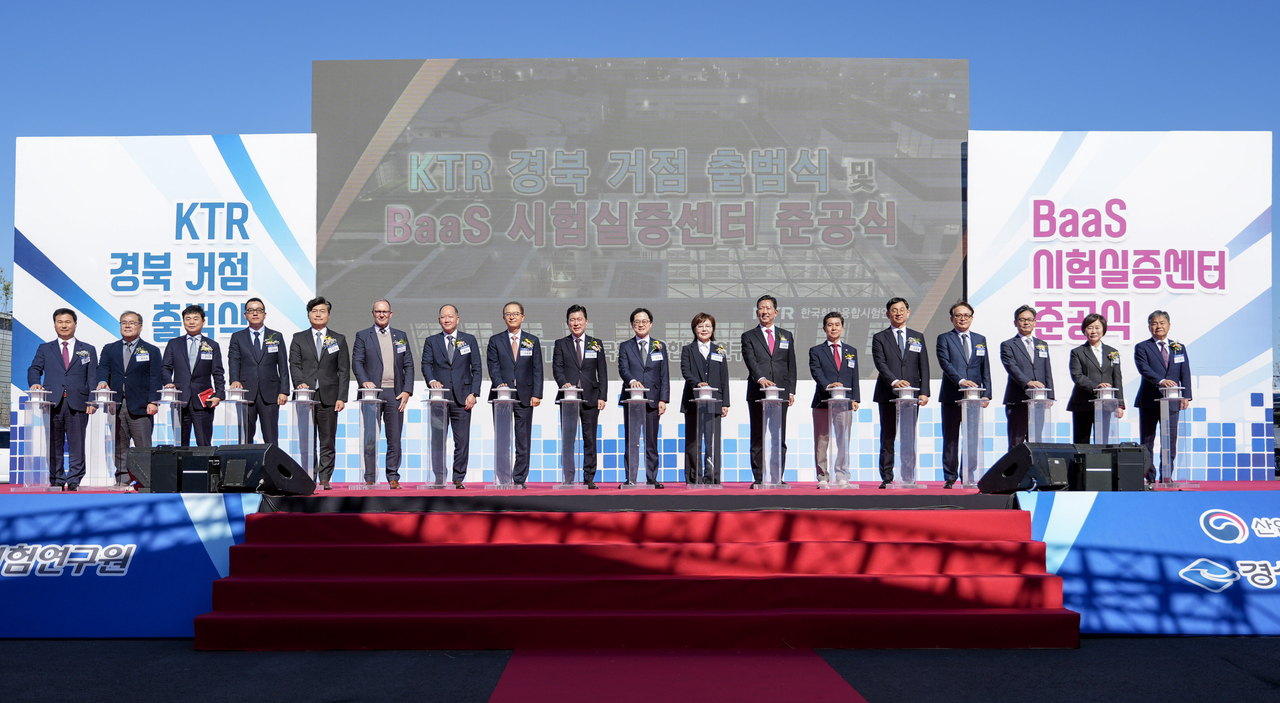
According to the testing and certification industry, KTR held a completion ceremony for the KTR North Gyeongsang hub and Battery-as-a-Service (BaaS) test and demonstration center at Gumi National Industrial Complex No. 1 in North Gyeongsang Province on Wednesday.
The ceremony drew about 300 attendees, including KTR President Lee Seung-ryeol, Minister of Trade, Industry and Energy Kim Jung-kwan, People Power Party lawmaker Koo Ja-geun of the National Assembly, North Gyeongsang Province Deputy Governor for Economic Affairs Yang Geum-hee, Gumi Mayor Kim Jang-ho, heads of project-executing organizations, representatives of related institutions, academics and industry officials.
The center was developed through the "BaaS demonstration infrastructure project to enhance battery usability," a joint initiative by KTR, North Gyeongsang Province and Gumi City under the Ministry of Trade, Industry and Energy's industrial innovation infrastructure program. Construction began in November 2024, with a total investment of 40.4 billion won ($30.2 million) — comprising 10 billion won in national funds, 15 billion won in local government funds and 15.4 billion won from KTR's own resources. The complex consists of six buildings in total: five newly constructed and one existing building repurposed as a testing facility.
The center provides demonstration services for batteries used in electric vehicles and other applications, covering: testing consultation and battery history management; disassembly and initial diagnosis of used batteries; electrical safety and performance evaluation; vibration and impact testing of used batteries; on-site energy storage system (ESS) testing using used batteries; and electromagnetic compatibility (EMC) testing.
Through the center, KTR will systematically diagnose and classify the condition and performance of used batteries to support their reuse in ESS and other applications. The center will also link with KTR's existing secondary battery testing and certification infrastructure — including facilities in Yongin — to provide full-lifecycle testing and certification services from manufacturing through second-life battery use.
The demonstration center will also serve as foundational infrastructure to meet growing demand for testing and certification driven by the rapid increase in used batteries, as the number of electric vehicles in Korea rises and battery service lives come to an end.
KTR, North Gyeongsang Province and Gumi City plan to invest a combined 23.4 billion won to establish an AI-based integrated support center for reusable batteries by 2029. The project will draw 10 billion won in national funds and 9 billion won in local government funds.
The infrastructure will use AI to collect and analyze full-lifecycle data on secondary batteries, including those from electric vehicles, and will provide integrated reuse support services covering diagnosis and evaluation, precision inspection and repackaging.
KTR plans to expand the BaaS test and demonstration center into a North Gyeongsang hub by integrating its existing KTR Daegu-Gyeongbuk Center and Gumi Center under a single operation.
"With the completion of the BaaS test and demonstration center, we now have the infrastructure to provide full-lifecycle secondary battery services from development through reuse," KTR President Lee said. "We will contribute to the development of Gumi and North Gyeongsang Province, as well as to strengthening the competitiveness of South Korea's secondary battery industry."
oskymoon@heraldcorp.com




