Non-metro companies make up only 30.1% of exporters
Regional export target set to rise from $180b to $350b
Foreign investment goal doubled to $12b
Intensive support planned for 1,000 novice regional exporters

South Korea is approaching an era in which its annual exports could top $1 trillion. The Korea Trade-Investment Promotion Agency, or KOTRA, is moving to boost exports from outside the Greater Seoul area. The agency aims to sharply raise non-metropolitan exports — currently about a quarter of the national total — by 2030, while doubling foreign investment in the regions.
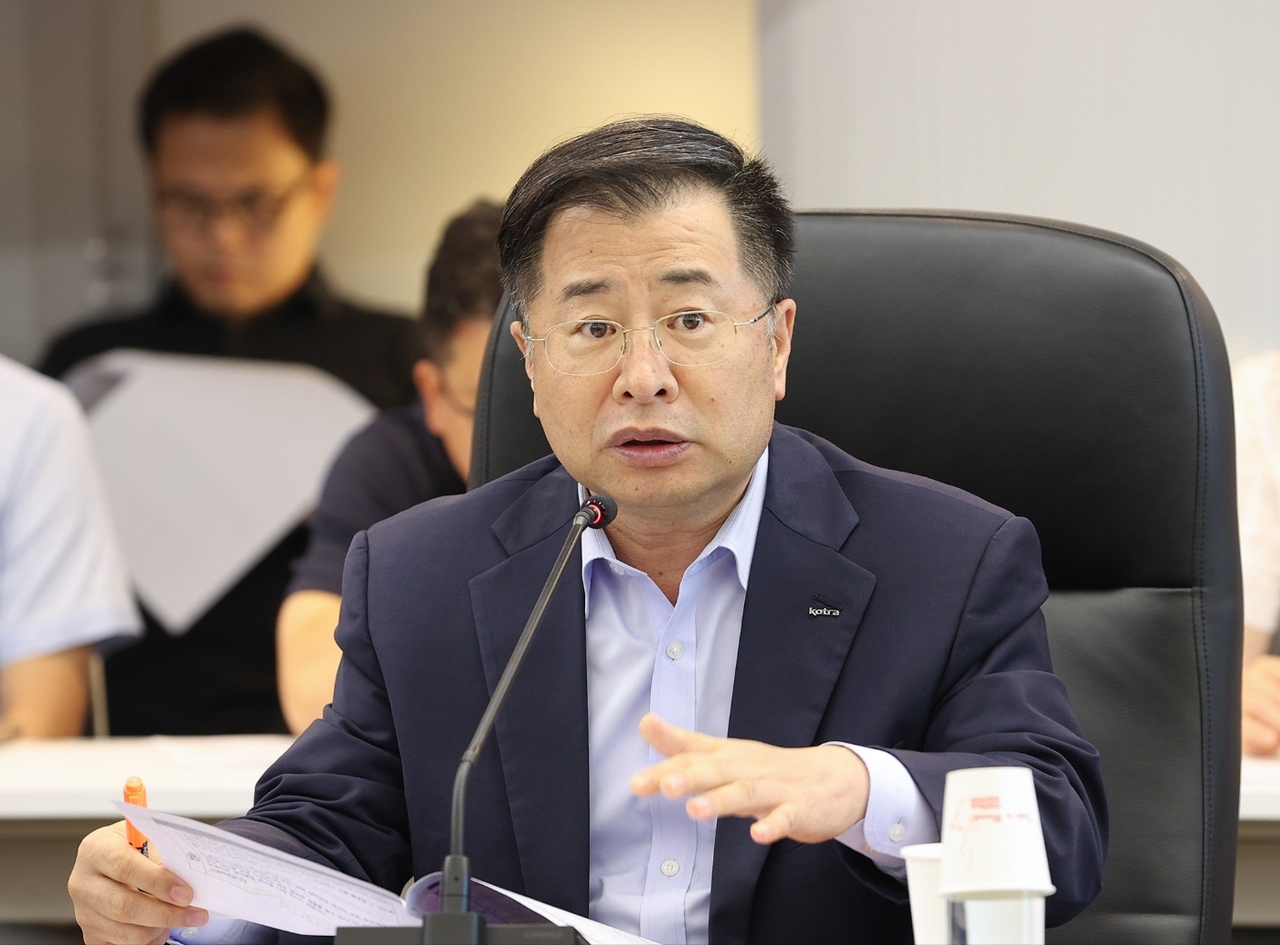
KOTRA held a "regional growth review meeting" at its Seoul headquarters on Tuesday, presided over by President Kang Kyung-sung. The meeting focused on strategies for expanding exports and investment outside the metropolitan area. Officials from the agency's 12 domestic regional support headquarters and 10 overseas regional headquarters took part, both online and in person.
Kang, who is currently in France in connection with President Lee Jae Myung's visit there, presided over the meeting via video link. KOTRA is discussing cooperation measures with Business France, the country's trade and investment promotion agency, after signing an MOU with the organization.
KOTRA set a goal of roughly doubling annual exports from non-metropolitan regions, from $180 billion in 2025 to $350 billion by 2030. Over the same period, the agency aims to expand foreign investment attracted to the regions from $6 billion to $12 billion.
The regional imbalance in South Korea's exports is stark. Non-metropolitan companies accounted for just 30.1% of the country's 102,304 exporting firms last year, and their share of total exports — $709.3 billion — came to 26.3%.
Among small and medium-sized enterprises, non-metropolitan companies made up 30.3% of exporters and accounted for 38.4% of export value. KOTRA sees this gap as evidence that there is considerable room for more regional companies to enter export markets.
This year's overall exports have already hit a record high. As of Saturday, cumulative annual exports reached $709.4 billion, surpassing last year's full-year record of $709.3 billion 117 days ahead of the pace set in 2025. Some forecasts suggest that if the current pace continues, South Korea could achieve $1 trillion in annual exports for the first time in early December.
However, dependence on a single industry has deepened, with semiconductors accounting for 40.6% of total exports between January and August this year. This is why KOTRA believes it needs to diversify not only its export items and markets but also the regional base of its exporting companies.
To this end, KOTRA will build what it calls a "regional overseas expansion expressway" that directly links each region's core industries with overseas industrial hubs. The initiative is coordinated with the government's regional growth plan, known as the "5-pole, 3-special-zone" framework.
For example, KOTRA plans to connect chipmakers in the southwestern region with demand for materials, parts and equipment from US and European companies. It will also help materials, parts and equipment makers in the southeastern and Daegyeong (Daegu-Gyeongbuk) regions enter the manufacturing supply chains of Japan and India.
KOTRA will also expand efforts to attract foreign investment linked to the government's "three mega projects" — semiconductors, physical AI and data centers. The plan is to bring production and research facilities of leading global companies into the regions, boosting both the export base and job creation.
KOTRA will also directly nurture regional companies with little export experience. Through its "Export Hopeful 1000" project, the agency will support a total of 1,000 non-metropolitan companies with annual exports under $1 million by 2030.
Selected companies will receive continuous support for up to three years. That support covers everything from export capability assessments to finding and connecting with overseas buyers, plus online and offline overseas marketing. The program is designed to provide step-by-step support for domestically focused companies and small business owners as they take their first steps into exporting.
KOTRA will also expand support to address the workforce, logistics and overseas certification challenges that regional companies frequently cite as obstacles. Working with local universities and municipal governments, the agency will train trade professionals skilled in AI use and connect them with local companies. It will also work with logistics firms to expand regional export logistics networks and strengthen support for companies undergoing overseas certification testing.
AI will also be put to use in regional export support. Using the agency's 12 domestic regional support headquarters and 20 "AI trade support centers" as hubs, KOTRA will help companies produce overseas marketing content and analyze promising markets. It will also automatically recommend buyers, arrange video consultations and connect companies with overseas trade offices.
KOTRA also plans to pool some of the overseas marketing budgets that individual regions have run separately in order to jointly host large-scale regional trade fairs and consultation events. It plans to designate hub headquarters to coordinate cooperation among its regional support headquarters and to expand the project and budget authority of each headquarters.
"We expect a remarkable outcome this year, with annual exports reaching $1 trillion, and to make that achievement sustainable, it is important to increase the number of exporting companies — particularly by boosting exports from regional companies," Kang said. "We will do our best to help revitalize regional economies by expanding support for regional companies' exports and investment, and to further lead the qualitative growth of exports in the era of $1 trillion."
kwater@heraldcorp.com