Japan's market restructuring saw 97.3% of market cap gains flow to top tier
Kosdaq tiering risks concentrating investment in upper segment
Supplementary measures seen as essential to preserve revitalization goals
Securities industry proposes ETF tax breaks; regulators actively reviewing
![The Korea Exchange's Yeouido office in Yeongdeungpo-gu, Seoul [The Herald Business DB]](https://wimg.heraldcorp.com/news/cms/2026/09/29/news-p.v1.20260304.c943d222815a48b1b841728e67de430d_P1.png)
Financial authorities are pushing to introduce a tiered promotion-and-relegation system for Kosdaq-listed companies as part of efforts to revitalize the market, but the plan is drawing concern from industry participants who warn it could deepen investment polarization within an already struggling exchange.
The worry is that capital will flow almost exclusively into a premium upper segment for blue-chip companies, leaving the rest of the market starved of investment. That concern is driving urgent discussions about tax incentives and other support measures to maintain liquidity in the lower segment.
Under the plan being pursued by financial authorities, the Kosdaq market would be divided into a premium segment for high-quality companies and a standard segment for general companies — both working titles — while firms at risk of delisting would be placed in a separate watch category. Companies meeting certain criteria would move up to the higher segment, while those falling short would be relegated to the lower one. The stated aim is to attract more institutional investment into Kosdaq by giving blue-chip companies their own distinct classification.
"If capital concentrates in the upper segment, the lower segment could become relatively marginalized," a Korea Exchange official said. "Incentives are needed to maintain or increase existing liquidity in the lower segment."
Japan offers a cautionary example. A similar restructuring of its stock market widened the gap sharply between upper and lower tiers.
The Tokyo Stock Exchange restructured its equity market in April 2022 into three segments: Prime, for large blue-chip companies; Standard, for mid-sized firms; and Growth, for high-growth companies. According to the Korea Institute of Finance, total market capitalization across Japan's stock market rose 582 trillion yen — from 712 trillion yen ($4.52 trillion) to 1,294 trillion yen — between April 2022 and April this year. Of that increase, 97.3 percent, or 566 trillion yen, was concentrated in the Prime market. The Prime segment's share of total market cap edged up from 96.1 percent to 96.6 percent, and foreign investors made net purchases of 18.1 trillion yen. Over the same period, the number of Prime-listed companies fell from 1,837 to 1,568, but average market cap per company more than doubled, rising from 372 billion yen to 797 billion yen.
The lower tiers told a different story. The Standard market's share of total market cap slipped from 3.02 percent to 2.61 percent, while the Growth market's share fell from 0.89 percent to 0.73 percent. The Growth segment attracted 68 percent of all newly listed companies over the four-year period, pushing its listed company count from 467 to 596. Yet average market cap per company grew only modestly, from 14 billion yen to 16 billion yen.
The Korea Institute of Finance warned of a "stigma effect," in which even solid companies are undervalued simply because they belong to a lower segment. "As quality companies leave, the average quality of remaining firms falls further, which in turn leads to an even steeper discount — making segment membership itself a negative signal," said Lee Bo-mi, a senior research fellow at the institute.
The domestic Kosdaq market already has no shortage of high-performing companies that fall outside major indexes. According to SK Securities, as of Sept. 4, 136 of the 1,749 companies listed on Kosdaq posted a return on equity above 23.4 percent — the ROE for the Kospi market as a whole. Of those, only 25 were included in the Kosdaq 150 index. Another 56 companies outside the Kosdaq 150 also recorded ROE higher than the overall Kospi.
Voices in the investment industry are calling for the Kosdaq restructuring to be accompanied by tax incentives. In a recent report, Na Seung-du, a researcher at SK Securities, said it was necessary not only to reflect the weight of a select index in the domestic equity benchmarks used by pension funds and other major investors, but also to create a structure through ETFs and fund products that allows retail investors to benefit from tax breaks.
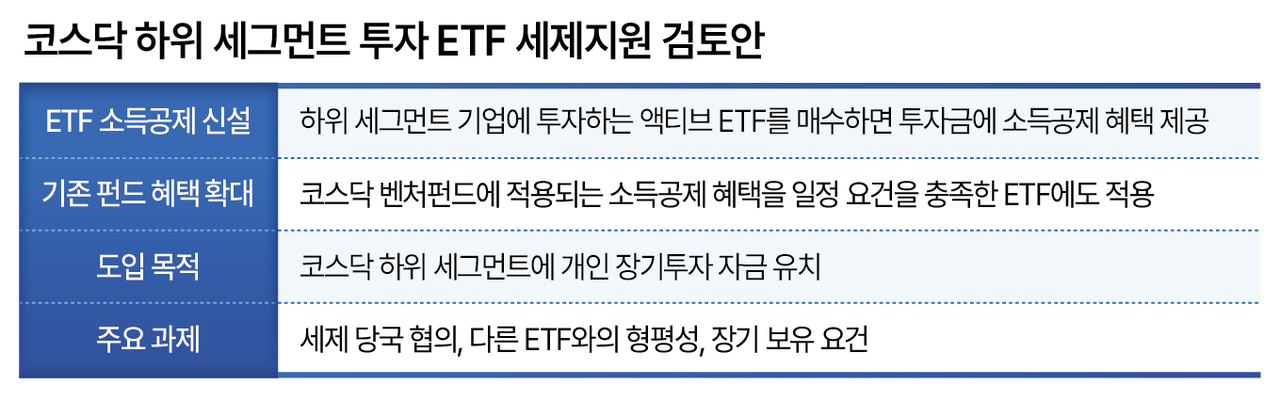
The Korea Exchange and financial authorities are separately reviewing a plan to offer income deduction benefits for ETFs that invest in the lower segment. Discussions are understood to center on limiting the benefit to actively managed ETFs — where asset managers select individual holdings — rather than passive ETFs that track the entire lower segment. The aim is to provide investment incentives for the lower segment and ease the concentration of capital in the upper tier.
Meanwhile, Korea Premium Week 2026, jointly organized by the Financial Services Commission and the Korea Exchange, is set to discuss measures to strengthen Kosdaq's competitiveness on Oct. 6. The event, which opened Monday, will cover improvements to Kosdaq's listing and delisting regime, the nurturing of innovative companies, and ways to boost investor confidence in its policy sessions. Attention will focus on whether the event produces an outline of specific support measures, including ETF income deductions.

hajun825@heraldcorp.com