Gangnam's long-term sellers hit year-high in August
City-wide trend falls while Gangnam surges
Tax deduction cuts spur 'sell before it's too late' rush
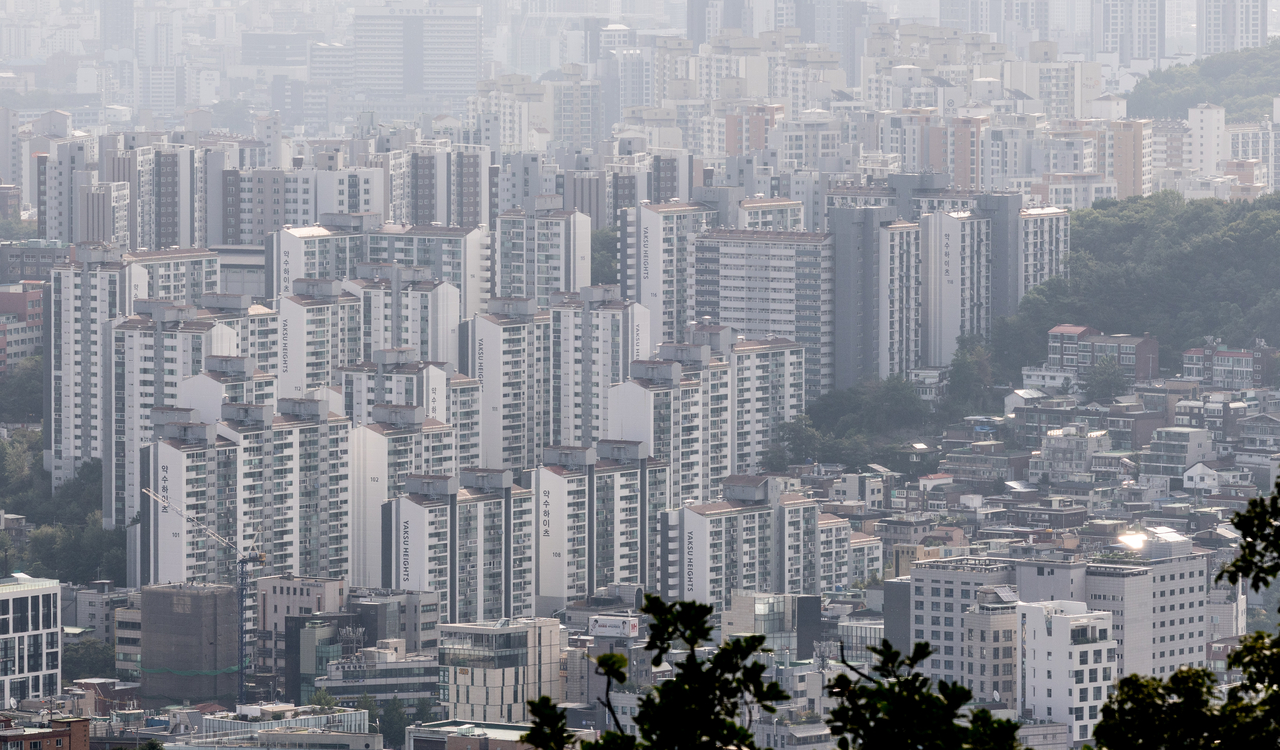
The number of sellers who had held properties for more than 10 years in Seoul's three Gangnam-area districts — Gangnam-gu, Seocho-gu and Songpa-gu — surpassed 900 last month, reaching a year-to-date high. While the city-wide count of long-term sellers was declining, the pace of disposals in the high-end residential belt was accelerating.
Analysts say the trend reflects two overlapping pressures: a wave of transactions concluded before the reinstatement of the capital gains tax surcharge on multi-home owners began flowing through registration records from June onward, followed by a fresh surge in selling activity as debate over cuts to the long-term holding special deduction intensified in July and August.
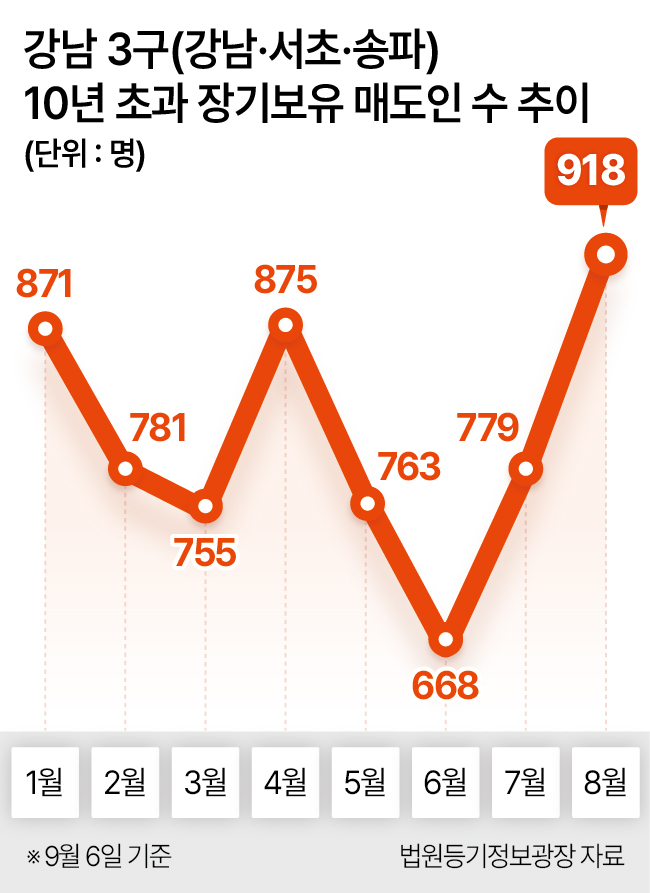
According to the Supreme Court's Real Estate Registration Information Plaza, the number of sellers with more than 10 years of ownership in the three Gangnam districts rose from 668 in June to 799 in July and 918 in August. The monthly increase exceeded 100 for two straight months — up 111 in July and 119 in August. Compared with June, the August figure represents a gain of 230 sellers, or 33.4 percent, over just two months.
By contrast, the total number of long-term sellers across Seoul fell to 4,619 in August from 4,704 the previous month, a decline of 1.8 percent. While the city-wide count was shrinking, the three Gangnam districts posted a 14.9 percent increase — a sign that owners of high-value properties were moving to sell even as overall transaction activity cooled.
The three districts accounted for 19.9 percent of all long-term sellers in Seoul last month, meaning roughly one in five of the city's long-term sellers came from just three of its 25 autonomous districts. The last time the Gangnam trio's 10-year-plus seller count exceeded 900 was in September last year, when it reached 959.
In the same period last year, the three districts moved in line with the broader city trend: Seoul's total long-term seller count fell from 4,160 in June to 4,158 in July and 4,023 in August, while the Gangnam trio slipped from 897 to 758 before edging back to 762. Compared with August last year, this August's Gangnam figure is up 156 sellers, or 20.5 percent — outpacing the city-wide year-on-year increase of 14.8 percent.
The rebound in long-term selling across the three Gangnam districts from June appears to stem partly from a timing gap between transactions and registration. The government reinstated the capital gains tax surcharge on multi-home owners in designated adjustment zones from May 10. Deals for which land transaction permit applications were filed by May 9 remained eligible for the previous surcharge exemption, however, concentrating a wave of disposals by multi-home owners in the April–May market before the heavier tax burden took effect.
The seller statistics compiled by the Real Estate Registration Information Plaza are based on the date of ownership transfer registration, not the date of the sales contract. Because obtaining a land transaction permit, settling the balance and completing the transfer takes time, some contracts concluded before the May surcharge reinstatement may have appeared in the statistics from June onward.
The intensification of real estate tax reform discussions in July and August also spurred further selling by long-term Gangnam homeowners. From just after the June 3 local elections, proposals circulated within the government and the ruling party to raise holding taxes on high-value and multi-home owners and to shift the long-term holding special deduction toward actual residency. The tax reform package released by the government in early August and finalized Tuesday included tighter levies on multi-home and high-value properties, analysts say, stoking selling pressure among those most concerned about rising tax burdens.
Among the three districts, Seocho-gu recorded the sharpest increase. Its count of sellers with more than 10 years of ownership rose from 158 in June to 259 in August — a gain of 101, or 63.9 percent. Over the same period, Gangnam-gu rose from 207 to 289, up 82 or 39.6 percent, while Songpa-gu climbed from 303 to 370, up 67 or 22.1 percent.
These districts have seen some of the steepest price appreciation in Seoul for years, meaning long-term holders typically sit on large capital gains. A reduction in the deduction tied to holding periods could sharply increase the tax bill on any sale.
Under the existing long-term holding special deduction, multi-home owners who had held a property for 15 years or more could deduct up to 30 percent of their capital gains — excluding properties in designated adjustment zones — while single-home owners who had both owned and lived in a property for 10 years or more could deduct up to 80 percent. The latest tax reform proposal introduces a deduction cap and shifts the eligibility criteria toward actual residency rather than mere ownership duration.
High-value homes will face a sharp rise in tax liability after a transition period regardless of how long they have been held, and the revised deduction framework appears to be reshaping the calculus for long-term Gangnam owners. The resulting increase in tax-motivated listings is adding downward pressure to the local housing market. Apartment prices in Gangnam-gu and Seocho-gu have fallen for four consecutive weeks, according to the Korea Real Estate Board's weekly apartment price survey as of Aug. 31.
Local real estate agents say selling will continue unless the long-term holding deduction policy is reversed. A Cabinet meeting Tuesday produced a revised proposal maintaining the basic deduction threshold for comprehensive real estate tax on non-resident single-home owners at 1.2 billion won ($885,000) and keeping the existing 150 percent cap on tax burden increases — but the overall direction, including the shift in the long-term holding deduction and higher comprehensive real estate tax rates, remained unchanged.
The head of a licensed real estate agency in Apgujeong-dong, Gangnam-gu, said: "As long as the long-term holding deduction stays as it is, owners still have to sell, so no one is pulling their listings. Right now there are more than 10 units on the market for each apartment size, and units in the 99-square-meter range that have come down by nearly 1 billion won have not sold in over a month."
Among some sellers, a wait-and-see mood is also emerging — a preference to hold off on a distressed sale and monitor the legislative process, given that the content and timing of the tax reform could still change as the bill moves through the National Assembly.
Experts say the trajectory of long-term selling will hinge on how the deduction legislation unfolds. Park Won-gap, a senior real estate specialist at KB Kookmin Bank, said the long-term holding special deduction is the pivotal policy driving long-term sellers' decisions. "We are seeing residential downsizing and asset restructuring begin in earnest, particularly among older homeowners with no regular income," he said.
Ham Young-jin, head of the real estate research lab at Woori Bank, said the ruling party could still move to revise the long-term holding deduction. "But if the government's current proposal goes through unchanged, properties held for decades with large capital gains will keep coming onto the market through next year," he said.
shy@heraldcorp.com
hope@heraldcorp.com