Pragmatism drives push for housing stability and stronger council expertise
'Policy over politics, results over slogans'
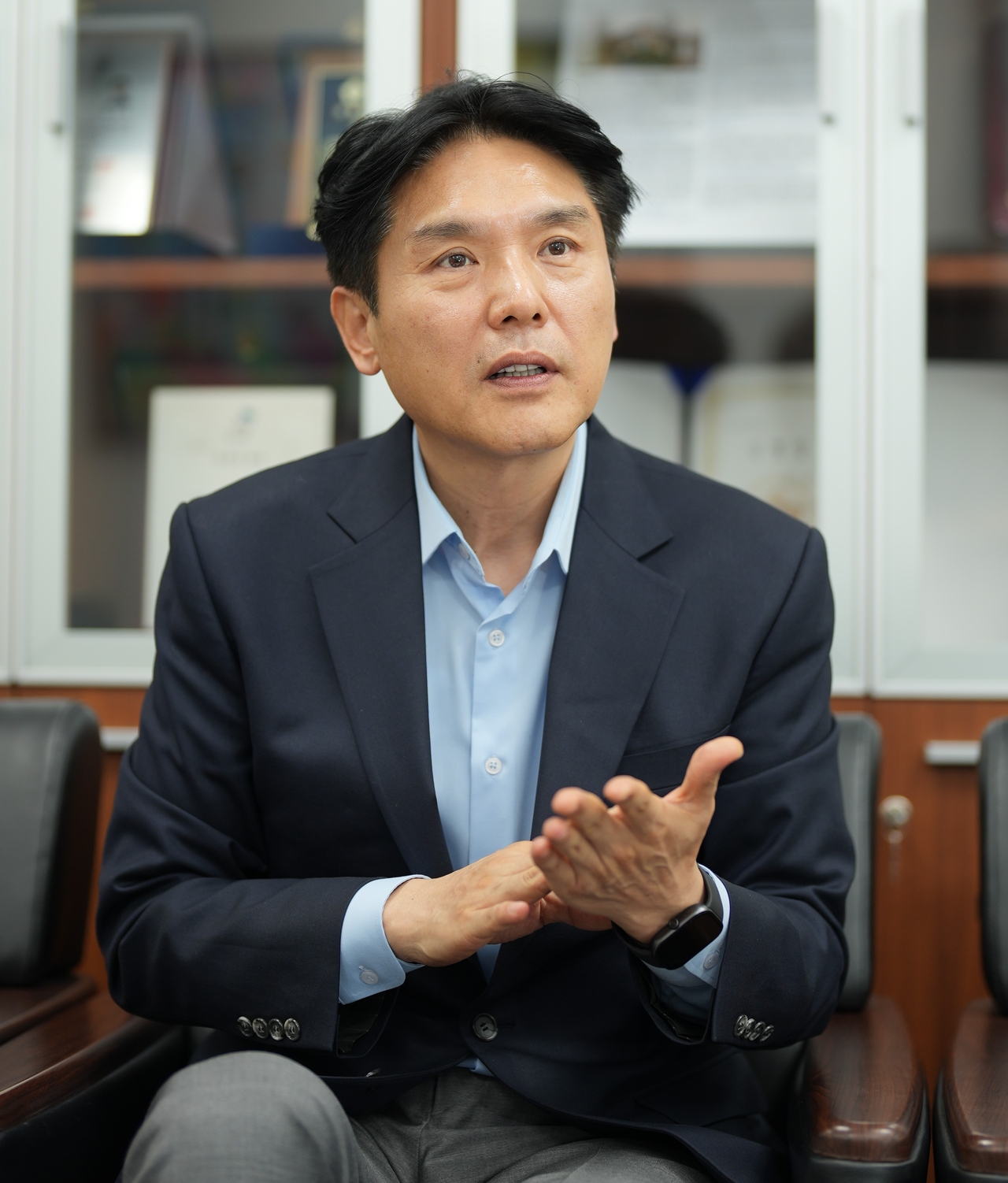
The People Power Party caucus on the Seoul Metropolitan Council, holding just 38 seats as a minority ruling party, is betting on policy competitiveness to break through its numerical constraints. Rather than relying on seat count, the caucus plans to build broader consensus inside and outside the council by leading with data, voices from the field and concrete alternatives.
Kim Gil-young, the PPP's floor leader on the Seoul Metropolitan Council representing Gangnam District 6, has put "practical learning" — the Confucian ideal of seeking truth from facts — at the center of the 12th council's operating philosophy. The idea is to move away from ideological confrontation and political sloganeering and instead focus energy on accurately diagnosing issues and finding workable solutions.
Kim believes that even a numerically disadvantaged minority can command genuine persuasive power if its arguments are grounded in solid evidence and objective data. He places particular weight on verification through statistics and figures, a conviction shaped by his experience working alongside former Assembly member Yoo Kyung-joon, a former commissioner of Statistics Korea, who showed him how data-backed reasoning builds credibility.
Kim's pragmatic approach is also visible in how the caucus has handled the student rights ordinance. Rather than pushing again for outright repeal, the PPP caucus shifted course toward amending the ordinance to address its shortcomings. The aim is to preserve the original intent of protecting student rights while incorporating teachers' rights, student responsibilities and obligations, and the right to learn — bringing greater balance to the educational environment. Provisions that conflict with higher-level law, including those governing the use of smart devices, are also slated for revision.
"I will lead the People Power Party on the principle that policy comes before political conflict, results before slogans, and people's livelihoods before ideology," Kim said. "As a minority ruling party that cannot compete on numbers alone, we will study harder and earn the public's trust through more sophisticated policy."
From housing to jobs: starting with the foundations of daily life
Kim identifies housing as the most urgent livelihood issue, driven by his recognition that soaring home prices and housing costs weigh heavily on young people and households without property.
His view is that regulations blocking redevelopment and reconstruction should be rationalized and complex procedures streamlined to expand housing supply in the city center, while also increasing the share of public housing such as long-term jeonse units. The goal is to combine private supply with public support to create conditions where those without homes can move into better living environments.
On real estate regulation, Kim called for rules that reflect the characteristics of individual neighborhoods rather than applying blanket restrictions. Broad measures such as the land transaction permit system can affect residents and local businesses with no connection to development projects, he argued, making it necessary to apply controls more precisely and target only the areas where regulation is genuinely needed.
Kim also sees youth policy as inseparable from housing, employment and care services. For young people to work, live and build their futures in Seoul, he said, stable jobs, decent housing and childcare and care services must all be in place together. "We need to remove unreasonable regulations that obstruct business activity to grow private-sector jobs, and also expand the public care infrastructure," he said.
He added that transportation should be viewed not merely as a matter of commuting convenience, but as a way to reduce the time and money residents spend by bringing homes and workplaces closer together.
Kim's approach to Seoul Mayor Oh Se-hoon and the city administration pairs cooperation with oversight. Rather than backing every project simply because the PPP is the ruling party, he said the caucus will examine fiscal burdens, project viability and budget efficiency to determine whether initiatives genuinely benefit residents.
The caucus also plans to raise the professional capacity of the local council. The aim is to strengthen the effectiveness of the policy adviser system and secure specialist staff to support budget analysis, legislative work and research, giving council members the tools to scrutinize city administration in greater depth.
On Seoul's long-term competitiveness, Kim raised both population decline and the need to attract global talent. He said the city must improve living infrastructure — housing, education, healthcare and culture — so that overseas talent can do more than visit, and instead work, live and put down roots in Seoul.
For Kim, the starting point is the field. He said he will continue visiting traditional markets, neighborhood commercial districts and residential areas to hear directly from residents and merchants and bring those voices into his council work.
Thirty-eight seats is an undeniable constraint. But Kim does not believe that numerical limitation has to define the scope of the caucus's work. His goal is to prove the minority ruling party's worth through rigorous, evidence-based analysis, persuasive alternatives and opinions gathered firsthand from the community.
7toy7@heraldcorp.com