A guide for borrowers weighing loan options amid rising rates
Variable-rate loans cut early interest costs; fixed-rate loans raise borrowing limits
New residual-balance COFIX moves slowly in a rising-rate cycle, offering another option
Paying off personal credit loans can sharply boost mortgage limits through DSR math
Young borrowers should check future-income DSR provisions and use loan comparison platforms
![A bank teller window in Seoul. [Yonhap]](https://wimg.heraldcorp.com/news/cms/2026/09/06/news-p.v1.20250801.ef8ab1b8d2cb49b7b472724c32a045cf_P1.jpg)
The government's Aug. 13 real estate measures expanded banks' overall lending capacity, but most consumers have yet to feel the difference. Because nearly all of the newly freed-up capacity must go toward group loans for pre-sale apartment buyers, banks have been reluctant to ease restrictions on ordinary borrowers. Rising loan interest rates are adding to the pressure.
Even so, there are ways to work the system. A careful look at the fine print of loan products can help borrowers squeeze out a higher limit or trim their interest burden.
Fixed rate in a rising-rate cycle? Not always the right answer
When interest rates are rising, the conventional wisdom is to lock in a fixed-rate (periodic) mortgage so that no matter how high market rates climb, the rate at the time of disbursement stays in place.
In the current environment, however, that is not necessarily the right call. The gap between fixed- and variable-rate products has widened considerably.
As of Friday, the fixed-rate mortgage range at the five major banks — KB Kookmin, Shinhan, Hana, Woori and NH NongHyup — stood at 4.80 to 7.22 percent per year. Variable rates ranged from 4.28 to 6.46 percent, putting the floor about 0.60 percentage points lower and the ceiling about 0.80 percentage points lower than their fixed-rate counterparts. Given that the Bank of Korea typically moves its benchmark interest rate in 0.25-percentage-point increments, the spread between the two products is not trivial.
The difference shows up in monthly payments as well. Using the upper end of each range, a borrower taking out 450 million won on a 30-year equal-principal-and-interest repayment plan would pay 3.06 million won a month on a fixed-rate loan versus 2.83 million won on a variable-rate loan. Although the variable rate resets every six months based on market conditions, in the first six months alone, a borrower can save roughly 200,000 won in interest compared with the fixed-rate option.
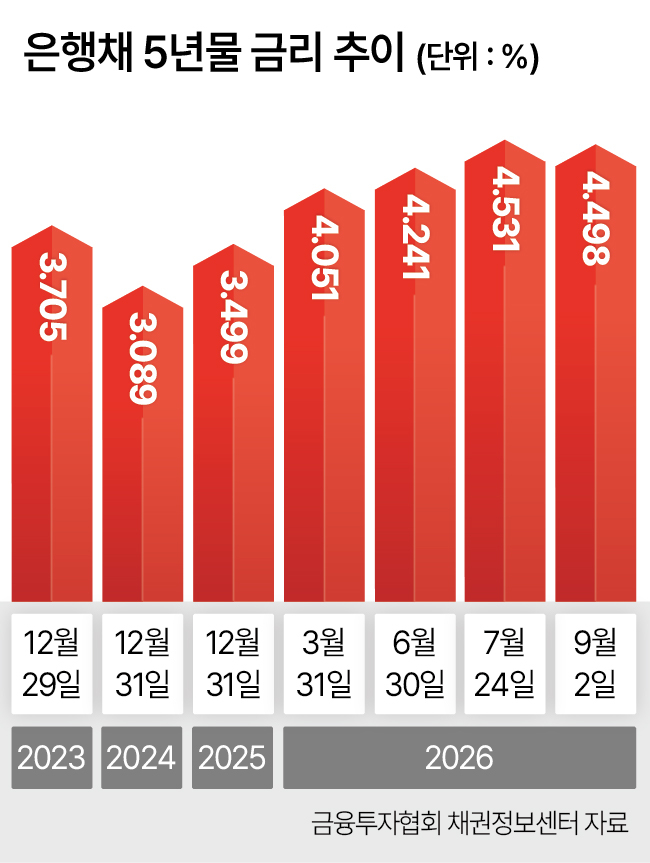
The widening gap between the two products stems from their different benchmark rates. Fixed-rate products are pegged to the five-year bank bond yield, which reflects market-rate movements in real time.
Variable-rate products, by contrast, are tied to the COFIX — a weighted average of the funding costs banks incurred over the previous month. Because it incorporates not only bank bond rates but also time deposits and other funding costs, it is a lagging indicator that moves more slowly than market rates.
For borrowers feeling the pinch right now, bankers say choosing a variable-rate loan is worth considering. "The rate rises more slowly than fixed-rate products, and prepayment penalties are waived after three years, so borrowers can always decide then whether to switch to a fixed-rate loan," an official at one commercial bank said.
Fixed rate too high, variable rate too uncertain? The new residual-balance COFIX is another option
Among variable-rate loans, one product moves particularly slowly when rates rise: loans tied to the new residual-balance COFIX.
While the new-issuance COFIX reflects the cost of funds banks raised fresh in the preceding month, the new residual-balance COFIX is calculated from the average funding cost across a bank's entire outstanding balance. Because it absorbs market-rate changes more gradually than the new-issuance COFIX, it can serve as yet another alternative in a rising-rate environment.
As of Friday, one commercial bank's new-issuance COFIX-linked loan rate stood at 4.80 to 6.00 percent per year, while its new residual-balance COFIX-linked rate was lower at 4.46 to 5.66 percent. Korea Federation of Banks data show that the new-issuance COFIX rose 0.41 percentage points from January through July this year, whereas the new residual-balance COFIX climbed only 0.17 percentage points over the same period.
The flip side of a slower rise is a slower fall. Borrowers should keep in mind that when rates eventually decline, the benefit will also take longer to filter through to a residual-balance COFIX-linked loan.
When the limit matters more than the rate, fixed-rate loans have the edge
For borrowers who care more about maximizing their loan limit than minimizing their immediate interest cost, a fixed-rate loan can be the better choice.
To account for the stability risk of variable-rate loans, the government applies a larger stress buffer — known as the stress debt service ratio — to variable-rate products when calculating the debt service ratio (DSR) borrowing cap.
Under the government's third-phase stress DSR rules, fixed-rate (periodic) loans carry an add-on of about 1.2 percentage points to the rate used in the DSR calculation, while variable-rate loans carry an add-on of about 3 percentage points. Borrowers whose DSR exceeds 40 percent cannot obtain a bank loan.
A simulation run by one commercial bank found that a borrower earning 80 million won a year could borrow up to 413 million won on a fixed-rate mortgage at 5.5 percent per year after the 1.2-percentage-point stress DSR add-on was applied.
The same borrower's maximum limit on a variable-rate loan tied to the new-issuance COFIX came to 374 million won. Although the variable rate of 4.68 percent per year was lower than the fixed rate, the 3-percentage-point stress DSR add-on sharply reduced the borrowing ceiling. On the same salary, the fixed-rate loan offered a limit roughly 40 million won higher than the variable-rate loan.
![[Created using Gemini]](https://wimg.heraldcorp.com/news/cms/2026/09/06/news-p.v1.20260906.2e7fbfb78a874b20a683462adb59cf4e_P1.png)
Pay off a personal credit loan and watch your mortgage limit rise — the DSR effect
Borrowers who carry a personal credit loan can significantly raise their mortgage limit simply by paying it off. Because personal credit loans have shorter maturities than mortgages, the annual principal-and-interest repayment amount they contribute to the DSR calculation is proportionally large.
Take a borrower earning 80 million won a year who holds a 50 million won personal credit loan at 6 percent per year and wants to take out a variable-rate mortgage at 4.5 percent per year. After the 3-percentage-point stress DSR add-on, the maximum mortgage limit works out to 226 million won.
If that borrower repays the 50 million won personal credit loan first, the total mortgage limit rises to 381 million won — more than three times the amount repaid.
Switching to a fixed-rate loan amplifies the effect further. Choosing a fixed-rate mortgage at 5.5 percent per year, combined with the lower stress DSR add-on, pushes the total limit up to 413 million won.
For borrowers planning to take out a mortgage at the same bank where they hold their personal credit loan, there is no need to come up with the cash upfront. The bank disburses the mortgage, uses part of the proceeds to retire the personal credit loan, and pays the borrower the remaining balance.
Because this approach can substantially raise the borrowing limit without requiring the borrower to produce cash, demand for consultations on such "repayment-condition special clauses" has been rising among buyers trying to get into the housing market before conditions tighten further.
Young borrowers should check future-income DSR provisions
Young borrowers should verify whether future-income DSR provisions apply to them. Since July 2021, the government has allowed projected income growth to be factored into the DSR calculation for young workers without homes who take out a mortgage to buy a property. Because both current and projected future income are used to determine the eligible loan amount, whether the provision applies can make a meaningful difference to the borrowing limit. Future income is calculated using Ministry of Employment and Labor statistics.
For example, a 30-year-old earning 60 million won a year who takes out a fixed-rate mortgage at 5.5 percent per year with the stress DSR applied can borrow up to 309 million won. Factoring in the future-income figure of 71.05 million won raises the limit to 367 million won — roughly 60 million won more, simply by applying the future-income provision.
Although the system has been in place for nearly five years, banks have not been required to proactively inform young borrowers that it exists. The Aug. 13 measures now require lenders to notify borrowers of whether the future-income DSR provision applies to them.
![[Created using Gemini]](https://wimg.heraldcorp.com/news/cms/2026/09/06/news-p.v1.20260906.7753d6fd860e4227930cae5feb80d400_P1.png)
Find the right loan at a glance — check comparison platforms regularly
Checking loan comparison platforms regularly is another way to track down favorable terms. Since 2019, the government has allowed fintech platforms to operate loan product comparison services as part of its innovative financial services initiative.
After a borrower enters personal details, the platform displays loan products from financial institutions matched to that borrower's credit profile. Borrowers can compare offerings from multiple lenders side by side to find the most favorable terms on rate or limit.
Platforms also run promotional events — offering interest subsidies or partial cashback on loan disbursements — as part of their marketing. Factoring in these benefits can shave the interest burden further.
"In a high-rate environment where finding even a slightly lower rate matters, we help users compare multiple loan products to find the highest limit and lowest rate available," an official at Banksalad, which operates a loan comparison platform, said. "We also offer services that automatically boost credit scores and guide users on raising their borrowing limit through DSR management."

hyuk@heraldcorp.com