Korea Federation of SMEs' SME Cooperation Center hosts info session for 'Everyone's Startup' Season 2
Sixty seats fill up in under a week; students, office workers and middle-aged applicants pack the room
Season 1 veterans join the fray, signaling fiercer competition ahead
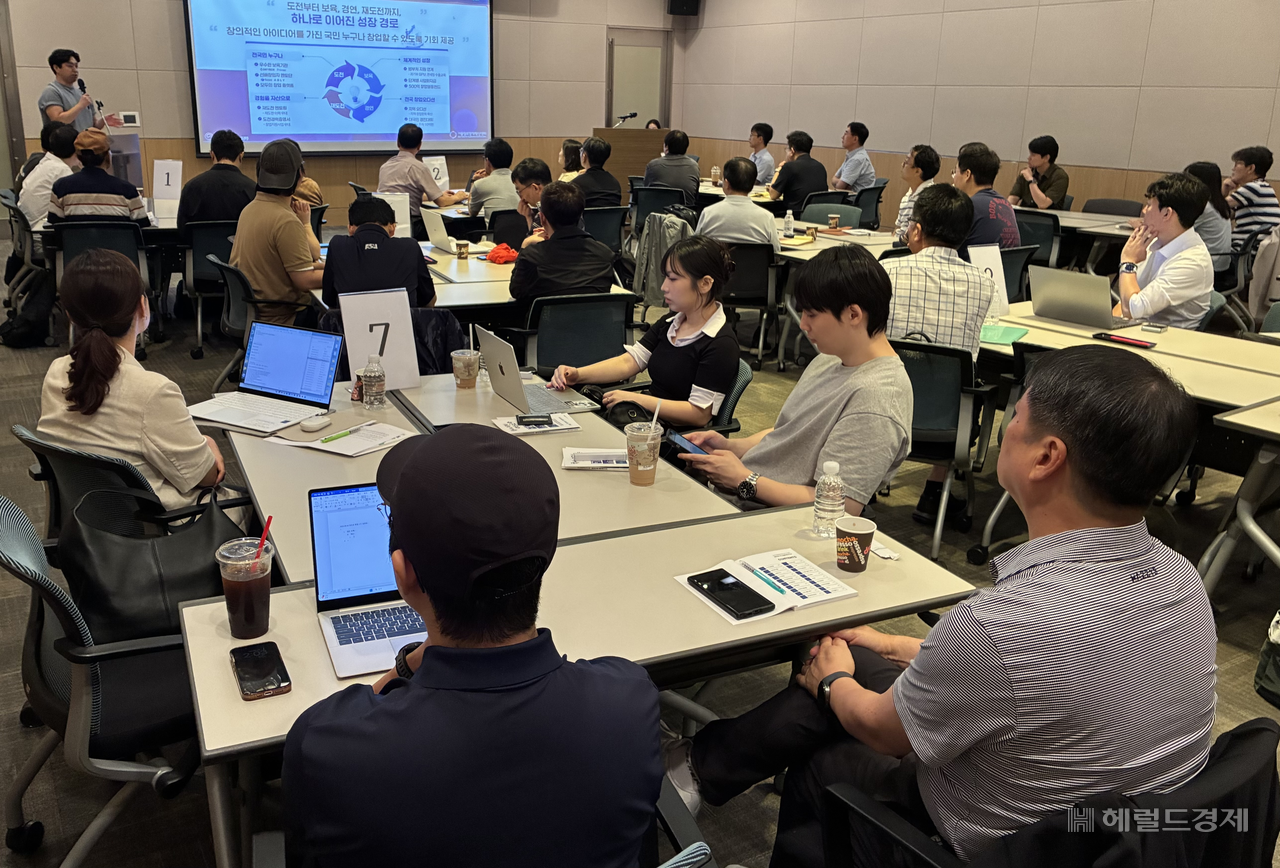
"There's nothing to lose, so why wouldn't you try? Even getting rejected is a win."
That was the mood Friday afternoon at FKI Tower in Yeouido, Seoul, where the "Everyone's Startup Season 2" information session drew a full house. Jang Ji-hyeon, 34, who works in accounting and tax services, said she had been weighing a career change after the rapid spread of AI left her uncertain about her industry's future — and the session brought her one step closer to a decision.
"I wasn't originally thinking about starting a business, but everyone around me kept talking about Everyone's Startup, so I got curious," she said. "You can get support and mentoring, so it feels like you're losing out if you don't at least try."
The Ministry of SMEs and Startups is currently running the second edition of the Everyone's Startup Project, following a successful first season. The program is designed to identify aspiring entrepreneurs at the idea stage and guide them through mentoring, incubation, commercialization, a competition round, and follow-up support for those who want to try again after setbacks.
The Season 2 application period opened Aug. 20 and drew 10,000 applicants in just 15 days — 10 days faster than Season 1, which took 25 days to reach the same milestone. Applications close Sept. 17. Participants at the session predicted the final tally would climb much higher, noting that most government program applications flood in on the last day. "A lot of people who went through Season 1 are back, so it's probably going to be even harder to get selected this time," one attendee said.
The information session organized by the Korea Federation of SMEs' SME Cooperation Center filled all 60 seats. The event was announced Aug. 28 — less than a week before it was held — yet registrations closed quickly. The crowd was strikingly diverse: a young college student with a backpack, office workers in button-down shirts, middle-aged attendees with graying hair, and a homemaker who arrived late after dropping her child off at a hagwon and scrambled to find an empty seat.
Some attendees were reviving entrepreneurial dreams they had shelved a decade ago. Han Ga-hee, 30, an actor, once tried to launch a women's health product business in high school but never got it off the ground. "I saw Everyone's Startup and thought it was a great chance to try again," she said. Her goal is to build a stable business alongside her main career in theater, where income is irregular.
Even people who had already started companies showed up. Jeong Seong-won, 29, is a first-year entrepreneur running an AI-based platform. "My existing business isn't eligible, so I'm planning to enter with a new idea," he said. "I wanted to have my entrepreneurial abilities evaluated and validated through Everyone's Startup." He added that the networking and mentoring opportunities were more appealing to him than the grant money itself.
Participants pointed to the program's low barrier to entry as a key draw. "The selection happens in stages across multiple rounds, so it doesn't feel as daunting," several said. Others noted that securing angel investment or early-stage funding typically requires at least some proof of sales, whereas Everyone's Startup lets applicants compete on the strength of an idea alone.
Fear of failure had held some back until now. One attendee, a 39-year-old surnamed Kim, said she had even hesitated to register for the information session and only signed up on the last day. "I'd seen so many people around me fail, and it scared me," she said. "But seeing the government actively encourage startups like this made me think: there must be real potential here, and maybe I can try too."
The session itself reflected the competitive atmosphere, focusing less on explaining the program and more on how to get selected. The Korea Federation of SMEs' SME Cooperation Center, serving as a mentoring organization for Season 2, brought in 13 mentors — professors and industry representatives — who lectured on how to write strong applications and sharpen ideas before breaking into small-group mentoring sessions.
"Introduce your idea in 100 characters. Do you think the evaluators are going to read that carefully, or just skim it?"
The answer, mentors stressed, was to lead with the essentials and make an immediate impression. They also advised applicants not to claim they had researched a topic after just one or two AI searches. "Write about what you were investigating three months ago, six months ago," one mentor said. Applicants were told to clearly articulate what sets their service apart from existing ones, spelling out both the concept and its competitive edge.
When the Q&A opened, hands shot up across the room — so many that the moderator had to call on people one at a time. Questions zeroed in on any edge that might improve an applicant's chances: "What are the acceptance rates by organization?" "Which region should I register my business in?" "Can my idea qualify as a regional project?"
A number of attendees were returning after being rejected in Season 1. Questions included whether reapplying with a different idea would earn bonus points, and how long after closing a business someone must wait before being recognized as a prospective entrepreneur. As the session wound down, several people asked whether the presentation slides from Friday's event could be shared.
Interest in the program shows no sign of fading after Season 2. The session noted that Seasons 3 and 4 are already planned, and that all participants — regardless of outcome — will receive a certificate of participation. Jeong said he was not counting on making it far this round given how little time he had to prepare. "I want to use this as a learning experience and come back for Season 3," he said.
hong@heraldcorp.com
snsd@heraldcorp.com