
National Education Commission weighs extending school hours for first- and second-graders
Korea Elementary School Principals Association says education, not extended hours, should be the focus
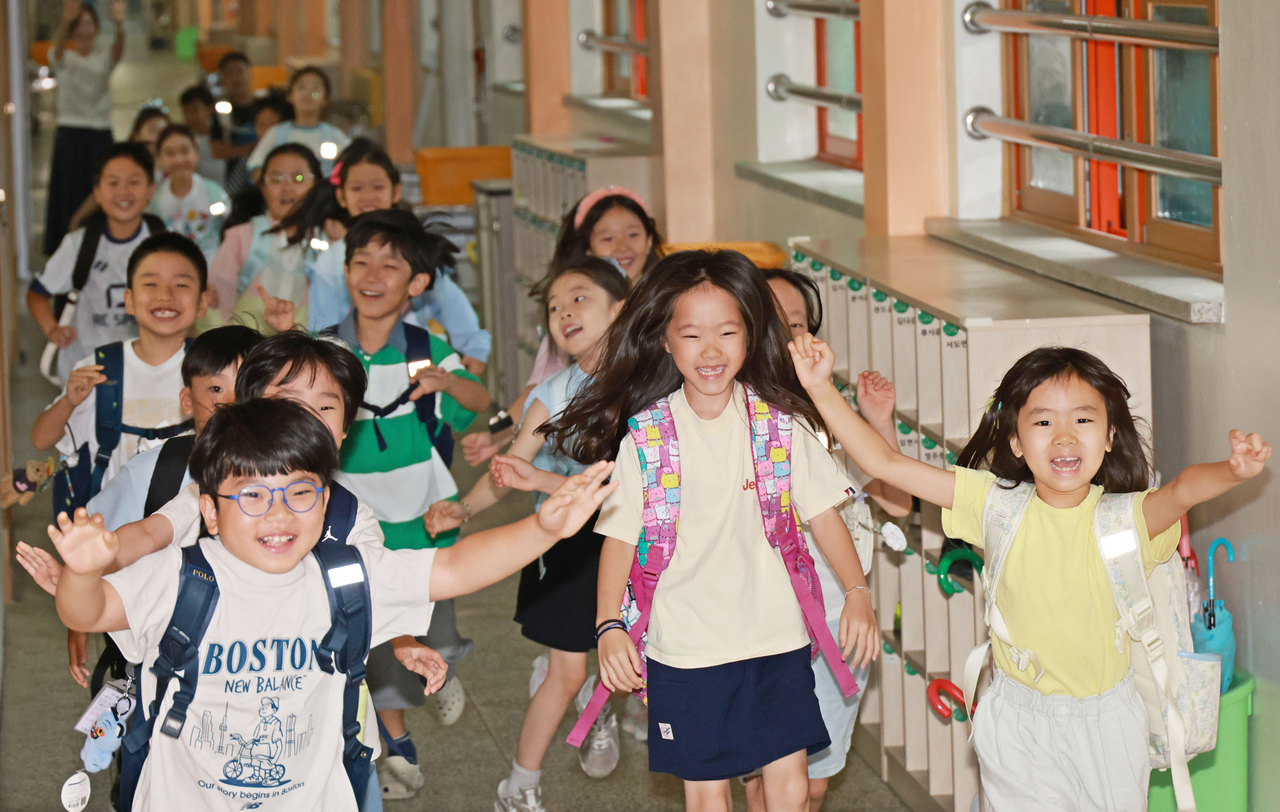
As the National Education Commission considers pushing back dismissal times for first- and second-graders to 3 p.m., the nation's elementary school principals have joined teachers' organizations in opposing the move.
The Korea Elementary School Principals Association, which represents the heads of more than 6,100 public and private elementary schools nationwide, called Wednesday for the government to reconsider a blanket policy rollout, saying it would be "educationally undesirable."
"First- and second-graders are at a stage where they need to grow in a balanced way — not only through learning, but through play, rest, physical activity, peer relationships and home life," the association said. "Before uniformly extending the time students spend at school, we must first ask whether doing so is educationally necessary for the children."
The group also raised concerns about overlap with existing programs. "Community care services and after-school programs are already operating at elementary schools across the country," it said. "Uniformly extending dismissal times to 3 p.m. for younger students could create conflicts in scheduling, space, staffing and function with those existing programs."
The association stressed that schools must not lose sight of their core purpose. "Above all, the fundamental role of a school is education," it said. "Student learning and growth must remain at the center of school policy, and simply increasing the time children spend at school should never become a policy goal in itself."
According to education officials, the National Education Commission will hold a forum Thursday with the National Assembly Future Research Institute and the Korea Educational Development Institute to begin gathering opinions on expanding instructional hours for lower elementary grades — a campaign pledge of President Lee Jae-myung.
A report released by the National Assembly Future Research Institute on Aug. 8 found that South Korean first- and second-graders receive 581 instructional hours per year, 28.7 percent below the OECD average of 815 hours. It also found that parents are filling the childcare gap around elementary school enrollment through parental leave and private tutoring.
Currently, first- and second-graders attend four or five class periods and are dismissed around 1 p.m. They may then voluntarily participate in free after-school care or extracurricular programs until 3 p.m., but spots are often scarce at crowded schools or for popular programs. Students who cannot get a place frequently turn to hagwon or private tutoring centers. Those who go home are cared for by family, but in dual-income households, parents must rely on paid caregivers or help from grandparents and other relatives.
These practical pressures have made many parents welcome the idea of a 3 p.m. dismissal, which would ease the childcare burden and reduce private education costs. In areas where hagwon-driven advanced learning is widespread, some have gone so far as to say schools have become places of childcare rather than education.
Discussions about extending class hours for younger students began in 2018, when bodies including the Presidential Committee on Aging Society and Population Policy raised the idea as a measure to address the low birth rate and prevent career interruptions for women. While daycare centers and kindergartens care for children aged zero to five until 6 p.m., the transition to elementary school sharply moves up the time children return home, increasing the burden on parents. The Ministry of Education notes that the United States, the United Kingdom and France also dismiss students after 3 p.m.
jshan@heraldcorp.com




