
Nominee sets up confirmation hearing office in Jongno-gu, begins work Thursday
Named amid cabinet reshuffle that put him at center of ruling-opposition clash
Led prosecution-reform legislation as lawmaker; now must implement it as minister
Minimizing fallout from sweeping criminal justice overhaul seen as top challenge
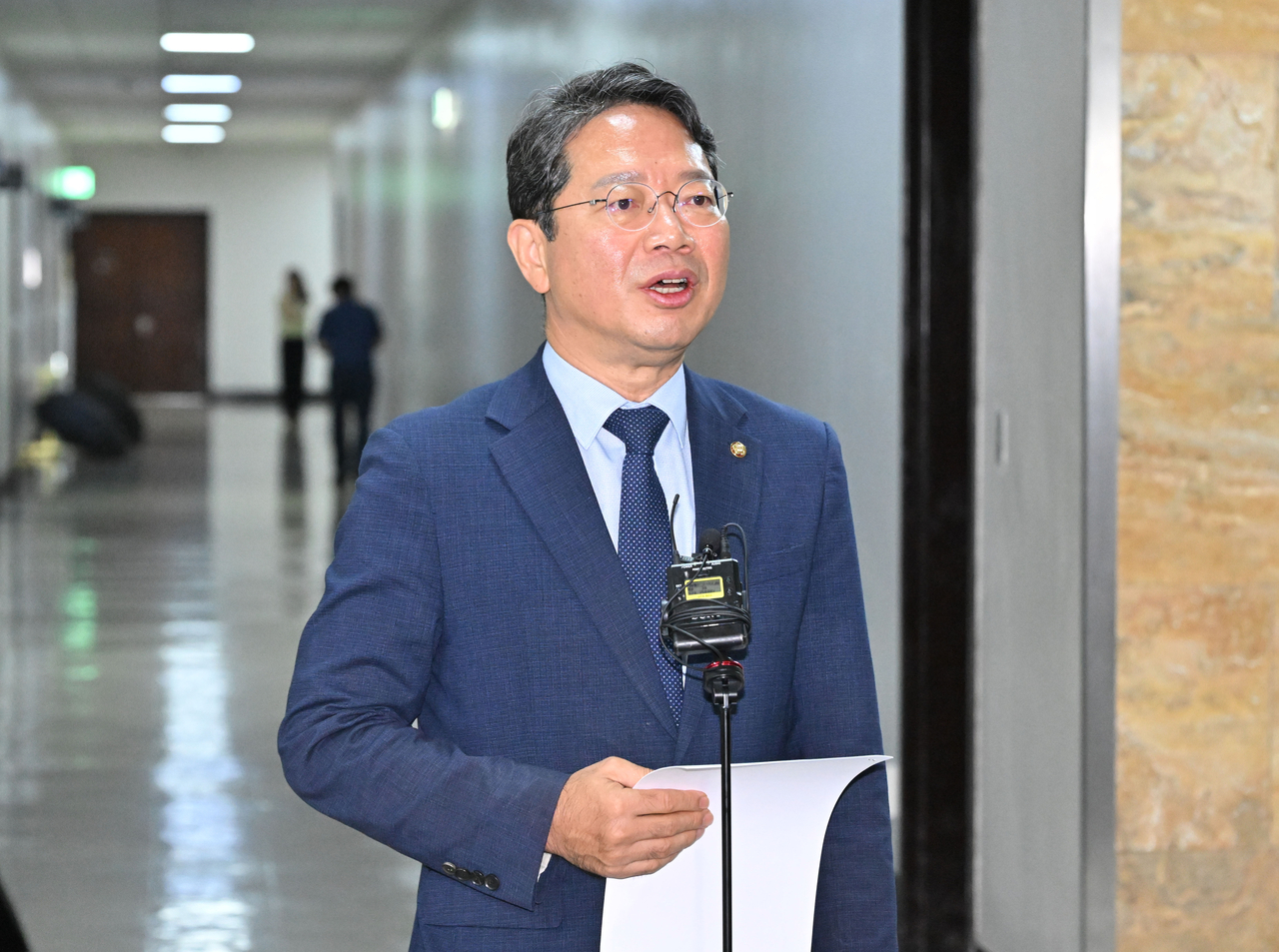
Kim Seung-won, President Lee Jae Myung's nominee for minister of justice, is preparing for his National Assembly confirmation hearing.
The opposition is sharpening its lines of attack on multiple fronts: Kim's past advocacy for dropping criminal charges against President Lee, controversy over his role as defense counsel in a case linked to the Daejang-dong development scandal, and allegations that he lobbied for expedited approval of a COVID-19 drug clinical trial — a matter that once made him the subject of a prosecution investigation. Given that the nominee would oversee the ministry responsible for managing the fallout from a sweeping criminal justice overhaul set for October, lawmakers are also expected to press him hard on policy competence and political neutrality.
According to the Ministry of Justice on Wednesday, Kim will set up his confirmation hearing preparation office on the fifth floor of Jeokseon Hyundai Building on Sajik-ro in Jongno-gu, Seoul, and will begin work there Thursday. The office is the same one used by his predecessor, former Justice Minister Jeong Seong-ho, during his own confirmation process. Cha Beom-jun, the ministry's chief of planning and coordination, will head the preparation team, with Seo Gyeong-won serving as overall team leader and Choi Tae-eun, the ministry's spokesperson, heading communications.
Kim drew more attention than any other nominee in the cabinet reshuffle immediately after his appointment, becoming the focal point of clashes between the ruling and opposition parties. The reason: the co-chair of a lawmakers' group that had publicly pushed to have President Lee's criminal charges dropped was now being nominated to lead the ministry that oversees prosecutors. Kim had served as co-chair of an Assembly members' group formed this year to pursue the withdrawal of charges against President Lee and a parliamentary investigation into related matters.
His stance on that issue is expected to be the central flashpoint at the confirmation hearing, which is scheduled for this month. Opposition lawmakers have already raised concerns that, if confirmed, Kim could use his position to influence the prosecution's handling of President Lee's cases. While the justice minister cannot directly order the withdrawal of charges, the minister is legally empowered to direct and supervise the prosecutor general.
At the hearing, opposition lawmakers are expected to press Kim on whether he still believes the charges against President Lee should be dropped and how he would handle related matters if confirmed. When asked about the issue on Monday, Kim declined to give a direct answer, saying only that he would "assess the ministry's current situation on pending matters before organizing and responding."
![Legislation and Judiciary Committee Chairwoman Seo Yeong-gyo (left) and justice minister nominee Kim Seung-won walk together after the opening ceremony of the 439th regular session of the National Assembly on Tuesday. [Yonhap]](https://wimg.heraldcorp.com/news/cms/2026/09/02/rcv.YNA.20260901.PYH2026090118630001300_P1.jpg)
Another point of contention is Kim's past inclusion in the defense team for Nam Wook, a lawyer and one of the developers at the center of the Daejang-dong scandal. The controversy emerged after it became known that Kim had been listed as part of the defense team — as an attorney at a law firm — in a 2015 case in which Nam faced charges of violating the Attorney-at-Law Act. People Power Party leader Jang Dong-hyeok said on his social media account on Sunday that President Lee had nominated "a Daejang-dong defense lawyer" to lead the Justice Ministry, describing Kim as "the very person who co-chaired the so-called charge-dismissal group."
Kim issued a statement addressing the controversy, acknowledging that he had been listed on the defense team in Nam's 2015 case but explaining that all attorneys at the law firm were formally listed on the retainer as a matter of procedure. He said his involvement was limited to a single consultation visit early in the case at the request of a senior partner, and that he had withdrawn from the defense team in July 2015. He added that he had no role as defense counsel in the main Daejang-dong development corruption case, which only came under investigation and went to trial from 2021 onward.
Kim will also need to publicly address and put to rest allegations that he lobbied for expedited approval of a COVID-19 drug clinical trial — a matter that previously made him the subject of a prosecution investigation.
In October 2021, Kim allegedly contacted the then-commissioner of the Ministry of Food and Drug Safety at the request of an acquaintance, asking that work related to a clinical trial for a COVID-19 treatment being developed by a pharmaceutical company be processed quickly. Prosecutors investigated him on those grounds, and the Seoul Western District Prosecutors' Office issued a deferred prosecution decision against Kim in December 2024.
Independent lawmaker Han Dong-hoon raised the allegations during a budget committee session at the National Assembly on Monday, directing his questions at the Ministry of Justice. Han said prosecutors had investigated Kim over allegations that he relayed a request from an acquaintance to the head of the Ministry of Food and Drug Safety to approve a new COVID-19 treatment, and asked, "Is this the kind of person who should become minister?"
On Tuesday, a press camera captured Kim sending a text message to Legislation and Judiciary Committee Chairwoman Seo Yeong-gyo of his own party on the floor of the National Assembly plenary chamber. The message read: "The core argument of the constitutional complaint is that there is no direct evidence of a 5 million won ($3,650) promise, no actual preferential treatment occurred, and even the court in the related case denied any quid pro quo — yet prosecutors left only a deferred prosecution decision against Assemblyman Kim Seung-won. This is a summary of the Ministry of Food and Drug Safety matter for you, Chairwoman." A follow-up message reading "I am sorry" was also sent.
Kim had previously announced in February last year that he would file a constitutional complaint with the Constitutional Court challenging the deferred prosecution decision against him. A deferred prosecution is a disposition in which prosecutors conclude that the alleged offense is substantiated but determine that the case does not warrant referral to trial, effectively closing it without indictment. Although it is a form of non-indictment, it carries an acknowledgment of criminal suspicion, which means the subject can challenge it through a constitutional complaint on the grounds that the alleged conduct should not have been recognized as an offense in the first place.
![Kim Seung-won, nominated as justice minister, gavels a subcommittee meeting of the Legislation and Judiciary Committee at the National Assembly on Monday. [Yonhap]](https://wimg.heraldcorp.com/news/cms/2026/09/02/rcv.YNA.20260831.PYH2026083106530001300_P1.jpg)
Beyond clearing the allegations against him, Kim also faces the task of stabilizing the criminal justice system following the abolition of the Prosecution Service. The agency, which falls under the Justice Ministry, is set to be dissolved on Oct. 2 and replaced by a new Public Indictment Service. Kim would need to oversee the practical work of reorganizing the structure and personnel and implementing follow-up measures required by the revised Code of Criminal Procedure.
Kim had previously led prosecution-reform legislation as the ruling party's floor leader on the Legislation and Judiciary Committee and as chair of its first bill-review subcommittee. If he clears the confirmation hearing, his role will shift from the lawmaker who designed the legislation to the minister responsible for carrying it out and minimizing its unintended consequences. Kim himself said after his nomination that "ensuring the new criminal justice system — the first in 70 years — takes firm root in Korea is the most urgent mission."
The political burden is also considerable. Kim was nominated to succeed Jeong Seong-ho, who served as the first justice minister under the Lee Jae Myung administration. Unlike Jeong, who was known within the party as a moderate despite being regarded as a close ally of President Lee, Kim has long been seen as one of the more hardline lawmakers in the Democratic Party. Jeong's confirmation hearing was considered relatively smooth, in part because of his reputation for maintaining cordial relations with opposition lawmakers. Kim, by contrast, is likely to face sustained opposition scrutiny over his political neutrality throughout the hearing process.
yg@heraldcorp.com



