Farm, livestock and seafood prices jump sharply before holiday
Dried yellow croaker, squid up 23% and 17% from a year ago
Imported wheat, corn and diesel add to cost pressures
Government launches record support package; experts urge long-term fix
![Shoppers browse a traditional market in Seoul. The government plans to supply 19 key seasonal goods at 1.6 times their normal volume ahead of Chuseok. [Yonhap]](https://wimg.heraldcorp.com/news/cms/2026/09/02/rcv.YNA.20260901.PYH2026090113880001300_P1.jpg)
Food prices are surging ahead of the Chuseok holiday as a string of heat waves and heavy rains drives up the cost of vegetables, fruit, meat and seafood commonly served at ancestral rite tables. Instability in global commodity markets has added pressure on imported raw materials, prompting the government to roll out a record support package to ease the burden on holiday shoppers.
Farm, livestock and seafood prices spike before Chuseok
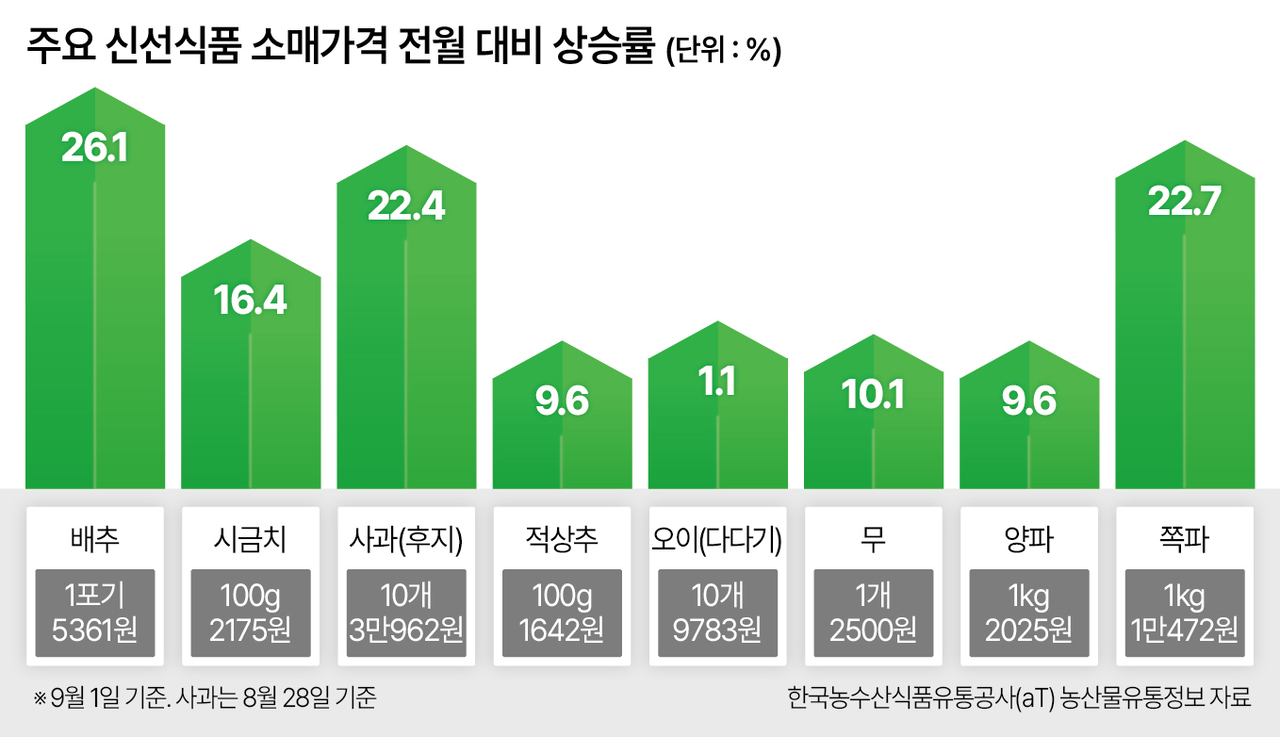
According to Korea Agricultural Marketing Information Service (KAMIS) data released Wednesday, the average retail price of napa cabbage stood at 5,361 won per head as of Tuesday — a 26.1 percent jump from a month earlier. Spinach rose 16.4 percent month-on-month to 2,175 won per 100 grams, while red leaf lettuce climbed 9.6 percent to 1,642 won per 100 grams. Green onions (22.7 percent), mini cucumbers (11.0 percent), radishes (10.1 percent) and regular onions (9.6 percent) also surged over the same period.
Apples — a staple of Chuseok ancestral rite tables — were no exception. The retail price of Fuji apples reached 30,962 won ($23) for 10 as of Friday, more than 22 percent above the previous month's level. Pears edged down slightly from a month ago to 45,389 won for 10 as of Monday, but remain 45.2 percent above the average for this time of year. Rice is trading at 61,238 won for 20 kilograms, up 1.1 percent from a year ago and 10.7 percent above the perennial average.
Data from the Korea Institute for Animal Products Quality Evaluation showed that as of Tuesday, retail prices for grade-1 beef brisket and galbi reached 6,083 won and 6,847 won per 100 grams, respectively. Brisket, commonly used in soups, was 9.8 percent more expensive than a year ago and 11.9 percent above the perennial average. Galbi rose 4.7 percent year-on-year and 1.9 percent above the perennial average. A tray of 30 XL eggs cost 7,228 won, down 0.3 percent from a year ago but still 8.3 percent above the perennial average. Seafood prices also climbed from a year earlier — dried yellow croaker by 23.6 percent, fresh squid by 17.3 percent and hairtail fish by 2.7 percent.
Abnormal weather — extreme heat and heavy rain — has disrupted supply and driven prices higher. According to the Ministry of Interior and Safety, heat waves between May 15 and Tuesday killed about 1.37 million livestock and about 12.26 million farmed fish. Torrential rain and strong winds from Friday caused flooding across 103.9 hectares of farmland and damaged 200 greenhouse facilities. Beef prices have remained elevated due to a shrinking domestic cattle herd, reduced slaughter volumes, lower output from exporting countries such as the United States, and a weak won.
The Ministry of Statistics said Wednesday that its fresh-food price index fell 6.7 percent in August from a year earlier. Fish and shellfish rose 4.1 percent, but vegetables and fruit dropped 9.8 percent and 10.0 percent, respectively. The divergence from KAMIS figures reflects a methodological difference: KAMIS tracks actual transaction prices, while the Ministry of Statistics weights items by category when measuring price changes.
Imported grains and diesel rise, adding pressure on processed food prices
Imported grain prices have also climbed. According to KAMIS, the average September price of hard red winter wheat at the Kansas City Board of Trade stood at $310.6 per ton, a 65.8 percent surge from a year earlier. Corn at the Chicago Mercantile Exchange averaged $205.3 per ton, up 26.1 percent year-on-year. Soybeans and soybean oil rose 28.2 percent and 43.5 percent, respectively, from a year ago.
Wheat and corn futures are trading at their highest levels in three years, driven by heightened military tensions between Russia and Ukraine — the world's largest grain-producing region — which have blocked the Black Sea, a critical grain trade corridor. Corn harvests have also been disrupted by heavy rain and disease in the United States and drought in Europe.
Rising prices for kerosene and diesel, which farmers rely on heavily, are squeezing production costs. According to the Korea National Oil Corporation's oil price information system Opinet, the tax-exempt indoor kerosene price used by greenhouse farmers reached 1,391.33 won per liter as of Tuesday, a 26.4 percent jump from a year earlier. Tax-exempt diesel rose 28.2 percent over the same period to 1,405.29 won per liter.
Higher import costs are feeding through to processed food prices. Food companies have already raised prices, citing increased input costs. Ottogi raised the price of its three-pack germinated brown rice and black rice products sold at convenience stores from 6,800 won to 8,800 won — a 29.4 percent increase — effective Tuesday. Other instant rice products under the Ottogi brand also went up by more than 20 percent. CJ CheilJedang earlier raised prices on some products, including its Hetbahn instant rice line, by an average of 8 percent. Dongwon F&B raised prices on some tuna cans, beverages and other products by an average of 9 to 10 percent, also effective Tuesday. Paldo adjusted the factory price of 12 cup noodle varieties up by an average of 5.5 percent.
![Shoppers browse a hypermarket in Seoul. [Yonhap]](https://wimg.heraldcorp.com/news/cms/2026/09/02/rcv.YNA.20260830.PYH2026083004650001300_P1.jpg)
Climate-driven price spikes keep recurring; experts call for long-term solutions
The government plans to expand discount support and boost the supply of seasonal goods to stabilize food prices ahead of Chuseok. It will inject a record 103 billion won — the largest amount ever — to offer discounts of up to 50 percent on farm, livestock and seafood products. It will also supply a record 183,000 tons of 19 key seasonal goods, including napa cabbage, radishes and apples. An Onuri gift certificate cashback event covering farm, livestock and seafood purchases will be held at 300 traditional markets nationwide, and the government said it is considering additional support measures.
The concern is that this situation is likely to repeat itself every year. Lee Chun-su, a professor of agricultural economics at Suncheon National University, said rising food prices stem from multiple causes but that climate change is ultimately the biggest factor. "The climate crisis will only worsen going forward, so we need measures that can secure supply-and-demand stability from a medium- to long-term perspective," he said.
Lee also warned that higher agricultural prices can hurt farmers by reducing sales volumes. "In that context, releasing stockpiles, cutting tariffs or expanding imports are short-term fixes at best," he said. "Over the medium to long term, they can erode farmers' production capacity and ultimately undermine their ability to cope with the climate crisis."
spa@heraldcorp.com