"For 15 years I have lived as if a nail were driven into my heart," said Ha Deok-hee. "If she is alive and doing well somewhere, that is enough. But I cannot even know that."
Ha's wife left home in 2011 and has not returned in 15 years. She was a nurse at a children's hospital in Seoul and went in for an early-morning shift — then all contact stopped. The couple's two children, who were in middle school at the time, are now adults. His mother, who had lived with the family, died this year. Ha still sends flyers bearing his wife's photo to temples and other locations across the country.
Ha said he filed a missing persons report with police at the time but received little active follow-up, leaving him to search on his own. The case was eventually handled by the Ansan Sangnok Police Station in Gyeonggi Province, which had no particular connection to him, and at some point he learned the case had been closed. In June, he filed a new missing persons report with the Gangdong Police Station, which covers his current neighborhood of Deungchon-dong, and registered his DNA.
The case of Jang Mi-ran, 37, who was reported missing in Jeju and later found dead, has laid bare the gaps in South Korea's system for managing adult missing persons cases. The officer in charge closed the case roughly two hours and 30 minutes after the report was filed, claiming to have contacted Jang in May and confirmed her safety — but no record of that call could be verified. Jang was found dead 104 days after she was reported missing. The same officer is also under investigation on charges of similarly falsifying the closure of another missing persons case involving a man in his 60s. Experts and families of the missing say the system's reliance on individual officers' judgment, and the tendency to treat adult disappearances as simple runaways, must be addressed.
'Just wait — it's probably a runaway': families who have searched for decades
Complaints about the initial classification of adult missing persons cases as "runaways" — and the limited early response that follows — have been raised repeatedly for years among families of the long-term missing. Cho Su-min, daughter of Jeong Mi-ryeong, vanished on Sept. 13, 2002, at age 17, after leaving school. She had arranged to meet a friend but never showed up and did not answer her phone. The family immediately reported her disappearance to a police substation near the school.
Jeong said that when she later visited the police station, she was told in effect to wait because it was probably a runaway situation and that the family should handle it themselves. Using cell tower information provided by police, the family conducted their own search of the surrounding area; officers were eventually deployed as well, but no significant leads were found.
"What I regret most is the initial investigation," Jeong said. Su-min was 17 when she disappeared; if she is alive, she would now be in her early 40s. The family still goes out to search every year. Jeong said a dedicated missing persons unit was established in 2010 but that attention to long-term cases remains insufficient, and called for a separate system specifically for long-term missing persons.
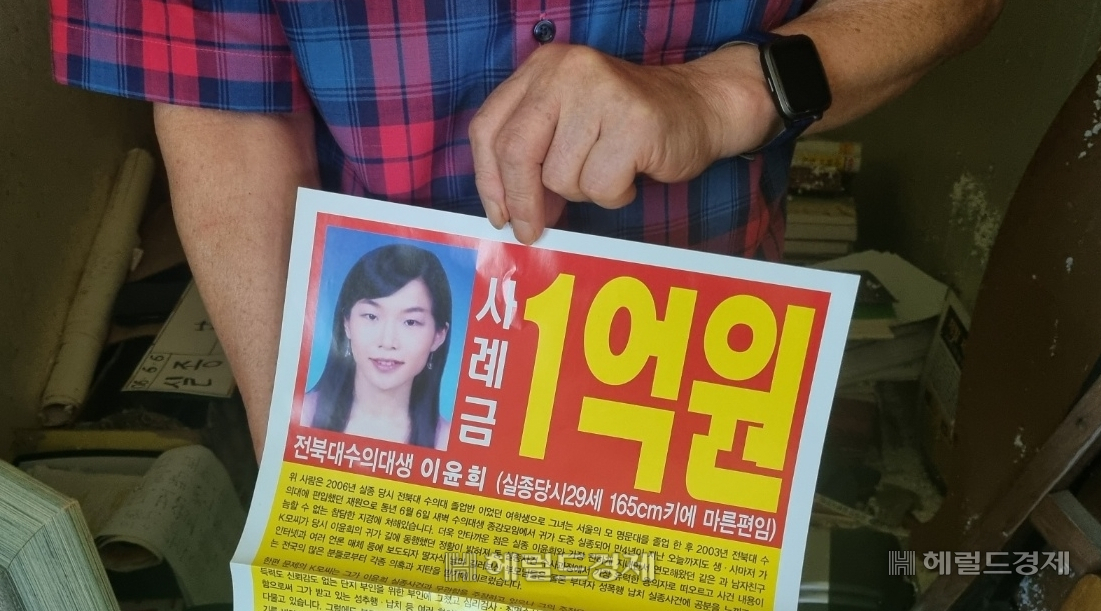
The 2006 disappearance of Lee Yun-hee, then a fourth-year veterinary student at Jeonbuk National University, also remains unsolved after 20 years. Her father, Lee Dong-se, said the scene was not properly preserved and computer access records were not checked in the immediate aftermath, expressing frustration over the initial police response.
Cases in which an adult has voluntarily cut off contact with family are even more complicated. One such case involves Jeon Yong-hee, who was a fourth-year student at Chonnam National University when he left home and lost contact with his family for an extended period. His father said police told him there was little they could do if his son, as an adult, did not want to see his parents. "I am past 80 now," the father said. "I just want to see his face once before I die."
There are cases where a person has chosen to leave family behind, or where — as with victims of domestic violence — their whereabouts must not be disclosed. But families of the missing share a common concern: if police classify a disappearance as a voluntary runaway without adequately checking for signs of crime or accident early on, the window for an effective search can close.
Seo Gi-won, head of the Missing Children Search Association, said adult disappearances involve many different circumstances — family conflict, financial problems and more — and cannot all be treated the same way. "But if police look into things a bit more specifically at the outset, they can determine whether it is a simple runaway or whether there is a possibility the person has been caught up in a crime or accident," he said.
70,000 reports a year, around 1,000 found dead — and too few officers to handle them
Last year, 70,814 missing persons reports involving adults aged 18 and older were filed — a figure that has held steady at roughly 70,000 a year. A significant number of those reported missing are later found dead. According to data released Friday by the Korean National Police Agency on deaths among missing adults, 1,112 people were found dead in 2024 and 931 last year. So far this year, 478 people have already been found dead through July. Of those totals, deaths attributed to crime numbered three, three and one, respectively.
While criminal deaths account for a small fraction, experts say risk factors must be assessed carefully from the moment a report is filed — because many of those reported missing die from accidents, suicide or health emergencies, or simply never return to their families and become cold cases.
Na Ju-bong, chairman of the National Association of Families Searching for Missing Persons and Lost Children, called the Jang Mi-ran case "a foreseeable incident." He said officers in detective and investigative roles build expertise by staying in one area for years, while missing persons officers are rotated through different posts on a regular basis. "It is hard to accumulate expertise, and on top of that the workload is enormous — one or two people handling dozens of cases," he said.

Seo also said that as missing persons work has been shuffled between departments through successive reorganizations, expertise has been difficult to build. "Even when a missing persons investigation team was set up within the women and youth division, it got pushed aside whenever school violence or domestic violence caseloads grew," he said. "The work kept moving — to the serious crimes unit, the mobile detective unit and so on." He added that even when four to six officers are assigned at the station level, shift rotations mean far fewer are actually working at any one time, and called for more personnel.
Families of the long-term missing also say cases are frequently closed without explanation. Ha Deok-hee, who has been searching for his wife for 15 years, said he only learned after the fact that her case had been closed at the Ansan Sangnok Police Station. "My understanding is that there has to be a clear reason to close a case, but I never received a satisfactory explanation for why it was closed," he said. "Watching what happened in Jeju, I found myself wondering how carefully the system for handling missing persons cases is actually being managed."
The Jeju case also exposed problems in the oversight of case closures. Procedures already existed requiring officers to report case outcomes to supervisors, but there was no step requiring a supervisor to review and approve the removal of a case from the missing persons profiling system. After the incident, police revised the system to require supervisory approval before a case can be closed, and introduced an interim measure requiring the head of the detective division to confirm case outcomes in writing until the new system is in place.
Four adult missing persons bills pending — but 'legislation alone is not enough'
Beyond staffing and procedures, the lack of a legal framework is also seen as a pressing problem. No law specifically governs missing persons cases involving ordinary adults. The existing Act on the Protection and Support of Missing Children covers those under 18, along with some people with disabilities and dementia patients — leaving ordinary adults outside any dedicated legal protection system.
To address the gap, four lawmakers in the 22nd National Assembly have introduced legislation on adult missing persons: Democratic Party lawmakers Lim Ho-seon, Heo Seong-mu and Yang Bu-nam, and People Power Party lawmaker Lee Dal-hee. The bills differ in their details, but their core provisions are similar — establishing an information system for missing adults and creating a legal basis for collecting location and movement data, as well as conducting DNA tests, for missing persons who meet certain criteria.
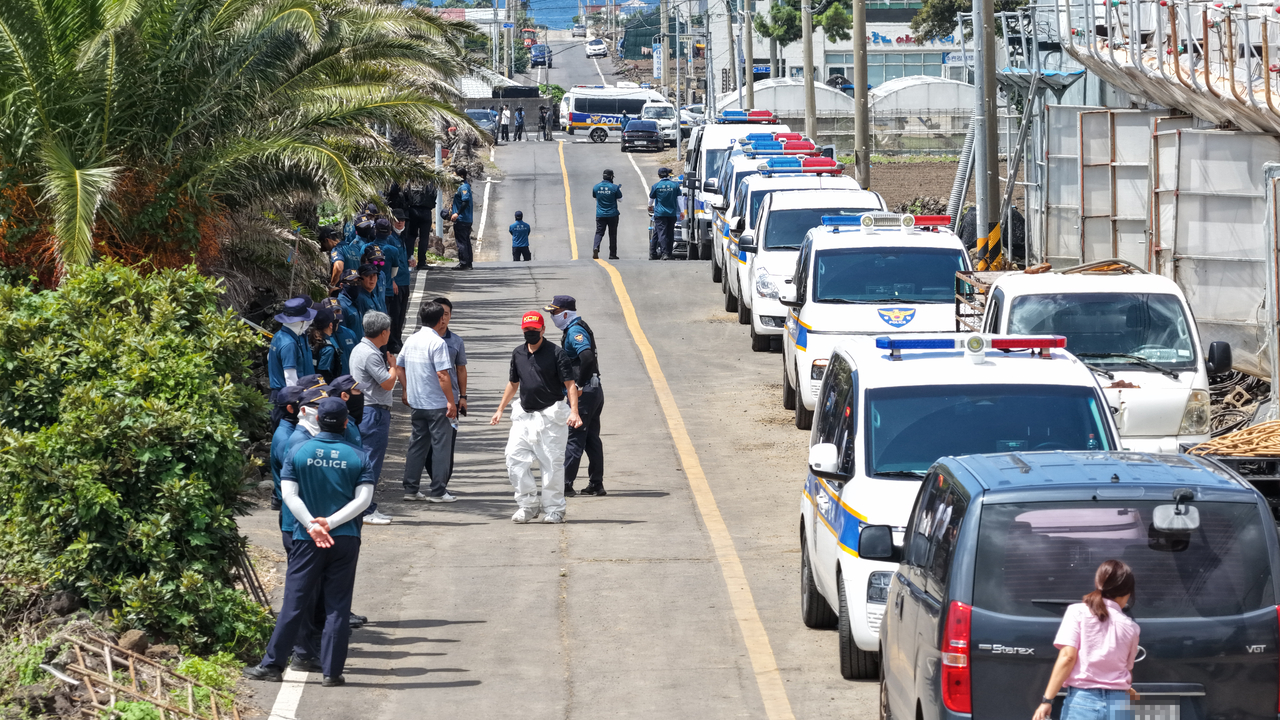
The Jang Mi-ran case has renewed attention to legislative efforts that had stalled. Democratic Party floor leader Han Byung-do said Thursday that the case had "brought renewed focus to the long-standing legislative need created by the absence of an adult missing persons law," and pledged to review the entire process — from the filing of a report through search, investigation and case closure — and to establish an information-sharing framework among police, local governments and the Ministry of Interior and Safety. A representative of lawmaker Yang Bu-nam's office said the adult missing persons bills are scheduled to be taken up by the interior affairs committee's legislation subcommittee in September.
Organizations that have supported families of the missing are also calling for more personnel and funding alongside new legislation. Seo said that without a dedicated law covering adult missing persons, "legislation must be accompanied by the people and budget to actually move on the ground." Na also urged the swift review and passage of the relevant bills.
Some experts caution, however, that legislation alone will not solve the problem. Im Jun-tae, a professor of police administration at Dongguk University, said that while clear legal standards would create corresponding duties and responsibilities for officers, there is a risk of "legislative omnipotence" — the assumption that passing a law will immediately change how things work on the ground.
"Adult disappearances stem from a wide range of causes — family conflict, debt and more — and verifying every case at the same level would require considerable manpower," Im said. "Law and guidelines must be backed by training for frontline officers and by specialist personnel." He also suggested that smaller police stations, which struggle to maintain dedicated missing persons staff, could be supported by regional specialist teams that handle missing persons cases across multiple stations.
Families of the long-term missing are also asking for sustained case management. Jeong Mi-ryeong, who has been searching for her daughter for 24 years, said: "If there were people dedicated to long-term missing cases and they resolved even one case a year, that would be a significant thing." Ha Deok-hee added: "I hope not just police but local governments and various agencies will work together and pay attention."

jookapooka@heraldcorp.com
kido@heraldcorp.com