Small-business version to expand to firms with under 100 workers starting next year
Eligibility retained even if workforce grows beyond threshold after enrollment
Individual IRP open to self-employed workers and freelancers
![Park Jong-gil, president of the Korea Workers' Compensation and Welfare Service, center, poses with executives and employees after signing up for the Pureun Ssiat IRP during a "One Account per Person" campaign held at the agency's headquarters on Tuesday. [Korea Workers' Compensation and Welfare Service]](https://wimg.heraldcorp.com/news/cms/2026/08/27/news-p.v1.20260825.2e67d99ef7ec412589eec7fc01ec8735_P1.jpg)
The eligibility criteria for "Pureun Ssiat" (Blue Seed), a public pension fund for small and medium-sized enterprises, are being gradually broadened. The workplace-based SME retirement pension fund currently accepts companies with fewer than 50 full-time employees, and starting next year the threshold will rise to fewer than 100. Employers that enroll and later grow beyond the limit will retain their existing membership.
A separate individual retirement pension (IRP) product was also launched last month, opening the fund to a wider public. Workers not employed at small businesses — including the self-employed, labor providers, platform workers and freelancers — can now join the individual version of Pureun Ssiat as long as they earn an income.
Pureun Ssiat is a publicly managed retirement pension fund operated by the Korea Workers' Compensation and Welfare Service. It pools contributions from multiple small businesses into a single fund and invests them through professional asset managers. The scheme was introduced in 2022 to give small businesses — which often lack the resources to design and manage their own retirement plans — access to professional asset management services.
Like a defined-contribution (DC) pension plan, employers contribute at least one-twelfth of each worker's annual wages. Unlike a standard DC plan, where individual members choose and manage their own financial products, Pureun Ssiat pools contributions from multiple workplaces and has professional managers invest them collectively.
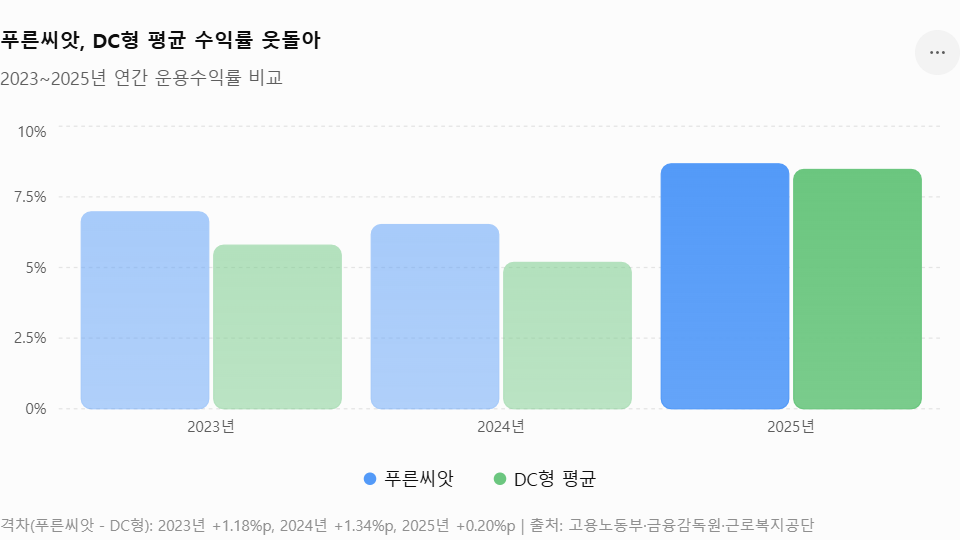
Since its launch, Pureun Ssiat has grown to approximately 190,000 members with accumulated reserves of about 1.9 trillion won ($1.37 billion), the Ministry of Employment and Labor said Thursday. Annual returns were 6.97 percent in 2023, 6.52 percent in 2024 and 8.67 percent last year.
Over the same period, the average return for all DC-type retirement pensions was 5.79 percent, 5.18 percent and 8.47 percent, respectively. Pureun Ssiat outperformed the DC average by 1.18 percentage points in 2023, 1.34 percentage points in 2024 and 0.20 percentage points last year.
Enrolled with 45 workers, now at 60 — do you lose eligibility?
Eligibility for the workplace-based Pureun Ssiat fund is being expanded in stages. Initially, only companies with 30 or fewer full-time employees could join, but the threshold widened to fewer than 50 starting July 1.
Companies with between 31 and 49 full-time employees can newly enroll through the end of this year. From Jan. 1 next year, the eligible pool will expand further to companies with fewer than 100 employees — meaning firms currently excluded with 50 to 99 workers will also be able to join.
A natural question arises: what happens to a company that enrolled when it had 45 employees and has since grown to 60?
The short answer is that it does not need to withdraw. The Korea Workers' Compensation and Welfare Service says a company that met the headcount requirement at the time of enrollment retains its membership even if its full-time workforce later exceeds the threshold. The same applies to companies that joined when the limit was 30 or fewer and have since grown past 50 or even 100 employees.
For new applicants, however, the headcount at the time of enrollment determines initial eligibility. Companies wishing to join this year must have fewer than 50 full-time employees at the time of application. Those currently at 50 or more will have to wait until January, when the ceiling rises to 100.
It is also worth noting that the number of employees on payroll does not always match the statutory definition of "full-time employees" used to calculate eligibility. Hiring additional staff does not automatically increase the statutory headcount by the same amount, so companies should verify their official count separately before applying.
Eligible companies are not automatically enrolled, either. Joining is voluntary: an employer must obtain consent from the workers' representative and then sign a contract with the Korea Workers' Compensation and Welfare Service.
Companies running a defined-benefit (DB) or DC retirement pension plan that wish to switch to Pureun Ssiat must sign a new contract and transfer existing reserves from their current financial institution, a process that also requires tax treatment of the transferred funds. Employers should obtain genuine, substantive consent from workers' representatives — a perfunctory sign-off could trigger disputes over the validity of the plan change.
Pureun Ssiat individual IRP: self-employed can join too — here's what to know
The workplace-based SME retirement pension fund and the Pureun Ssiat individual retirement pension (IRP) are separate products.
The Pureun Ssiat IRP, which launched July 1, is open not only to salaried workers but also to the self-employed, labor providers, platform workers, freelancers and anyone else with an income. Eligibility is unrelated to the size of one's employer or whether that employer offers a retirement pension plan.
The defining feature is that members do not need to compare and select individual financial products such as deposits or funds on their own. The Korea Workers' Compensation and Welfare Service allocates assets and manages risk through a dedicated investment manager in response to market conditions, reducing the burden on members who find it difficult to pick and monitor investment products themselves.
The fund continues to manage remaining reserves even after a member begins drawing a pension. Rather than winding down asset management at retirement, the structure keeps assets invested throughout the payout period, slowing the depletion of retirement savings over the long term.
The same tax benefits that apply to standard IRPs are available here. Personal contributions, combined with pension savings accounts, are eligible for a tax credit on up to 9 million won per year. The credit rate is 15 percent for workers with total annual wages of 55 million won or less, or for members with aggregate income of 45 million won or less; it drops to 12 percent above those thresholds. The actual credit amount varies depending on income and contribution levels.
Professional management does not guarantee returns, however. The value of accumulated reserves can rise or fall depending on investment performance, and as a long-term retirement account, early withdrawals are subject to restrictions.
As of Tuesday, 853 people had signed up for the Pureun Ssiat IRP since its July 1 launch. The Korea Workers' Compensation and Welfare Service plans to hold information sessions at regional offices and affiliated hospitals through September to expand public awareness of the product.
This article is part of a series that explains useful policy information in plain language, examining the background behind policy proposals, the significance of changes, and guidance on who can use them, when and how.
fact0514@heraldcorp.com