
The supply-and-demand landscape of the Kosdaq market, long regarded as the exclusive domain of retail investors, is shifting. The share of total trading value attributable to individual investors has fallen by more than 10 percentage points over two years, while the shares held by foreign and institutional investors have both expanded. With capital inflows through ETFs also rising, analysts say the Kosdaq's investor base — once overwhelmingly retail — is diversifying.
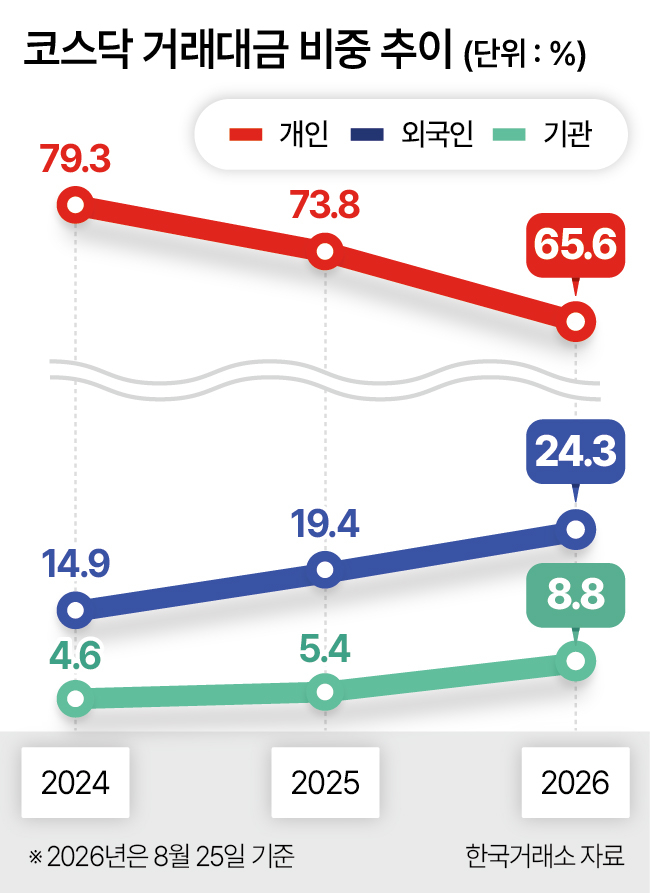
According to Korea Exchange, retail investors accounted for 65.6 percent of total Kosdaq trading value from the start of this year through Tuesday. That figure stood at 79.31 percent in 2024, slipped to 73.8 percent last year, and has now fallen to the mid-60s.
Foreign and institutional investors have filled the gap. The foreign investor share rose from 14.92 percent in 2024 to 19.4 percent last year and 24.3 percent so far this year. The institutional share climbed from 4.61 percent to 5.4 percent and then to 8.8 percent over the same period. The simultaneous expansion of both groups signals a structural shift in Kosdaq's supply-and-demand dynamics.
Retail investors still dominate Kosdaq relative to the main Kospi board. As of Tuesday, individual investors accounted for just 39 percent of Kospi trading value, with foreign and institutional investors making up 24 percent and 35 percent, respectively.
ETF inflows are also underpinning Kosdaq demand. According to Mirae Asset Securities, as of Aug. 16, there were 42 ETFs that either track the Kosdaq index or hold Kosdaq-listed stocks at a weight of 70 percent or more. Their combined assets under management stood at 14.2 trillion won ($10.3 billion), a 3.8-fold increase from 3.8 trillion won at the end of last year.
"Kosdaq ETF listings and capital inflows continue to grow, and ETFs beyond those that directly track the Kosdaq index are also increasing their exposure to Kosdaq-listed stocks," said Yoon Jae-hong, a researcher at Mirae Asset Securities.
Kosdaq has recently outpaced Kospi by a wide margin. The Kosdaq index rose 14.92 percent from the start of this month through Tuesday, compared with a gain of just 2.23 percent for Kospi over the same period. After breaking above the 1,200 level in April, the index underwent a sharp correction and fell to around the 640 level last month before staging a rebound and rapidly recovering its losses.
Analysts attribute the recent rally largely to a shift in supply-and-demand conditions. Regulations on single-stock leveraged ETFs eased the concentration of flows into large-cap Kospi stocks, redirecting capital toward Kosdaq, which had been relatively overlooked.
Securities analysts say the earnings picture also supports renewed attention to Kosdaq. "The combined operating profit of all Kosdaq-listed companies rose 62.4 percent year-on-year in the first half of this year," said Na Seung-du, a researcher at SK Securities. "The reason Kosdaq was overlooked for so long was not an earnings problem but a supply-and-demand and investor-attention problem. With profits now proven in the numbers, there is no reason to keep turning a blind eye."
Some analysts also expect Kosdaq-listed companies to post faster profit growth than their Kospi counterparts next year. "Kospi's operating profit growth rate is expected to peak at 226 percent this year before slowing to 34 percent next year," said Heo Jae-hwan, a researcher at Eugene Investment & Securities. "Kosdaq's operating profit growth rate will also slow, from 82 percent this year to 38 percent next year, but it will still outpace Kospi."
Heo added that IT home appliances, chemicals, utilities and cosmetics — sectors with strong earnings expectations for next year — deserve continued attention.
According to FnGuide, the consensus operating profit estimate for Kosdaq-listed companies this year stands at 14.18 trillion won, up 68.21 percent from a year earlier. That figure is projected to rise to 19.13 trillion won next year.
moon@heraldcorp.com




