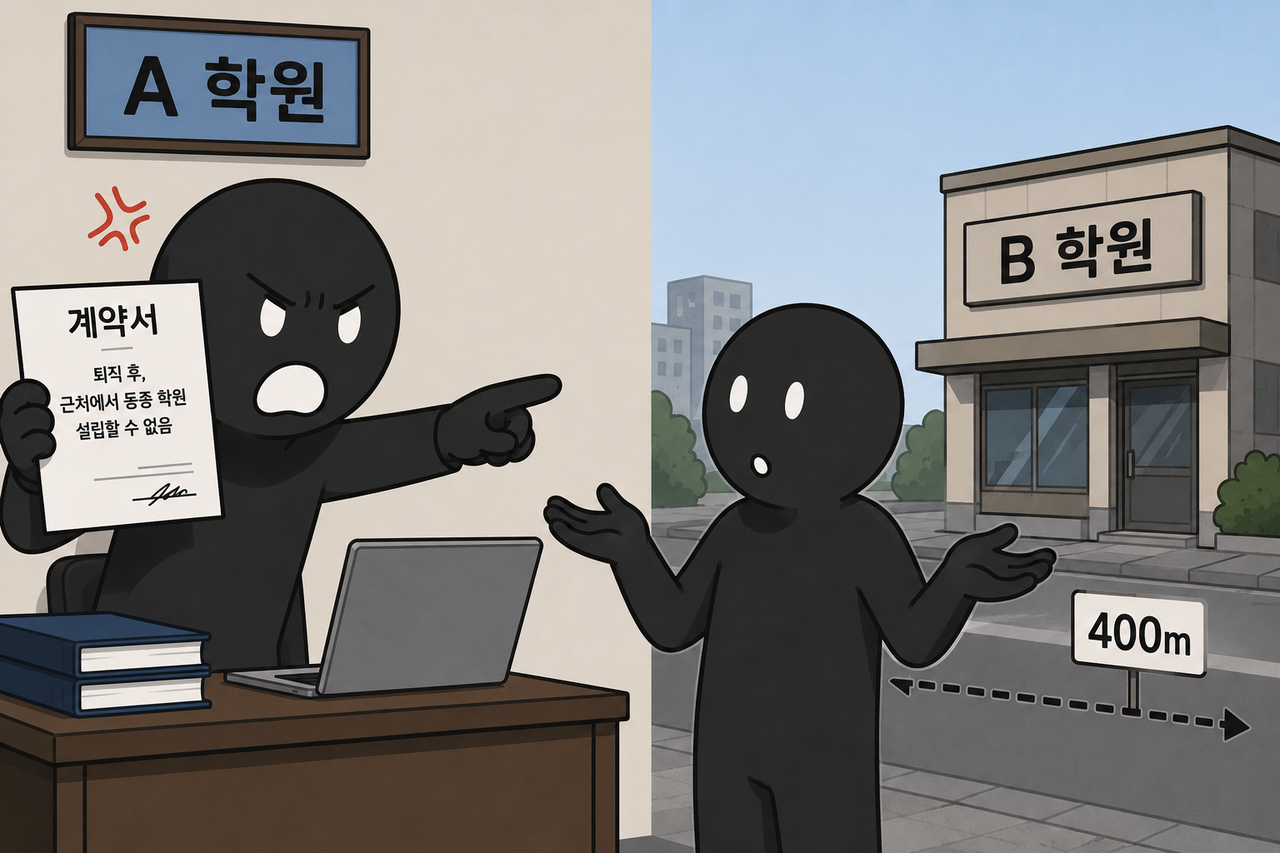
A court has ordered an English-language hagwon instructor to pay 26 million won ($18,800) in damages after he left his employer and immediately opened a competing hagwon just 400 meters away. The instructor argued the non-compete clause infringed on his freedom to choose his occupation, but the court ruled that his conduct — including actively luring students away from his former employer — made him heavily liable.
Judge Lee Gang-min of the Seoul Northern District Court's Civil Division 5 ruled partly in favor of hagwon owner A on July 10, in a damages suit A filed against instructor B seeking 50 million won in compensation.
According to facts established by the court, A operated an English hagwon in Seoul serving elementary and middle school students. Instructor B worked there as an English teacher for seven months beginning in January 2023. Under the employment contract, B was prohibited from taking a job at or opening a competing hagwon within a 5-kilometer radius for two years after leaving. A breach would require B to pay 50 million won in damages.
B violated that agreement.
Immediately after resigning, B opened an English hagwon 400 meters from A's school. Beyond simply opening the new school, B was found to have actively recruited students from his former employer. B contacted students, offered advice on English study methods, and persuaded them to switch to his hagwon, which he described as being closer to their homes. A significant number of students were found to have transferred as a result.
A learned of this and went to confront B in May 2024. The two parties drew up a written pledge at that meeting. B promised to close the hagwon within one month and to stop contacting A's students. If B failed to comply, he agreed to pay 50 million won plus any additional damages suffered by A's hagwon.
B broke that pledge as well. A sent a formal notice demanding compliance, but B ignored it. B was found to still be operating the English hagwon at the same location under a registered business.
A ultimately filed a civil lawsuit against B, demanding that B pay 50 million won as stipulated in the employment contract and the written pledge. The court sided with A.
The court found that "B opened an English hagwon 400 meters from the former workplace immediately after resigning, which constitutes a recognized violation of the contractual non-compete obligation," and ruled that B must pay damages.
The court added that "B's conduct was not simply a matter of taking a job at a nearby competing hagwon as an instructor, but of opening a competing hagwon himself," and said the violation was made more serious by the fact that B had gone on to lure away students after opening.
The court further said that had B honored the agreement, students who attended A's hagwon might have continued there rather than transferring. It found that the non-compete clause represented a legitimate interest worth protecting — one designed to prevent student attrition and maintain A's revenue.
During the trial, B argued that the contract and pledge were void because they had been signed under duress, but the court rejected this, finding no evidence that B had acted out of fear.
B also argued that actual damages had not been proven, and that his hagwon specialized in English conversation for adults and therefore did not compete with A's school. The court rejected both claims.
The court said actual damages did not need to be proven and that harm to A was sufficiently established in any case. It also noted that a large number of students from A's hagwon had transferred to B's.
On the freedom-of-occupation argument, the court said that removing such restrictions would lead to frequent poaching of popular instructors among competing hagwon, and warned this "could disrupt the commercial order of the hagwon industry and infringe on students' right to uninterrupted instruction."
However, the court reduced the damages award to 26 million won, saying the actual loss suffered by A appeared to be well below 50 million won.
Even so, the court cautioned that reducing the award too steeply "could render non-compete agreements ineffective," adding that doing so "would not only run counter to the principle of contractual respect but would also be socially undesirable."
The ruling has not yet been finalized. B filed an appeal on July 20, and a second hearing is set to be held at the Seoul Northern District Court.
notstrong@heraldcorp.com