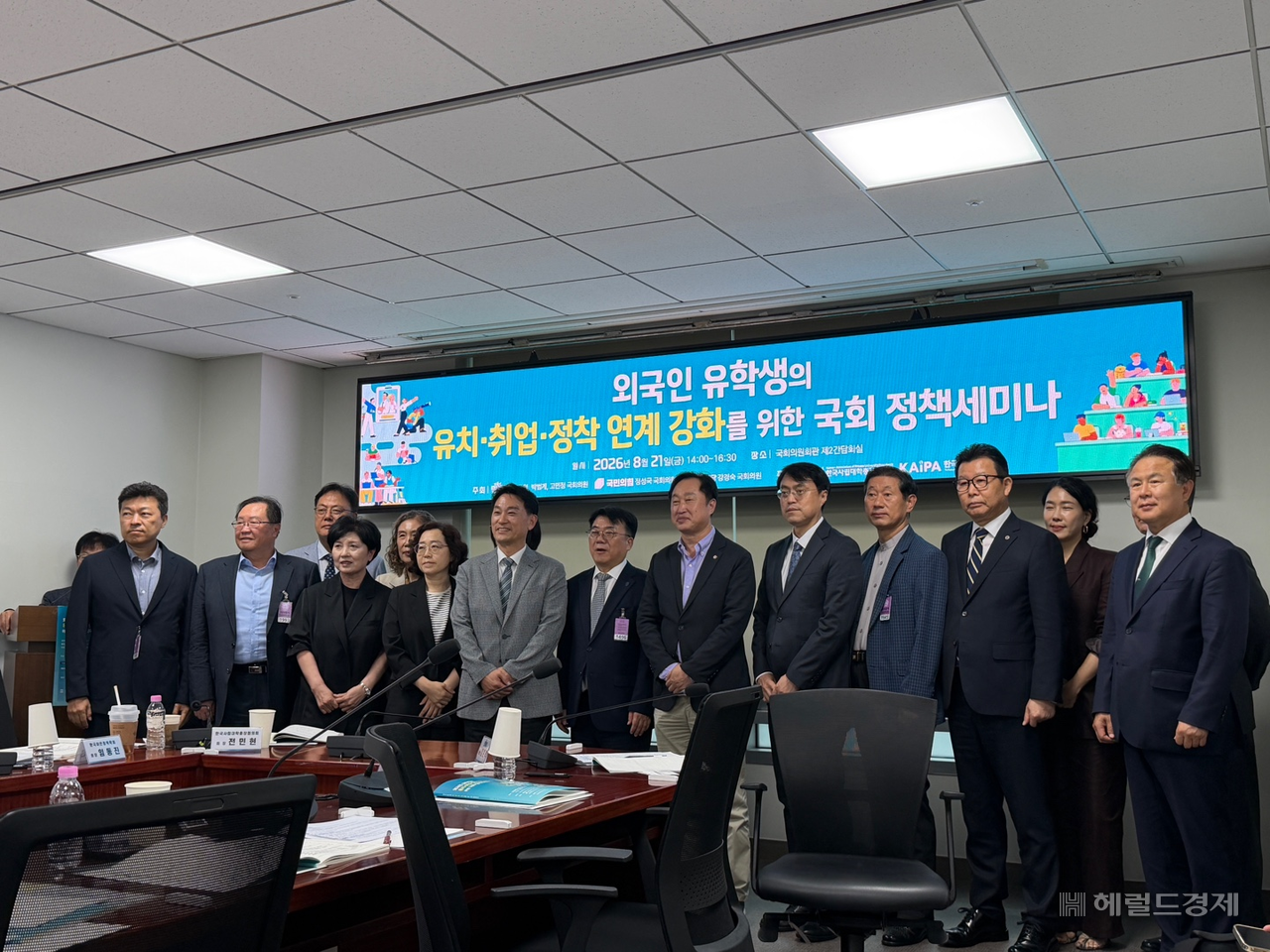
As South Korea's foreign student population reaches 300,000, voices from university campuses are calling for a fundamental shift in policy — away from recruitment targets and toward a system that supports students through education, employment and regional settlement.
The Korean Council for University Education and the Korean Association for Immigration Policy co-hosted a National Assembly policy seminar Friday afternoon at the National Assembly Members' Office Building in Yeongdeungpo-gu, Seoul, to discuss ways to strengthen the link between foreign student recruitment, employment and settlement.
The seminar focused on problems universities face after students arrive and what can be done about them. Moon Seong-je, president of Sunmoon University, said current policy has become structurally fixated on recruitment because regional universities are fighting for survival as the school-age population shrinks. "Right now, universities are essentially poaching students from one another," Moon said. "We need a properly designed system that allows universities to recruit international students, educate them and run programs that help them settle in the local community."
Moon also said some universities hold a single day of in-person classes and then shift to online instruction, in effect leaving students to fend for themselves. "We need to seriously ask whether this is consistent with the spirit of Study Korea 300K and the Education Internationalization Certification system," he said. The government's Study Korea 300K initiative, announced in 2023, aims to attract 300,000 foreign students by 2027. Ministry of Justice statistics show the number had already reached around 310,000 as of February this year.
Participants also raised the problem of students recruited by regional universities migrating to the Greater Seoul area. Lee Jeong-gi, president of Kosin University, said regional universities face a "triple burden" of recruiting, retaining and finding jobs for foreign students. Students prefer universities in the Greater Seoul area, those universities are aggressively competing for international enrollment, and regional universities face additional difficulties even at the visa application stage, he said.
"Students prefer the metropolitan area over the regions, and universities there are going on the offensive to recruit international students," Lee said, calling on authorities to apply more flexible visa and recruitment rules for regional universities to curb the concentration in Greater Seoul. The common view among those at the seminar was that a missing link exists between bringing students to the regions and keeping them there.
Ryu I-hyeon, a research fellow at the Democratic Research Institute's policy research division, said student policy should be designed to cover not just recruitment numbers but also academic quality and students' life paths after graduation.
Ryu noted that fewer than 30 percent of foreign students at two-year colleges nationwide meet Korean language proficiency requirements, and said "qualitative expansion must mean quality of study and work, not just recruitment volume." Students who lack adequate Korean language skills and subject-matter competency will struggle to find employment after graduation, ultimately limiting their ability to settle in South Korea.
Government to unveil comprehensive foreign student policy in September
In response, the Ministry of Education said it would shift foreign student policy from quantitative recruitment to qualitative growth. Choi Ha-young, the ministry's director for education internationalization, said simply growing the number of foreign students would not automatically solve population decline or industrial labor shortages, and that the government must strategically recruit and develop talent in fields where the country and its regions have genuine needs.
To that end, the ministry said it would give greater weight in the Education Internationalization Certification system to students' Korean language and subject competency and to universities' efforts to prevent dropouts. It also plans to crack down on improper academic management — such as holding classes only once a week or relying primarily on online instruction. The ministry will additionally pursue measures to help students build subject, language and vocational skills while enrolled so they can move into employment after graduation.
The Ministry of Justice said it would also establish a visa framework linking study, employment and settlement. Lee Hyang-suk, head of the stay management division at the ministry's immigration policy bureau, said foreign student policy "is not simply an education policy but a complex administrative matter where workforce, diplomacy and regional policy intersect," adding that the ministry would treat foreign students as core prospective members of the workforce and combine oversight with support.
The ministry plans to introduce a wide-area visa system — building on its existing region-specific visa — under which local governments would identify regional strategic industries and labor needs, then work with universities to select and recommend students, with study visas linked to subsequent work visas. The ministry said its analysis of foreign graduates' academic and employment paths over the past five years found that more than half of those who found work tended to settle in the region where their university was located, and it intends to use that finding to inform regional settlement policy.
The government plans to release a comprehensive package in September covering the qualitative transformation of foreign student policy and measures to recruit, develop, employ and settle talented international students.
newday@heraldcorp.com