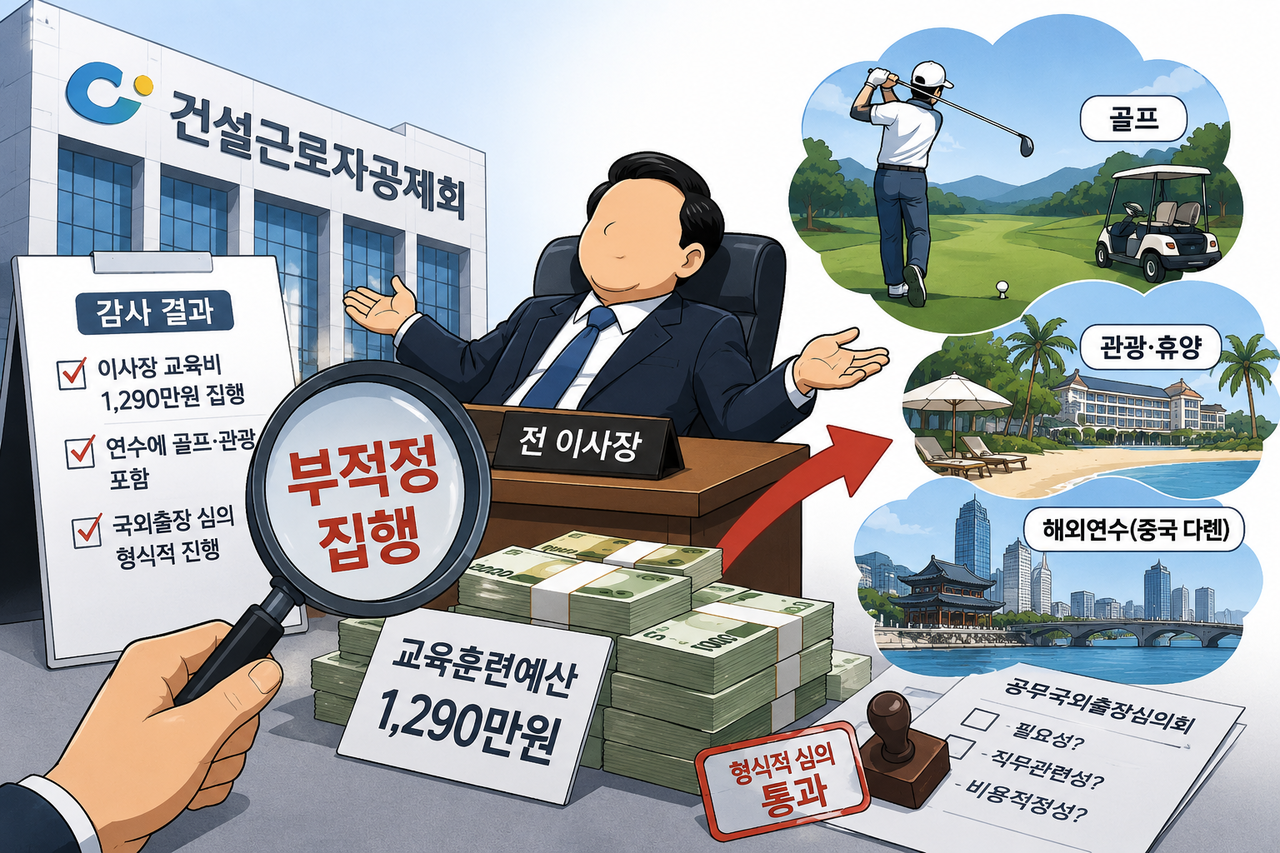
A Ministry of Employment and Labor audit has found that the Construction Workers' Mutual Aid Association spent 12.9 million won ($9,260) from its employee training budget to enroll its former chairman in an executive education program — a course that included domestic and overseas retreats centered on golf and sightseeing alongside regular classes.
The ministry's audit office flagged the spending in an audit report on the association published May 18, citing problems with how training funds were used for the former chairman's CEO course and how overseas official travel was reviewed.
The audit report found that the association drew 12.9 million won from its training budget to cover the former chairman's enrollment in the CEO program. The core issue was who the training budget was actually meant for.
The association's 2025 training plan applies to its employees. Under the association's employment rules and personnel regulations, the ministry said, executives are in principle not eligible for training under that plan.
The association's code of conduct and ethics guidelines also prohibit executives and employees from using association assets for personal purposes or spending its budget on activities outside its intended scope.
Despite this, the association spent 12.9 million won from the training budget on the former chairman's CEO course enrollment.
Beyond regular classes, the program included domestic and overseas retreats. The orientation workshop was held at Sono Felice in Hongcheon, Gangwon Province, and a Jeju retreat took place at Aden Hill Resort. The overseas component included a trip to Dalian, China.
The ministry said these extracurricular activities amounted to "a junket-style program centered on golf and sightseeing."
The review of overseas official travel for the China trip was also found to have been inadequate.
Under government guidelines on public institution reform, public institutions must establish a review committee and conduct advance scrutiny of the necessity and appropriateness of overseas official travel.
The ministry determined, however, that a review committee meeting held April 16 last year had approved the overseas trip without substantively examining its necessity, job relevance or cost appropriateness — making it little more than a formality.
The ministry concluded that training funds had been spent on a CEO program with insufficient job relevance and necessity, and that the overseas travel review had approved a junket-style trip without properly assessing whether it was necessary or work-related.
Association funds were also used to cover a gathering the former chairman held with fellow participants in the CEO program.
The audit found that the former chairman organized a gathering composed entirely of fellow CEO program participants, ostensibly to build camaraderie, and spent 907,400 won of association funds on it. The ministry deemed this an improper use of the budget for social networking and relationship-building.
In response, the ministry directed the association to establish internal rules governing training standards, approval procedures, budget categories, advance review criteria and post-training management requirements applicable to executives including the chairman.
The ministry also called for clawbacks: 300,000 won improperly paid for junket-style activities with no recognized job relevance, and 907,400 won spent on the networking gathering, are both to be recovered.
Disciplinary action was also called for against the individuals involved. Staff responsible for failing to properly review the appropriateness of the CEO program and for lax oversight of training fund disbursements, as well as those who neglected their duties in reviewing the overseas travel, were each issued a "Caution."
Managers who failed to adequately review the CEO program and the propriety of the spending, along with committee members who rubber-stamped the overseas travel review, were directed to receive either a warning or disciplinary action. The association was also told to strengthen internal controls, including advance reviews of budget expenditures and performance management.
The Construction Workers' Mutual Aid Association is a public institution that administers a retirement mutual aid program for construction workers and provides welfare and vocational training services.
The association's current head is not the former chairman cited in the audit. The association appointed Jang Geon as its new chairman in April. The CEO program spending flagged in the audit report took place during the tenure of his predecessor.
fact0514@heraldcorp.com