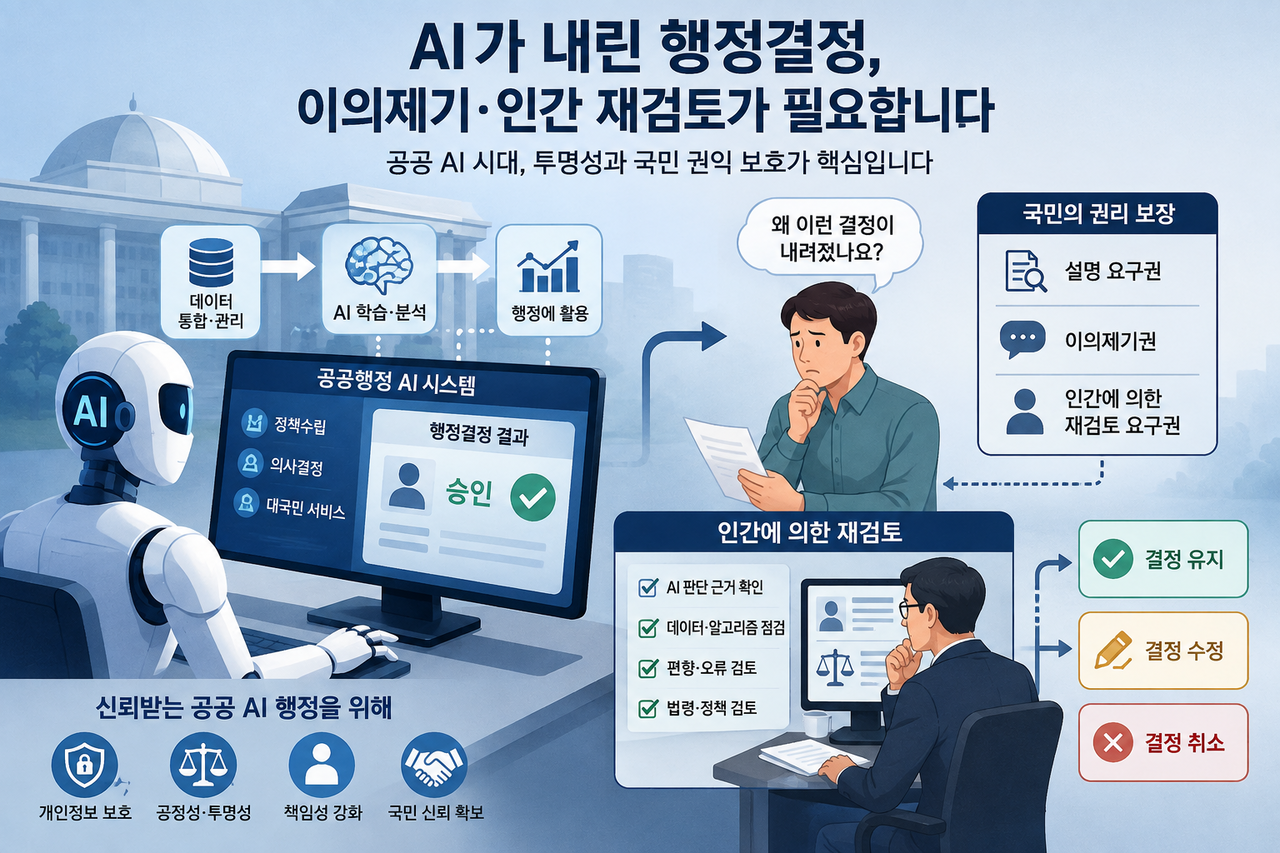
South Korea will establish a formal legal basis for using AI in policymaking and administrative decision-making when a new law takes effect Friday, marking a significant expansion of AI use in the public sector.
But critics say the legislation falls short on a key question: what recourse do citizens have when an AI system influences a decision that affects their rights or obligations — and can they demand a human review it?
According to the National Assembly Research Service, the Act on the Promotion of Artificial Intelligence and Data-Based Administration — an amendment to the existing data-based administration law passed in January — takes effect Friday. The law's core aim is to build an institutional foundation that goes beyond data use to actively promote the adoption and application of AI across the public sector.
Under the amended law, the government's scope for using AI will broaden considerably. AI-related provisions will be added to the framework governing the construction and operation of integrated data management platforms, and public institutions will be able to build shared infrastructure for jointly adopting and using AI. The law also establishes a basis for requiring heads of public institutions to secure adequate quality standards for data used in AI training.
The law introduces safeguards for when AI is applied to policy judgments. Even when public institutions use AI in policymaking or decision-making, final authority and accountability remain with the institution itself. Institutions must consider personal data protection, AI and data bias, and decision-making transparency, and are required to establish ethical guidelines for AI use.
Particularly notable is the introduction of a "public-sector AI impact assessment," which requires institutions to examine the potential effects on citizens' fundamental rights before deploying an AI service — a mechanism designed to detect in advance any risk that AI use in administrative settings could infringe on citizens' rights and interests.
The concern, however, is what happens after an AI system goes into operation. The data an AI system uses, the environment in which it runs, and its performance can all change over time. A system deemed problem-free at deployment may develop new errors or biases once it is actually in use.
Yet the current regime places most of its weight on pre-deployment impact assessments. Critics say there is no adequate system for continuously monitoring errors, biases or unexpected outcomes that emerge during operation, nor for conducting post-deployment reassessments.
The question of how citizens can challenge AI-driven decisions also remains unresolved. When AI is used in an administrative decision that affects a person's rights or obligations, the law does not sufficiently address whether that person can demand an explanation of how the decision was reached, file an objection, or request that a civil servant or other human being review the matter afresh.
Blind spots exist in the AI impact assessment regime as well. Assessments may be waived for matters involving national security, defense or other areas requiring a high degree of confidentiality, as well as for routine, repetitive or minor matters. Whether to grant an exemption is left largely to the discretion of the head of the institution concerned, and while consultation with the Interior and Safety minister is required when an assessment is skipped, the outcome of that consultation is not binding on the institution.
Data — the foundation of AI-driven administration — presents its own unresolved challenges. Under the current regime, whether to register data needed for shared use on the integrated data management platform is largely left to each public institution's own judgment. Institutions can also refuse to share data with other agencies when other laws classify it as confidential or restrict its use for purposes other than those originally intended.
While such restrictions are unavoidable for reasons of national security and personal data protection, critics warn that if the grounds for refusal are applied broadly, individual institutions may become reluctant to share data, potentially entrenching the existing "data silo" problem rather than dismantling it. Ultimately, this could make it harder to secure the volume of data needed to develop and deploy AI effectively.
Quality control standards for AI training data also need to be made more concrete. The amended law requires heads of public institutions to secure an "adequate quality level" for training data, but what that standard actually means remains vague, and no delegating provision has been established to spell out the specific measures required.
If training data contains inaccuracies, underrepresentation of certain groups or pre-existing biases, an AI system will learn from those flaws and may amplify and reproduce errors or discriminatory outcomes. Disparities in quality control standards across institutions could in turn affect the accuracy, fairness and reliability of AI-driven administration.
These gaps have prompted calls to more clearly enshrine "ultimate human control" in law before AI spreads further through public administration — particularly for decisions with significant consequences for citizens' rights and obligations. Kim In-tae, a legislative researcher at the National Assembly Research Service, said institutional mechanisms are needed to allow humans to review and correct AI judgments in such cases. "Procedures that allow citizens to request explanations, file objections and seek human review must also be clearly defined in law," Kim said.
fact0514@heraldcorp.com