![Cooling towers at the Dukovany nuclear power plant in the Czech Republic. [Reuters]](https://wimg.heraldcorp.com/news/cms/2026/08/20/news-p.v1.20250528.857910cb5dab412abebfb77d864427c7_P1.jpg)
The value of overseas plant contracts won by South Korean construction firms has surged roughly 170% in just three years, driven by the global energy transition and rising demand for advanced infrastructure. With the plant sector now accounting for about 80% of total overseas construction contracts, experts are urging companies to sharpen their competitive edge through better risk management, country-specific strategies and stronger "Team Korea" cooperation — building a high-value, technology-driven order base that can extend South Korea's dominance in the global market.
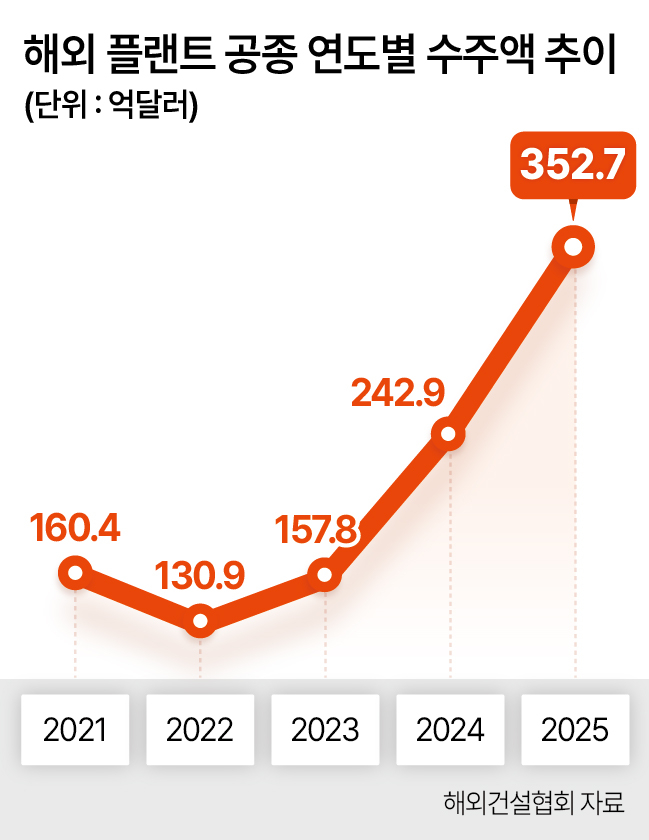
According to data on annual plant contract trends released Thursday by the Overseas Construction Association of Korea, domestic construction firms secured 69 overseas plant contracts last year worth a combined $35.27 billion. That figure represented 79.2% of total overseas construction contracts — the second-highest share on record.
The growth trajectory has been steep: plant contract values stood at $13.09 billion in 2022, then climbed to $15.78 billion in 2023, $24.29 billion in 2024 and $35.27 billion last year — a 169% increase in just three years. The number of contracts also rose 25%, from 55 in 2022 to 69 last year. As of late July this year, firms had secured 45 contracts, reaching 65% of last year's total count, though the contract value stood at $8.49 billion.
Kim Tae-jun, head of the new growth strategy research division at the Korea Research Institute for Construction Policy, wrote in a report titled "Outlook and Challenges for the Overseas Construction Market in 2026" that "the most notable feature of overseas construction contracts is the sustained rise of the plant sector." He added that civil engineering and architecture had been the dominant categories before the 2000s, but plant projects have grown steadily in share since then as firms expanded into that space.
Green and power infrastructure orders rise; contract geography diversifies
The expansion in overseas plant contracts over recent years reflects a convergence of forces: a global push toward clean energy and power infrastructure, and a growing pipeline of high-value public-private partnership projects that blend construction with project finance. The drive to build hydrogen, ammonia and LNG facilities in pursuit of carbon neutrality has accelerated, while a worldwide surge in power demand from AI data center construction has spurred more orders for gas-fired combined-cycle plants, small modular reactors and other nuclear infrastructure. On top of that, Korean firms and the government have leveraged their technical capabilities and project management expertise to break into PPP deals, pushing individual contract sizes into the multi-trillion-won range.
An official at the Overseas Construction Association of Korea said the global power generation market, centered on renewable energy, "is growing rapidly as surging demand for low-carbon energy transitions to address climate change, sharp increases in electricity consumption driven by urbanization and industrialization, and investment in large-scale, continuous power supply with low carbon emissions all converge."
A structural diversification of markets has also contributed to the rise in plant contract values, as Korean firms have expanded well beyond their traditional stronghold in Middle Eastern petrochemicals into advanced economies including the United States and Europe. Last year, the "Team Korea" consortium — comprising Korea Hydro & Nuclear Power, Daewoo Engineering & Construction and Doosan Enerbility, among others — won an $18.7 billion contract from Czech utility CEZ to build the Dukovany nuclear power plant.
Kim noted that the Middle East accounted for half of all overseas contracts in 2024 and had consistently held around 30% in prior years, but its share fell sharply to 25.1% last year. "The share of the Pacific-North America and European regions is gradually increasing," he said, adding that sustained investment in North America under US tariff agreements means the region could become a core market for Korean overseas contracts going forward.
Global power project pipeline worth $7.96T; market diversification demands tighter risk monitoring
The global power plant market offers abundant opportunity ahead. According to market research firm GlobalData, the total value of power generation projects under development worldwide stood at $7.96 trillion as of last year, with $4.89 trillion — or 61.4% — still in the planning stage. Should those projects advance and secure financing, they represent a significant pipeline of potential work for Korean firms.
Nuclear power is also gaining momentum as the energy transition creates new challenges. As of early this year, 58 reactors totaling 60 GW of capacity were under construction across 18 countries, and with reactors more than 30 years old making up 66% of the global fleet, new nuclear orders are expected to increase. Beyond the Eastern European markets where Korean firms are already active, strategic collaboration with countries holding proprietary SMR technology — such as the United States and Sweden — is also expected to grow.
![A rendering of TerraPower's small modular reactor plant in Wyoming. [Provided by Doosan Enerbility]](https://wimg.heraldcorp.com/news/cms/2026/08/20/news-p.v1.20260814.197912dee93646c8ba56358f7ac6edd9_P1.jpg)
To turn these opportunities into contracts, experts say Korean firms must strengthen risk monitoring as markets diversify, develop country- and region-specific entry strategies, and upgrade both horizontal and vertical cooperation frameworks.
As the market expands from the Middle East and Asia into North America and Europe, firms need to build risk assessment systems that account for differing legal frameworks, contracting practices, exchange rate volatility and political stability across countries. Given persistent geopolitical uncertainty, experts also recommend expanding the use of policy finance tools — export insurance and investment guarantees — to reduce the risk burden on Korean firms operating in politically unstable regions.
Kim stressed that "the European market in particular requires thorough advance analysis of strict environmental regulations, quality standards and labor law requirements," while "the North American market demands preparation for work visa issues and immigration enforcement."
Analysts also say that horizontal cooperation within the construction industry must be paired with vertical cooperation involving project owners, financial institutions and the government. As PPP projects and other large-scale work make it increasingly difficult for any single firm to submit a competitive bid alone, the government needs to build systems that provide tax incentives, financial support and expanded guarantees for firms pursuing overseas projects, along with financing packages suited to major deals.
Kim said that "as demand grows for a wide range of plant types — data centers, battery manufacturing facilities and more — strengthening ties with other industries is also essential, on top of cooperation within the sector." He called for building technology-sharing platforms between companies and activating cooperative networks to share overseas project experience and expertise.
hwshin@heraldcorp.com