6,958 long-term holders in Seoul sold in two months after tax reform plan
Gangnam 3 districts account for 20% of sales, led by retired elderly owners
Mid-priced areas see surge in sellers with 10–15 years of ownership
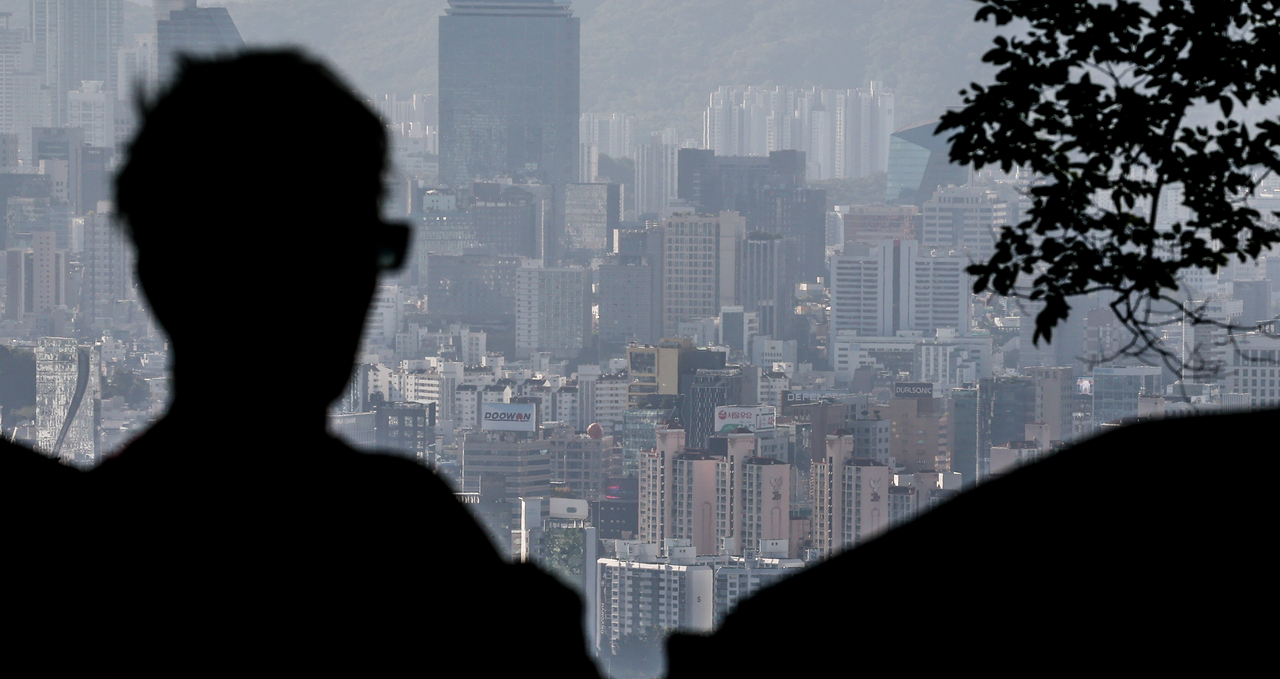
Nearly 1,300 long-term holders of collective residential buildings — apartments, townhouses, multi-family homes and officetels — in Seoul's three Gangnam-area districts sold their properties in the two months since the government unveiled its Aug. 3 tax reform package. The sellers, concentrated in Gangnam-gu, Seocho-gu and Songpa-gu, account for roughly 20 percent of all long-term sellers in Seoul, reflecting an accelerating push by elderly retirees and long-term residents to offload properties before heavier holding and capital gains tax burdens take effect.
According to the Court Registry Information Plaza, 16,698 owners sold collective residential buildings in Seoul from the day the Aug. 3 tax reform plan was announced through Sept. 29. Of those, 6,958 — about 42 percent — had held their properties for more than 10 years, up 6 percentage points from the 36 percent share recorded in January and February of this year, when 7,711 of 21,636 sellers were long-term holders.
The trend reflects a wave of preemptive tax-motivated selling by retired elderly owners ahead of real estate tax changes targeting not only multi-home owners but also high-priced and non-resident single-home owners. The finalized reform plan the government released last month retained the 1.2 billion won ($883,000) basic deduction for non-resident single-home owners and kept the comprehensive real estate tax burden cap at the current 150 percent. However, measures that broadly increase the tax burden on high-priced homes remained in place, including a higher fair market value ratio, a new ceiling on the long-term holding special deduction for single-home owners and the phased elimination of residency requirements.
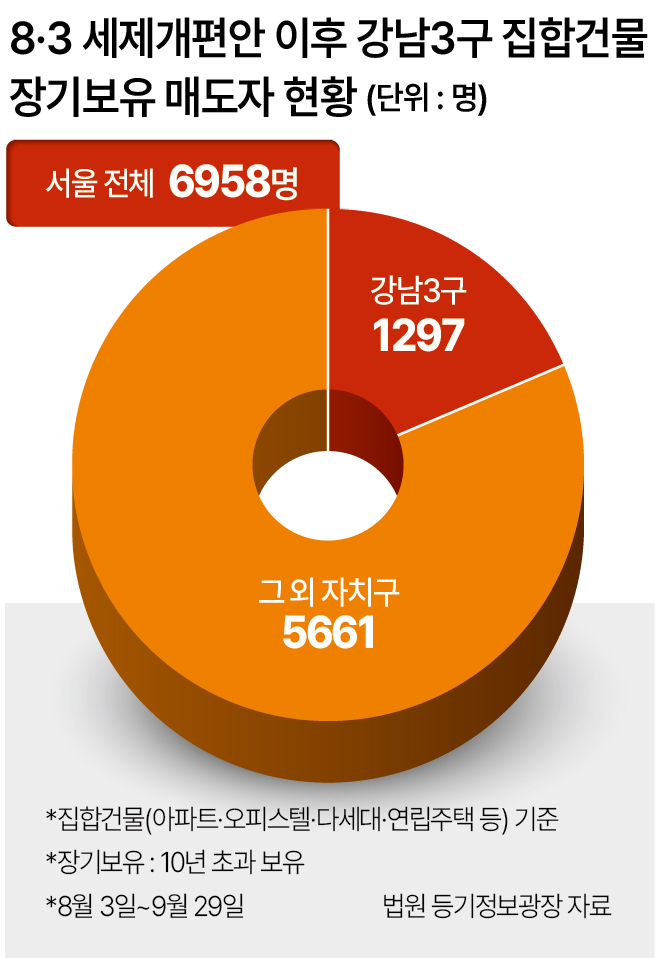
In practice, 1,297 long-term holders in the three Gangnam-area districts sold during the period, making up about 20 percent of all long-term sellers in Seoul. The sales were concentrated in high-priced neighborhoods — including Banpo, Apgujeong, Cheongdam and Jamsil — where market prices exceed 3 billion won per unit, as distressed listings with reduced asking prices intermittently converted into completed transactions.
Breaking down sales by holding period, Gangnam-gu saw the most sellers among those who had held for more than 20 years, at 159, followed by 149 in the 10-to-15-year bracket and 99 in the 15-to-20-year bracket. In Seocho-gu, the 10-to-15-year bracket numbered 133, those holding more than 20 years totaled 123, and the 15-to-20-year range came to 59. Songpa-gu recorded the highest figures overall, with 237 in the 10-to-15-year bracket, 209 holding more than 20 years and 129 in the 15-to-20-year range.
Ko Jun-seok, a professor at Yonsei University's Sangnam School of Management, said owners who have lived in their homes for 30 or 40 years are sitting on substantial capital gains and are moving to realize those gains before the long-term holding special deduction is scaled back. "Those who have no income after retirement, or those who find the property too expensive to gift, have already moved heavily toward selling since the tax reform plan was announced," he said. Ko added that some long-term holders in the Gangnam 3 districts who have already met residency requirements are choosing to rent out their homes on a jeonse or monthly rent basis and hold on for now, making it too early to say whether the upward trend in long-term selling in those districts will continue.
In contrast to the Gangnam 3 districts, where distressed listings have kept apartment prices falling, the Han River belt and mid-to-lower-priced districts that have continued to see price gains recorded a notable concentration of sellers in the 10-to-15-year holding bracket. The pattern reflects upgrade demand — owners whose home values have risen sharply over roughly a decade are selling to buy discounted listings in more desirable areas.
In Gangdong-gu, sellers in the 10-to-15-year bracket numbered 108 in the two months since the tax reform plan, the highest of any holding-period segment in the district. Across the Han River belt and mid-to-lower-priced districts, the same bracket dominated: Gangseo-gu recorded 143 such sellers, Seongbuk-gu 129, Dongjak-gu 116, Mapo-gu 109 and Gangbuk-gu 70.
"Because home prices in mid-to-lower-priced areas and the Han River belt have risen steeply this year, single-home owners in those areas are increasingly motivated to trade up to higher-tier locations," Ko said.
Meanwhile, apartment prices across the Gangnam 3 districts have been falling for a month as a growing supply of tax-motivated listings pushes asking prices lower at complex after complex.
Nam Hyeok-woo, a real estate researcher at Woori Bank, said the Gangnam 3 districts are being weighed down by policy uncertainty surrounding the tax reform plan, rising international oil prices and concerns about a prolonged high-interest-rate environment driven by rising US government bond yields. "Policy uncertainty persists, and investment sentiment has also contracted in response to rate increases, so there is a strong likelihood that transaction slowdowns and price weakness in those areas will continue for now," Nam said.
hwshin@heraldcorp.com