![The domestic ringleader of an etomidate smuggling operation moves drugs to his vehicle. [Seoul Metropolitan Police Agency]](https://wimg.heraldcorp.com/news/cms/2026/08/20/news-p.v1.20260820.fc98b0213d904765a1d654d3af216457_P1.jpg)
Etomidate, a sedative anesthetic recently classified as a controlled narcotic in South Korea, gained public notoriety after singer Wheesung was found unconscious at a commercial building after being administered the drug. Police have now arrested a ring of 32 people who smuggled large quantities of the substance into the country — not out of addiction, but purely for profit. The two domestic ringleaders had no history of drug use themselves. They recruited acquaintances and even romantic partners as couriers, brought the drug into the country and distributed it. The ring was caught attempting to move etomidate with a street value of more than 1 billion won ($713,000).
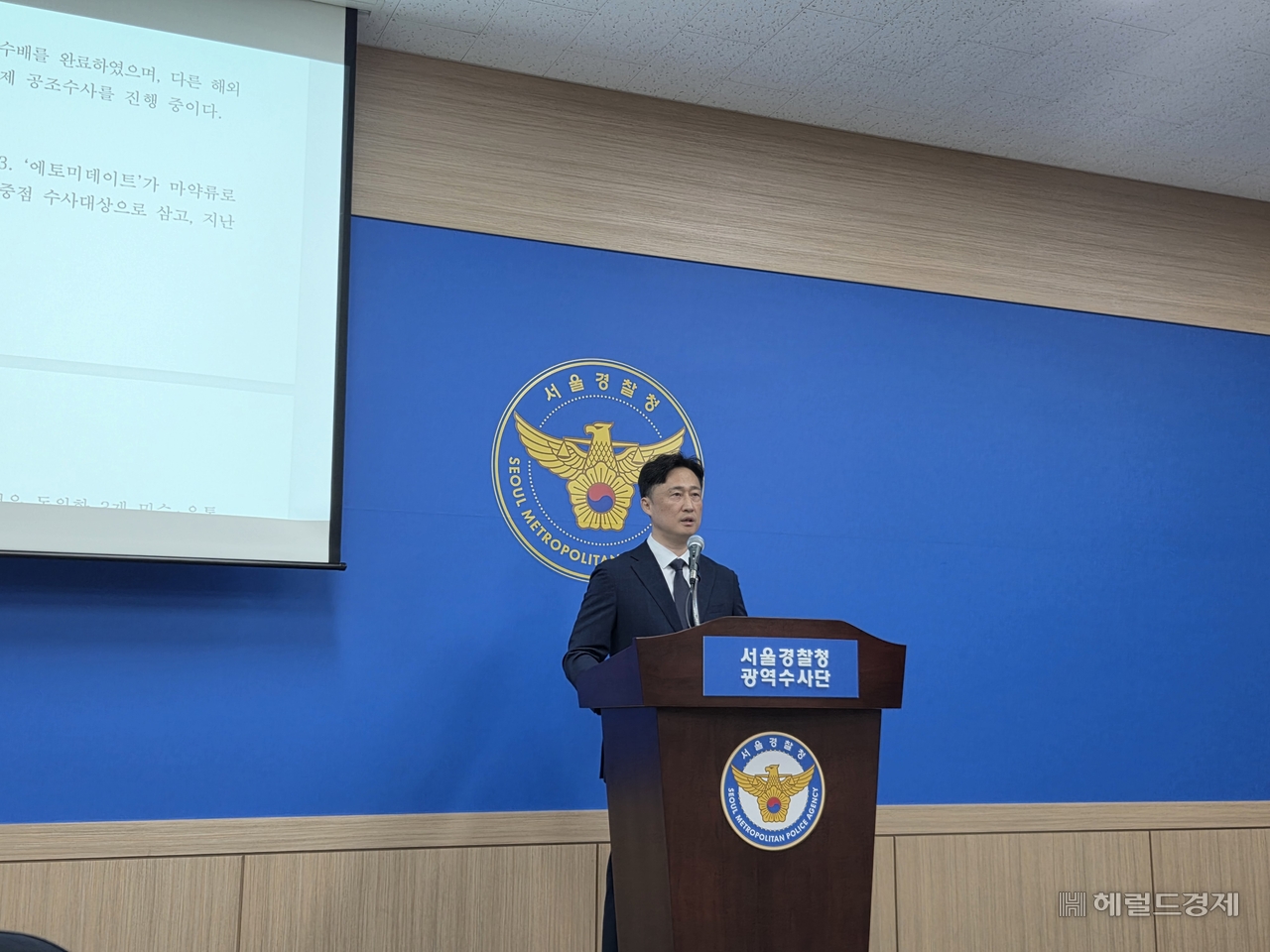
Kang Seon-bong, head of the first section of the Seoul Metropolitan Police Agency's narcotics investigation team, said police arrested 32 people — including members of three separate smuggling and distribution rings, sellers and buyers — on charges of violating the Narcotics Control Act. Of those, 13 were detained and referred to prosecutors. The three ringleaders, one from each ring, were also arrested and handed over to prosecutors.
Police launched a crackdown on etomidate after it was fully classified as a controlled narcotic in February. The operation netted all three rings. Investigators also seized and recovered the proceeds of the crimes — recouping 120 million won in criminal profits and confiscating 2 kilograms of etomidate with a street value of 1.2 billion won.
Smuggled for money, not addiction
The suspects were driven entirely by financial gain. Ordinary civilians with no drug habits planned the smuggling operations solely for profit. The two main ringleaders, identified as A and B, never used etomidate themselves — they simply planned to import it and sell it domestically.
A, a man in his 30s who worked as an air-conditioning installer, was drawn in by a younger relative operating as a drug dealer in Thailand. Lured by the promise that etomidate smuggling was lucrative, A recruited an acquaintance as a courier and smuggled 1 kilogram of etomidate through Incheon International Airport in two separate runs in June and July.
![Cosmetics containers used by the etomidate smuggling ring to conceal the drug, seized by the Seoul Metropolitan Police Agency Metropolitan Investigation Unit's narcotics investigation team. [Seoul Metropolitan Police Agency]](https://wimg.heraldcorp.com/news/cms/2026/08/20/news-p.v1.20260820.74f5e238aef1459a99f27d2123595120_P1.gif)
A's group concealed the liquid etomidate inside cosmetics containers. A purchased 1 kilogram of the drug in Thailand for 8 million won. Police said that once brought into South Korea and divided into smaller portions for sale, the haul could generate up to 600 million won in revenue. Police have issued an Interpol red notice for the South Korean drug dealer who supplied etomidate to A.
B, a man in his 40s, was neither recruited by anyone nor addicted to narcotics. He acted purely for criminal profit. B traveled to Thailand, began dating a Thai woman and used the relationship to learn the local drug trade.
In January, B proposed the scheme to his Thai girlfriend — a cross-border trader who regularly traveled between Thailand and South Korea — and to an acquaintance who worked as a delivery driver. The group smuggled 500 milliliters of etomidate from Thailand to Incheon Airport, hidden inside a fabric softener pack.
C, a Vietnamese national who had worked as a sailor, went undocumented after leaving his job and planned the crime while living in the country illegally. In March, C acted on instructions from an overseas drug dealer he had connected with through Telegram and other channels. He hired a cross-border trader and directed the person to carry a food box without disclosing its contents.
![E-cigarette cartridges seized from the etomidate smuggling ring arrested by the Seoul Metropolitan Police Agency Metropolitan Investigation Unit's narcotics investigation team. [Seoul Metropolitan Police Agency]](https://wimg.heraldcorp.com/news/cms/2026/08/20/news-p.v1.20260820.1455959c0c0845e08d18570d465a94da_P1.jpg)
Using this method, C smuggled 1 kilogram of etomidate from Vietnam into Incheon Airport and divided it into 1 to 1.25 milliliter portions loaded into e-cigarette cartridges. The cartridges were then distributed to Daegu and Gyeongsan in North Gyeongsang Province through drop couriers.
According to police, all three — A, B and C — had no prior drug convictions and smuggled and distributed narcotics solely for financial gain.
Etomidate quietly spreading across South Korea
Since its classification as a controlled narcotic in February, etomidate has been circulating through increasingly sophisticated channels. Where it once moved in the form of pharmaceutical-grade injection ampoules, it has now shifted to e-cigarette liquid form.
"All of the etomidate seized in this operation involved raw liquid smuggled from abroad and repackaged into e-cigarette liquid cartridges for distribution — the methods have been cleverly adapted," Kang said.
Etomidate is a dangerous substance that, when abused, can cause a sharp drop in blood pressure, abnormal heart rate and death. Illegal distribution has been rising across Asia. "The distribution methods that have fueled serious social problems in China and Taiwan are now actively trying to penetrate South Korea," Kang said. "Aggressive, preemptive enforcement and regulation are urgently needed."
![Officers from the Seoul Metropolitan Police Agency Metropolitan Investigation Unit's narcotics investigation team seize drugs hidden by the etomidate smuggling ring for domestic distribution. [Seoul Metropolitan Police Agency]](https://wimg.heraldcorp.com/news/cms/2026/08/20/news-p.v1.20260820.1669a904d09041578c76dde189448e55_P1.jpg)
Police said the current moment is a critical window to detect and respond to etomidate's infiltration of South Korea, and called for early establishment of a legal basis for enhanced penalties.
Under current law, the aggravated punishment provisions of the Narcotics Control Act for etomidate apply only to import, export and manufacturing — there is no legal basis to impose enhanced penalties for large-scale domestic distribution. In response, police recently submitted a formal request to the Ministry of Justice to revise the legislation and close that gap.
"We will work closely with customs and other relevant agencies to fundamentally block liquid-type novel narcotics from penetrating the daily lives of the public," Kang said. "We will continue aggressive enforcement from the point of smuggling at the border all the way through domestic distribution networks."
20ki@heraldcorp.com