

AI already scores job applications and rates interview performance — yet many job seekers have no idea they are being evaluated by an algorithm.
Under current law, companies face no explicit obligation to inform applicants when AI is used in hiring. As AI-driven recruitment spreads rapidly, calls are growing to amend the Fair Hiring Procedure Act to require advance disclosure.
According to the Ministry of Employment and Labor on Thursday, a 2025 corporate hiring trends survey conducted by the Korea Employment Information Service found that 86 of 396 responding companies — 21.7 percent — among the top 500 firms by sales were already using AI tools in their hiring processes.
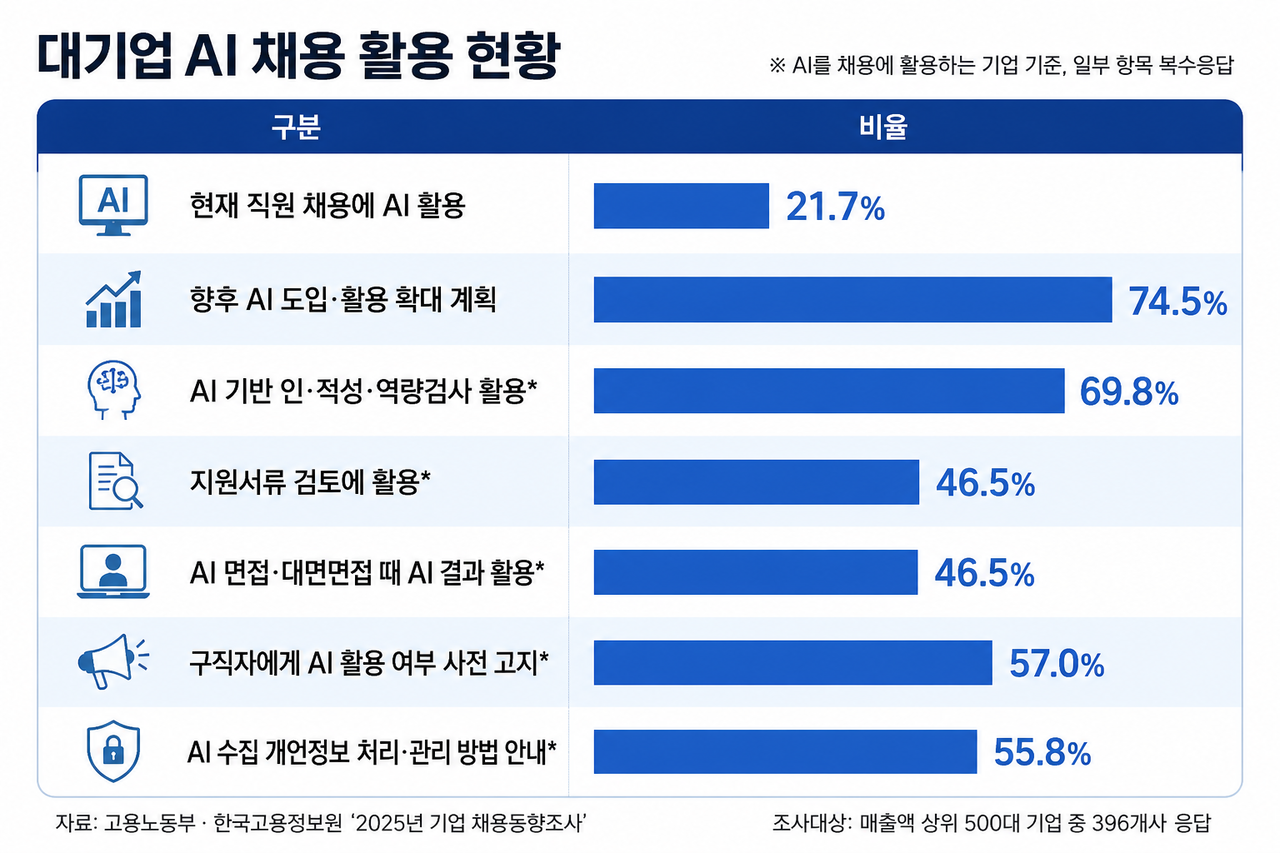
Among companies using AI in hiring, 69.8 percent said they apply it to aptitude or competency assessments. Another 46.5 percent each said they use AI to screen application documents and to incorporate AI results in interviews — both in-person and AI-conducted. Across all responding firms, 74.5 percent said they plan to introduce or expand AI use in hiring.
Despite the rapid spread of AI hiring, disclosure remains entirely voluntary. Of companies that use AI in recruitment, only 57 percent said they notify applicants in advance, and just 55.8 percent said they inform candidates how personal data collected through AI tools is handled and managed.
The Fair Hiring Procedure Act contains no provisions directly governing the use of AI or algorithms in recruitment. It sets no explicit requirement for companies to tell applicants that AI is being used, or at which stage of the hiring process it plays a role.
Companies themselves are calling for clearer regulatory standards. When asked what government support they need for AI hiring, 65.4 percent of respondents cited legal guidelines covering ethical standards and personal data protection in AI-based screening. Another 50.3 percent said independent verification of AI tools for fairness and bias — along with public disclosure of results — is necessary.
The government has acknowledged the need for reform. When releasing last year's corporate hiring trends survey, the Ministry of Employment and Labor said it would develop guidelines covering ethical standards and a step-by-step checklist for AI hiring, and would pursue amendments to the Fair Hiring Procedure Act to mandate advance disclosure and prohibit discrimination in AI-assisted recruitment.
Some experts argue the reforms should go further — giving applicants the right to request an explanation of how AI evaluated them, not merely requiring companies to disclose that AI was used.
The Personal Information Protection Act already includes a mechanism allowing individuals to request explanations of "automated decisions" or, in certain circumstances, to refuse them. The provision applies only when a fully automated system processes personal data and makes a decision that significantly affects an individual's rights or obligations.
In practice, most companies use a hybrid model: AI scores applicants' documents, competency tests, or interview responses, and a human recruiter then uses those scores to decide who advances or receives a final offer. If a person is meaningfully involved in the final decision, the process may not qualify as an "automated decision" under the Personal Information Protection Act — meaning applicants could have no right to an explanation even when AI substantially influenced the outcome.
The AI Basic Act, which took effect this year, is seen as a partial remedy for this regulatory gap. When an AI system plays a significant role in evaluating or judging candidates during hiring, it may qualify as high-impact AI, triggering transparency obligations under the law.
fact0514@heraldcorp.com




