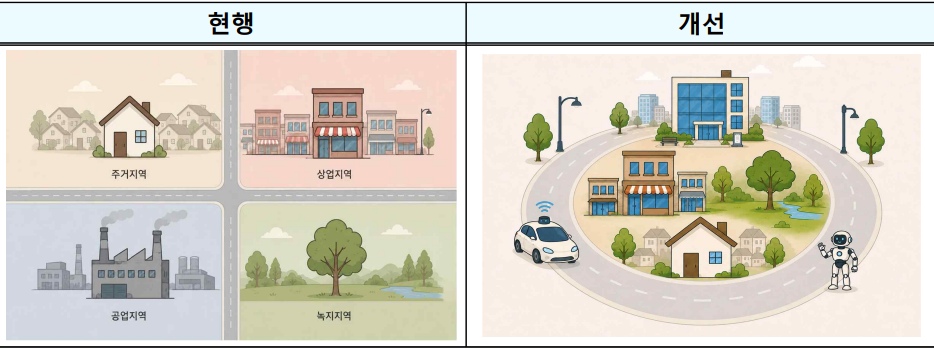
"From an era of separating work and home to an era of integrating them."
The most striking element of the government's rapid housing supply plan — announced Thursday to stabilize the jeonse, monthly rent and sales markets — is a philosophical shift in urban planning and building regulation. The core of the plan is to move away from the rigid, traditional zoning system toward a more flexible one, in step with the AI era and a surge in remote work.
The vision is to move beyond the strict separation of residential and industrial zones, expand mixed-use buildings in urban centers and allow commercial zones to serve both commercial and residential purposes.
The government currently divides urban land into broad categories — residential, commercial, industrial and green zones — to promote rational land use. Residential zones are further broken down into six subcategories ranging from first-class exclusive residential to quasi-residential. These classifications restrict permitted building uses as well as building-to-land ratio, floor area ratio and height. Critics have long argued, however, that the rigid system prevents buildings from being used efficiently in ways suited to the times.
Jang Woo-cheol, the Ministry of Land, Infrastructure and Transport's housing policy director, said current urban building regulations were designed for the Industrial Revolution era. "We have entered the AI age, and with changes in industry and work patterns, the need to strictly separate residential and work spaces has largely disappeared," he said. He added that unlike the era when jobs were created in factories, jobs today are created in office buildings, making it difficult to respond flexibly to reality under rigid urban building regulations.
The shift is also aimed at addressing the oversupply of commercial buildings and the difficulty — due to inflexible location and construction standards — of converting knowledge industry centers and lifestyle accommodation facilities into officetels and similar uses.
In the e-commerce era, regulations requiring a set proportion of retail space in new developments have had the unintended effect of producing vacant storefronts. Jang noted that the retail vacancy rate in Seoul's Songpa district stands at 16.6 percent, and said some developers report significant stress over unsold commercial units in mixed-use buildings in new towns. "In Sejong, the situation has gotten so bad that people are even talking about a 'vacant shop expo,'" he said.
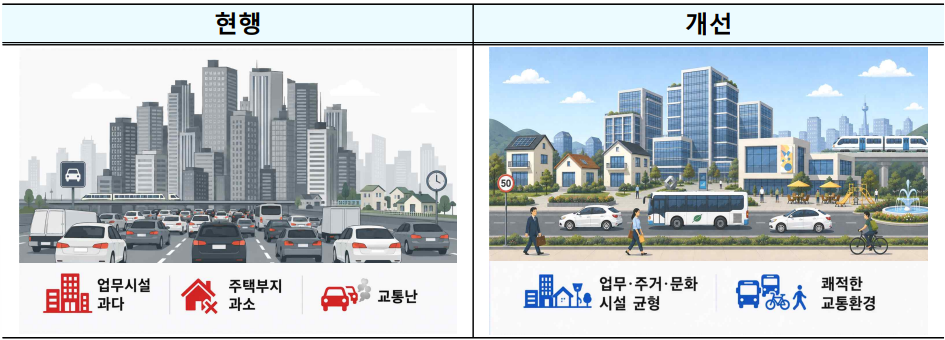
The Ministry of Land, Infrastructure and Transport said outdated regulations are distorting reality and producing a range of side effects, and announced it would allow mixed-use development not only in existing completed buildings but from the construction stage of new ones. To that end, the ministry said it would enact a special law and establish a support framework.
For new buildings, the ministry plans to designate transit-oriented areas and similar locations as "mixed-use building zones," easing regulations and offering incentives to developers who build with future change of use in mind. For existing buildings, construction and parking standards would be applied flexibly through architectural committee review, while permits covering landscape, education and traffic would be streamlined through a consolidated joint committee review.
The ministry also said it would seize the opportunity to pursue a broader overhaul of the zoning system, citing the difficulty of responding flexibly to diverse spatial demands driven by industrial upgrading, remote work and other lifestyle changes. It said it would review reforms to reflect conditions of the AI era while also examining measures to guard against side effects such as sharp land price increases and uncontrolled development.
smh@heraldcorp.com