
![The Kosdaq index is displayed on a screen at Hana Bank's dealing room in Jung-gu, Seoul, on Monday. [Yonhap]](https://wimg.heraldcorp.com/news/cms/2026/08/11/rcv.YNA.20260810.PYH2026081014270001300_P1.jpg)
Kosdaq is staging a sharp rebound, driven by recovering trading volume, institutional buying and strength in biotech stocks — all against a backdrop of easing supply-demand distortions following tighter regulations on single-stock leveraged products.
According to Korea Exchange, Kosdaq had risen 18.72% from the start of August through Monday, while the Kospi fell 4.48% over the same period.
Measured against the year-to-date low of 662.68 recorded on July 29, the index has climbed roughly 35% — recovering the bulk of last month's steep losses in less than two weeks.
Market analysts point to an oversold rebound as the primary driver. Earlier this year, capital flows on the domestic market concentrated heavily in large-cap semiconductor names such as Samsung Electronics and SK Hynix, leaving Kosdaq starved of buying interest.
The supply-demand vacuum showed clearly in trading volume. "Since the start of the year, the daily average trading value on the Kospi has been 35.2 trillion won ($24.9 billion), compared with 12.4 trillion won on the Kosdaq — a gap of about 2.8 times," said Kwon Beom-seok, a researcher at Samsung Securities. "Ultimately, that supply-demand vacuum translated into a sharp index decline."
Lee Gyeong-min, a researcher at Daishin Securities, said Kosdaq had underperformed even during the Kospi's strong run in May and June, which concentrated bargain-hunting in the index. "Buying was led by semiconductor materials, components and equipment stocks, as well as pharmaceutical and biotech names, which drove the index higher," he said.
The mood has shifted recently. Since regulations on single-stock leveraged products were tightened, trading volume that had flooded into those instruments has dried up sharply, and flows are now spreading back into Kosdaq.
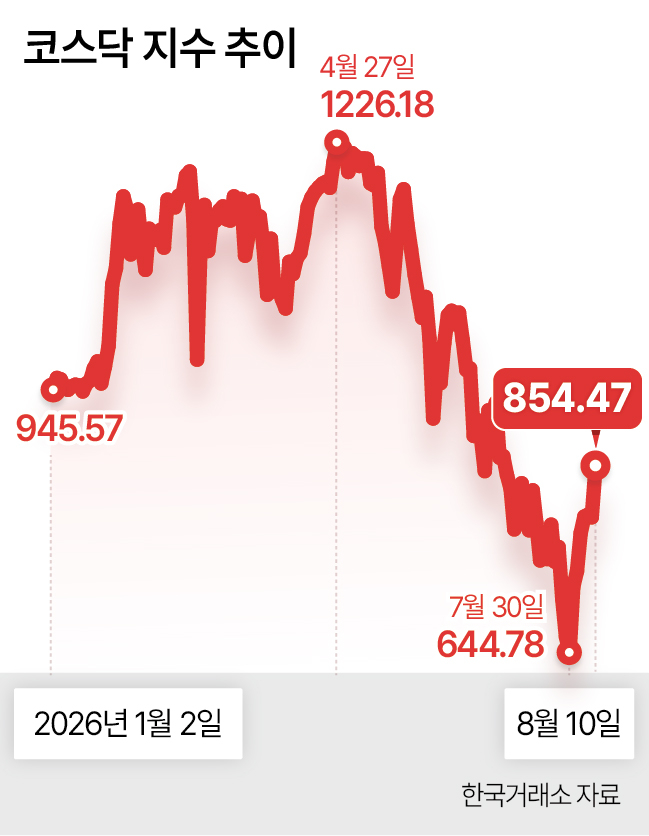
Kosdaq's daily trading value climbed from 4.49 trillion won on July 30 to 7.07 trillion won on Monday. Kosdaq's share of combined Kospi and Kosdaq trading value jumped from 10.49% to 27.26% over the same period — the highest level since May 26, just before single-stock leveraged products were listed, when the share stood at 28.48%.
Institutional buying has also supported the rebound. Institutions net purchased just 78.9 billion won worth of Kosdaq-listed shares throughout July, but expanded that to 1.22 trillion won in net purchases from the start of this month through Monday.
Pension funds have also reversed course. After net selling 252.8 billion won worth of Kosdaq shares last month, they swung to net purchases of 137.1 billion won so far this month.
Strong buying has flowed into pharmaceutical and biotech stocks, Kosdaq's flagship sector. The Kosdaq 150 Healthcare index surged 34.66% from the start of this month through Monday, far outpacing the broader Kosdaq (18.72%) and the Kosdaq 150 (22.28%) over the same period — the best performance among all Kosdaq sector indexes.
Alteogen, Kosdaq's largest company by market capitalization, also helped lead the index higher. The biotech firm surged more than 14 percent on Monday after it emerged that BlackRock, the world's largest asset manager, had acquired a stake of more than 5 percent in the company.
Analysts are broadly optimistic about Kosdaq's prospects for further gains in the second half. Despite the recent sharp rebound, the index still lags the Kospi's performance for the year, leaving relative valuation appeal intact. An upcoming announcement of detailed rules for a promotion-and-relegation system aimed at improving Kosdaq market quality is also seen as a factor that could bolster investor sentiment.
"Before and after the application of single-stock leveraged ETF regulations, volatility has contracted and ETF flows are spreading beyond semiconductor-focused products," said Yoon Jae-hong, a researcher at Mirae Asset Securities. "Given the extreme neglect Kosdaq suffered in the first half, expectations for a recovery in the second half are running high."
moon@heraldcorp.com



