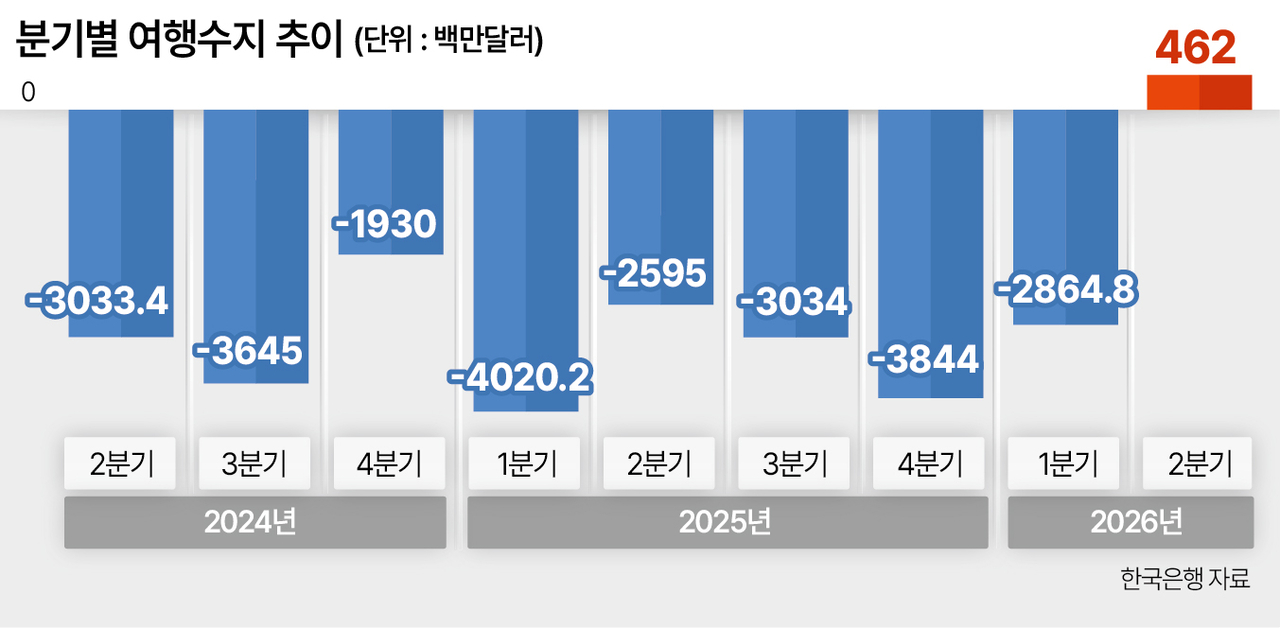
South Korea's travel balance swung to a surplus of $462 million in the second quarter of this year, marking the first quarterly surplus in 17 years since the first quarter of 2009. The turnaround came as a surge in foreign visitors pushed travel receipts to a record high, while a persistently weak won and rising fuel surcharges discouraged Koreans from traveling abroad.
The Bank of Korea said Friday the travel balance recorded a surplus of $462 million in the second quarter, reversing from a deficit of $2.86 billion in the first quarter. The improvement was even sharper compared with the first quarter of last year, when the deficit stood at $4.02 billion. The last time the quarterly travel balance was in the black was the first quarter of 2009, when it posted a surplus of $159.7 million — the first such result in 69 consecutive quarters. In terms of surplus size, it ranked 10th largest on record, just behind the fourth quarter of 1998, which posted $502.1 million.
The travel balance measures the difference between what foreign tourists spend inside South Korea — travel receipts — and what Korean residents spend abroad, known as travel payments. The surplus grows larger as foreign visitors spend more domestically and Korean travelers spend less overseas.
The biggest driver of the second-quarter surplus was a sharp rise in foreign spending within Korea. Travel receipts reached $7.83 billion in the second quarter, up $2.01 billion, or 34.5 percent, from $5.82 billion in the same period last year.
About 10.71 million foreign tourists visited Korea in the first half of this year, up 21.3 percent from the same period last year, according to the Ministry of Culture, Sports and Tourism. Foreigners' domestic card spending also surged 50.8 percent year-on-year in the first half, reaching 10.04 trillion won ($7.08 billion).
At the same time, Korean residents' overseas spending fell. Travel payments dropped $1.05 billion, or 12.5 percent, to $7.36 billion in the second quarter from $8.42 billion in the same quarter last year. Analysts attributed the decline to higher fuel surcharges following the Iran war and a high exchange rate, both of which increased the cost of traveling abroad.
Fuel surcharges are fees airlines add to ticket prices to reflect fluctuations in jet fuel costs. As oil prices spiked in the second quarter in the wake of the Iran war, surcharges rose sharply. Korean Air's surcharge on its shortest routes soared 78.6 percent, from 42,000 won in April to 75,000 won in May, before falling back to 35,200 won in August.
The average won-dollar exchange rate in the second quarter, based on weekly closing prices, stood at 1,501.6 won — the second highest on record since the first quarter of 1998, when it reached 1,596.9 won. According to the Bank for International Settlements (BIS), the won's real effective exchange rate — a measure of the currency's external value and price competitiveness — fell 1.66 points from the previous month to 83.06 in June, its lowest level since March 2009, when it stood at 79.31.
This surplus can be characterized as a "boom-driven surplus" compared with the one recorded 17 years ago. In 2009, travel payments plunged $2.51 billion to $2.89 billion from $5.4 billion in the first quarter of 2008, while travel receipts rose only $1.03 billion — from $2.01 billion to $3.05 billion over the same period. The decline in payments was roughly 2.5 times larger than the increase in receipts. This year's second quarter tells the opposite story: the increase in travel receipts ($2.01 billion) was roughly twice the decline in travel payments ($1.05 billion).
In sum, the travel surplus of 17 years ago was a "recession-driven surplus" built primarily on a contraction in overseas spending by Korean residents, whereas the second-quarter surplus this year was a "boom-driven surplus" fueled by an expansion in foreign spending within Korea.
Whether the surplus will persist in the second half remains uncertain. The Bank of Korea projected that the number of outbound travelers will rise from July onward as the peak summer travel season — including school vacations — gets underway. Whether the inflow of foreign visitors continues to grow on a sustained basis will be the key factor shaping the travel balance going forward. The Ministry of Culture, Sports and Tourism earlier listed achieving 40 million K-tourism visitors as one of its six priority tasks in its second-half work plan.
Some are calling for measures to maximize the economic impact of the tourism industry. A report recently published by the Bank of Korea, titled "Growth Effects of the Tourism Industry from a Service Exports Perspective and Policy Directions," found that South Korea's tourism exports as a share of GDP stood at 1.17 percent last year, 0.29 percentage points below Japan's 1.46 percent. The Bank of Korea recommended that translating the recent growth in foreign visitor numbers into tangible economic gains will require not only attracting more tourists but also improving their spending patterns and the value-added rate of core tourism industries.
kimstar@heraldcorp.com