![Workers at an apartment construction site in Seoul. [Yonhap]](https://wimg.heraldcorp.com/news/cms/2026/08/07/rcv.YNA.20250811.PYH2025081106320001300_P1.jpg)
The government has made expanding housing supply its top priority for stabilizing the real estate market, but the construction industry — the key actor in delivering that supply — finds itself paralyzed by a triple burden of funding shortfalls, surging costs and mounting regulations. Observers also note that prospective homebuyers waiting for new supply face their own constraints, with lending restrictions limiting their ability to act.
President Lee Jae Myung and related ministries have reached a shared understanding on the need for financial support to boost supply and have begun reviewing regulations and drawing up remedies. Lee is set to chair the second real estate policy review meeting on Friday, where specific financial and tax measures are expected to be discussed.
Deputy Prime Minister and Finance Minister Koo Yun-cheol said on MBC Radio's "Kim Jong-bae's Morning Focus" that day that the government is considering targeted support measures to ease lending restrictions for low- and middle-income homebuyers and will announce additional steps soon. "We will work with full force to expand housing supply as quickly as possible — including non-apartment housing — and to address the difficulties facing newlyweds and young people in accessing housing finance," he said.
The construction industry is calling on the government to include measures that address the severe tightening of the project financing (PF) market in whatever additional steps it announces.
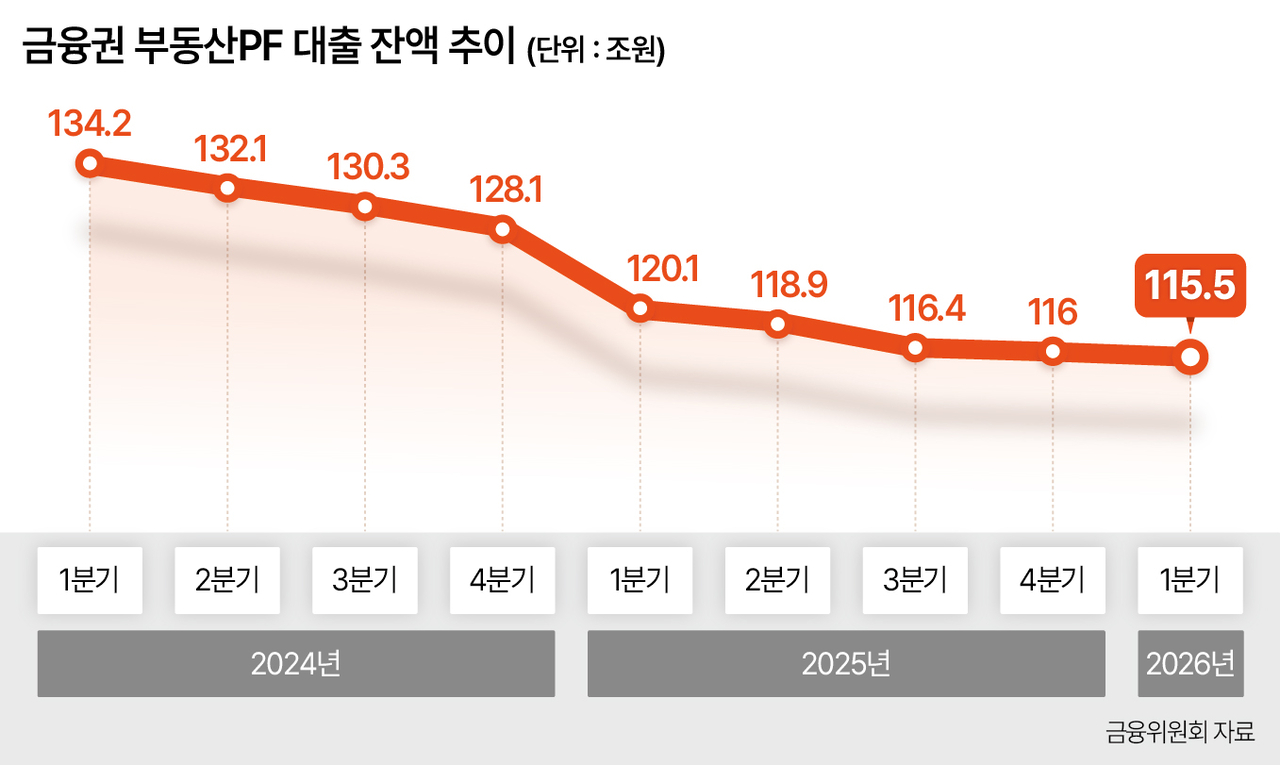
Outstanding PF loans in the financial sector stood at 115.5 trillion won ($81.4 billion) as of the first quarter of this year, according to Financial Services Commission data — down 18.7 trillion won, or 14 percent, from 134.2 trillion won in the first quarter of 2024. The decline reflects ongoing restructuring of distressed PF projects in the wake of high interest rates, tighter screening of new bridge loans and main PF financing, and a sharp contraction in the overall flow of funds into the market.
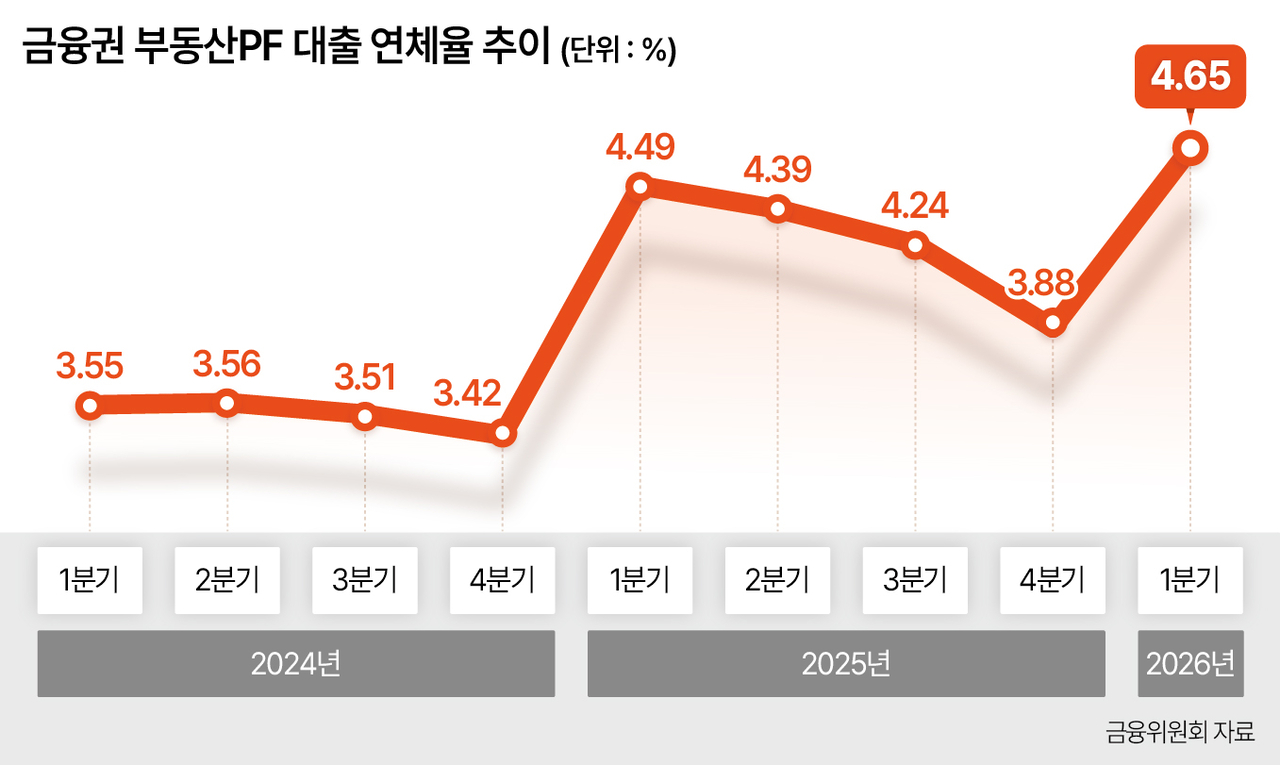
The PF delinquency rate climbed from 3.55 percent to 4.65 percent over the same period, compounding liquidity pressure on construction companies. Builders unable to cover construction and financing costs due to the funding freeze are falling into delinquency, which in turn raises the bar for new lending — a vicious cycle that shows no sign of breaking.
On the ground, the near-total closure of early-stage funding channels such as PF loans has left many project sites unable to break ground even after completing feasibility reviews. Construction companies typically rely on PF loans to cover land acquisition and building costs, but the higher threshold for converting bridge loans into main PF financing — combined with difficulties extending existing loan maturities — has stalled new ground-breakings across the industry.
"The biggest concern on the ground is the government's plan to raise the equity ratio for PF projects to 20 percent by 2030, at a time when even existing loans are hard to roll over," said one industry official. "When the money tap is already shut and companies are on the verge of collapse, tightening regulations like this is effectively telling smaller developers to shut down new projects."
On top of the funding squeeze, soaring construction costs driven by the war in the Middle East, a high exchange rate and rising labor expenses are adding further obstacles. The construction cost index published by the Korea Institute of Civil Engineering and Building Technology hit an all-time high of 138.22 in June. With raw material prices for cement and steel rebar continuing to rise as the Middle East conflict drags on, major builders have increasingly shifted to selective bidding — pursuing only the most profitable projects.
Tightened safety and redevelopment regulations are also contributing to supply delays, on top of the financial and cost pressures, according to the construction industry.
"The proposed Special Act on Construction Safety — which has not yet passed but would impose a penalty of up to 3 percent of sales revenue when a fatal accident occurs on a construction site — would force builders to factor in additional risk and safety management costs," said an official at a construction industry association. "Disputes over costs with redevelopment associations are already widespread due to rising construction expenses, and this would only increase those conflicts and slow the pace of supply further."
Against this backdrop, construction-related industry groups are urging the government to expand public guarantees on PF loans through bodies such as the Korea Housing Finance Corporation and the Korea Housing and Urban Guarantee Corporation, and to lower risk weightings on PF lending. Broader public guarantees would reduce the potential losses borne by lenders, enabling them to extend more financing.
President Lee ordered related ministries to "mobilize all available means to expand supply" at a roughly seven-and-a-half-hour real estate and stock market review session held Monday — shortly after returning from visits to San Francisco and South America. Financial and fiscal support measures for the construction industry are expected to follow soon. At that meeting, Lee stressed that officials should "find every available administrative, financial, fiscal and deregulatory tool to achieve rapid supply expansion."
hwshin@heraldcorp.com