Gyeonggi Province's finances have fallen into disarray reminiscent of 2010, when President Lee Jae Myung — then mayor of Seongnam — became the first local government head in the country to declare a debt moratorium.
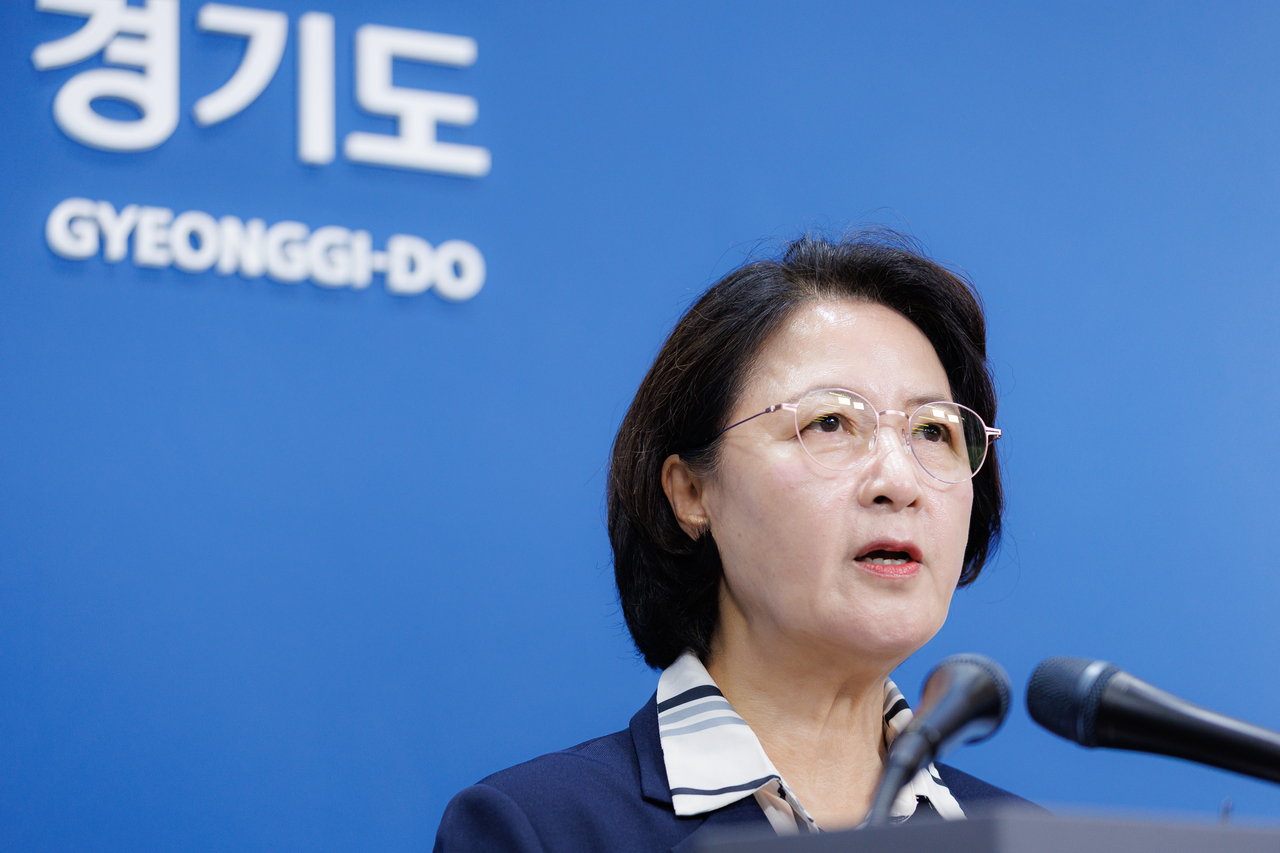
Governor Choo Mi-ae officially declared a "fiscal emergency" in Gyeonggi Province on Wednesday.
Choo warned that without immediate action, the province could fall into a vicious cycle of issuing new local bonds every two to three years just to repay existing debt. She announced a package of emergency measures including cuts to operating expenses, a crackdown on wasteful spending, organizational restructuring and systemic reform — framing the declaration not as simple austerity but as a formal acknowledgment of a structural fiscal crisis requiring fundamental solutions.
Speaking at a press conference at the Gyeonggi Provincial Government building Wednesday, Choo said some had questioned whether the alarm over the province's finances was exaggerated or politically motivated. "That is not the case at all," she said. "Gyeonggi Province has reached a point where it is difficult to sustain even ongoing projects, let alone pursue new campaign pledges."
Choo said the previous administration had budgeted many essential public welfare projects for only nine months rather than a full 12 months, citing insufficient funds. "I was briefed on these critical facts and the true state of the province's finances only after taking office," she said. "What is even more serious is that even within the civil service, the fiscal situation was not being shared, and the severity was not being fully recognized."
She added that the province's finances would not improve on their own with the passage of time. "If nothing is done now, we could fall into a vicious cycle within just two to three years, having to issue local bonds again to repay existing debt," she said. "We must make a decisive move to put the finances in order and protect the lives of Gyeonggi residents and the province's future before it is too late."
Many public welfare projects left underfunded; window for correction at risk of closing
Choo provided a detailed account of the province's dire fiscal situation Wednesday.
Gyeonggi Province issued local bonds three times in 2025, totaling approximately 943 billion won ($660 million) — 99.6 percent of the 946 billion won issuance ceiling. It was the first time in 20 years the province had issued local bonds. On top of that, the previous administration amended the integrated fiscal stabilization fund ordinance in May last year to make it easier to redirect earmarked funds to other purposes. Following the amendment, about 558.8 billion won was drawn from various funds through the integrated account and channeled into the general account and elsewhere via a third supplementary budget. For example, 34 billion won of the 38.4 billion won inter-Korean cooperation fund — established to support cross-border exchange and peace projects — was transferred to the integrated account, leaving only 4.4 billion won in the fund.
"The province issued local bonds and raided various funds to paper over the immediate crisis, yet even after all that, it could not fully put together this year's budget — an incomplete, half-finished budget," Choo said. "The price of that has been a hollowing out of public welfare spending."
Over-reliance on acquisition tax a structural problem
Choo said that if the current revenue and expenditure structure were left unchanged, the fiscal crisis would deepen every year, and she outlined the realities facing the province.
Gyeonggi Province's total budget stands at about 41.7 trillion won, but the funds the province can allocate at its own policy discretion amount to only about 3.5 trillion won. The remainder is already committed to welfare programs, national government matching projects and municipal adjustment grants, with both the purposes and the amounts fixed in advance.
Seoul has relatively stable revenue sources such as individual and corporate local income taxes, but Gyeonggi Province does not collect local income tax.
Gyeonggi does not receive ordinary local allocation tax and depends on acquisition tax — which fluctuates sharply with real estate transactions — for more than half of its total provincial tax revenue. Acquisition tax receipts reached about 11 trillion won in 2022 but are expected to fall to around 8 trillion won this year, a decline of roughly 30 percent.
Hopes for acquisition tax revenue from the third-generation new town development projects have also dimmed.
An expanded share of public rental housing and the Korea Land and Housing Corp.'s direct development model have pushed the projected acquisition tax take from the new towns down to around 230 billion won, from an initial estimate of 650 billion won. At the same time, the province faces enormous costs for transportation, fire services and infrastructure expansion driven by the new town development.
Choo also pointed to a structural imbalance in which Gyeonggi Province provides administrative and financial support to expand power, water and transportation networks to attract advanced industries such as semiconductor manufacturers, yet the corporate local income tax generated by those businesses flows to individual cities and counties rather than to the province. The province leads the infrastructure investment but captures none of the resulting tax revenue.
On the spending side, Gyeonggi's welfare budget accounts for about 49 percent of total expenditures, and at the current rate of growth it could approach 60 percent before long. Since 2022, the province's total population has grown by about 300,000, but the population aged 65 and older has grown by roughly twice that — about 600,000. Over the past five years, Gyeonggi's elderly population has grown at an average annual rate of 6.8 percent, above the national average of 5.4 percent.
Official declaration of fiscal emergency
"As of this moment, Wednesday, I officially declare a fiscal emergency in Gyeonggi Province," Choo said, announcing a set of emergency measures.
Choo said she would take personal responsibility as governor, starting with cuts to operating expenses for senior officials including herself. She said she would immediately implement a rigorous restructuring of expenditures to eliminate unnecessary spending.
Second, she said the province would completely block the budgeting and execution of wasteful spending. One-off and populist events and non-essential projects would be halted, and recurring research contracts, private outsourcing arrangements and commissioned projects would be reassessed before any decision to proceed. There are also growing calls to reduce or eliminate budget allocations for media partnership projects.
She made clear, however, that the fiscal crisis would not be used as a reason to abandon public welfare. "Budgets that must be secured — for the lives and safety of residents and the protection of vulnerable groups — will be defended to the end," Choo said.
Third, she said the province would fundamentally overhaul its civil service culture, reorganizing the governor's advisory staff and reallocating personnel and organizational resources across departments and public institutions more efficiently. Critics have noted that officials who avoid communicating with the press — such as the spokesperson's team leader — should be reassigned to less prominent posts rather than promoted.
For the fourth and final measure, Choo said cutting expenditures alone could not fundamentally resolve the crisis, and pledged to pursue institutional reform to normalize Gyeonggi Province's revenue structure.
fob140@heraldcorp.com