Korea's dairy farming and milk processing industries are grappling with a double blow: falling raw milk output and slowing sales. Extreme heat is cutting into production, while cheap European ultra-high-temperature (UHT) milk entering the country duty-free is adding to the pressure.
Dairy industry officials said Wednesday that a prolonged heat wave, with daytime temperatures soaring to 40 degrees Celsius, has been driving down raw milk output. Holstein cows, which make up the majority of Korea's dairy herd, are particularly vulnerable to heat. Research shows that when temperatures exceed 27 degrees, milk output drops 8 percent compared with output at 21 to 23 degrees, and 4.2 percent compared with output at 24 to 26 degrees.
According to the National Institute of Animal Science, the average Temperature-Humidity Index for August has reached 87.2 — the highest since records became available in 2018. In South Jeolla Province on Tuesday, the THI soared to 93, an all-time high for the region. A THI above 78 puts dairy cows on "warning" status, while a reading above 89 signals "danger." The index uses a five-tier scale: normal, caution, warning, danger and serious.
"Milk volumes did not change much through early July, but they dropped sharply in the second half of the month," one industry official said. "When a heat wave lasts more than a week, the damage is severe — and with the heat continuing since last week, the impact could grow."
Competition from imported UHT milk is adding to the strain. American UHT milk has entered Korea duty-free since January, and EU products gained the same tariff-free status last month. European brands including Mlekovita, Risolat and Oldenburger are now widely available in the domestic market.
Convenience stores have joined hypermarkets in stocking more UHT milk. GS25, which introduced imported UHT milk in 2024, now carries five varieties. Daily sales of its flagship product — Polish brand Mlekovita — jumped 59.2 percent this year compared with its first year on shelves. CU expanded its UHT milk lineup from six products last year to eight this year, and its UHT milk sales last month surged 74.1 percent from the same period a year earlier.

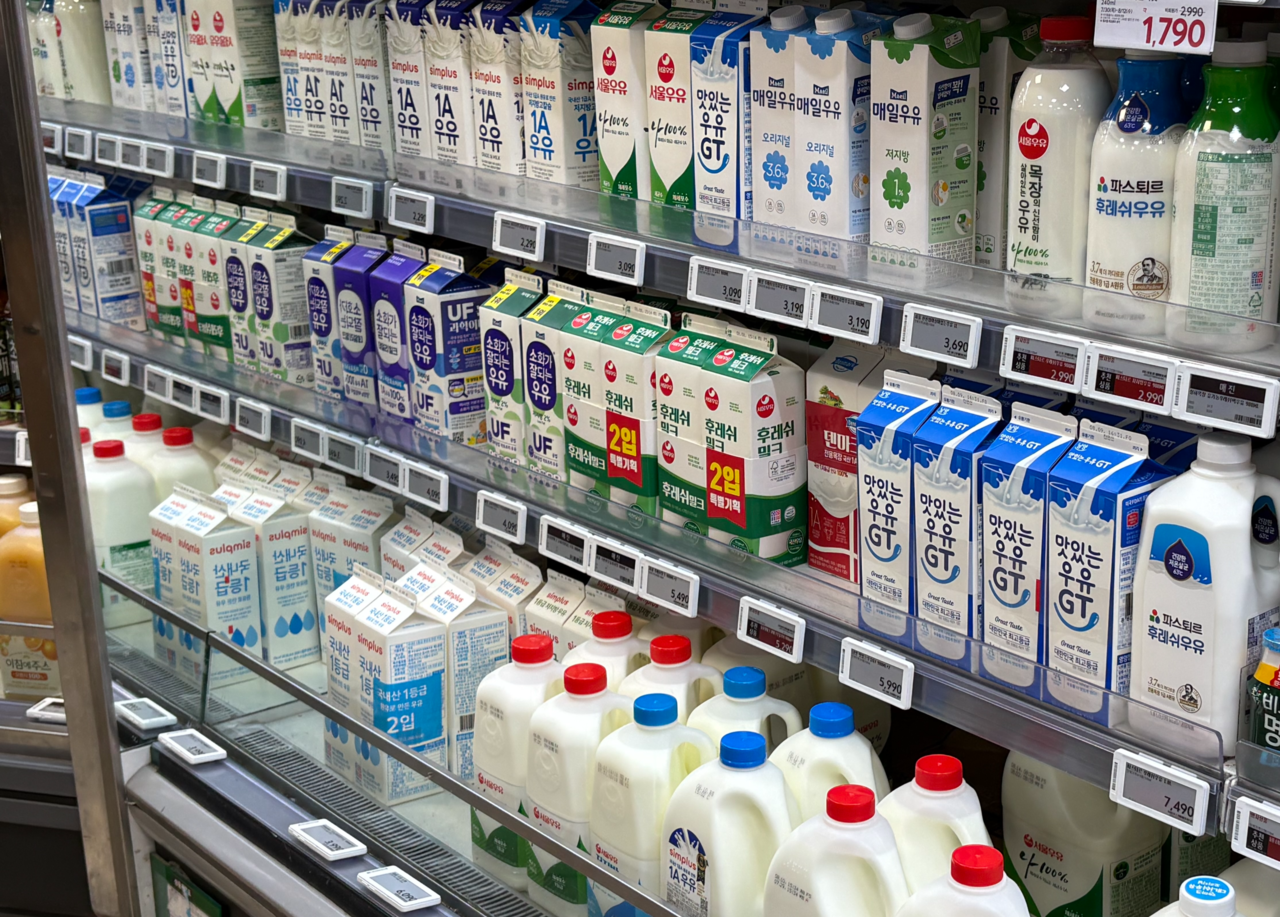
UHT milk's main selling point is price. A one-liter carton costs 1,000 to 2,000 won ($0.72 to $1.44), well below the 3,000-won range for domestic refrigerated milk. Demand is growing among budget-conscious consumers and small cafe operators. According to Korea Customs Service trade statistics, UHT milk imports exceeded 50,000 tons last year. In just the first half of this year, 24,735 tons entered the country — a 27.3 percent increase from the same period a year earlier. The industry expects full-year imports to reach 60,000 tons.
High exchange rates and elevated fuel costs have pushed up feed and operating expenses for dairy farmers, while the low birth rate continues to erode white milk consumption. According to the Korea Dairy Committee, per capita white milk consumption last year fell to 22.9 kilograms, down 9.5 percent from the previous year — the lowest level since the late 1980s.
The dairy industry is working to broaden its consumer base beyond children to older adults, recognizing that white milk alone can no longer sustain profitability. Seoul Milk is expanding a premium dessert line using Jersey cow milk while also differentiating itself with A2 milk, a higher-quality raw milk variety. Namyang Dairy Products and Maeil Dairies are focusing on alternative beverage development. Namyang, which has launched plant-based drinks including soy milk and almond milk, saw related sales grow 10 percent last year from the previous year.
"The drop in output from the heat wave and competition from UHT milk are becoming entrenched problems," one industry official said. "Since there are limits to how much we can grow white milk consumption, we have no choice but to build survival strategies through portfolio diversification."
spa@heraldcorp.com