![Under the comprehensive real estate tax rates for residential properties in the "2026 Tax Reform Plan" announced by the Ministry of Economy and Finance on Monday, the tax rate for properties with a tax base between 600 million won and 1.2 billion won will rise from the current 1.0 percent to 1.3 percent next year, based on single-homeowner rates. Pictured is a notice related to property holding taxes and capital gains taxes posted at a real estate agency in southern Seoul on the same day. [Yonhap]](https://wimg.heraldcorp.com/news/cms/2026/08/05/rcv.YNA.20260803.PYH2026080315410001300_P1.jpg)
Concerns are mounting that housing costs in Seoul will rise sharply as more landlords are expected to move into their own properties to reduce their tax burden under the government's real estate tax reform plan, further shrinking the already tight supply of jeonse and monthly rental units. While the government has offered an expanded monthly rent tax credit as a compensatory measure, market observers say more fundamental steps are needed to boost private rental supply.
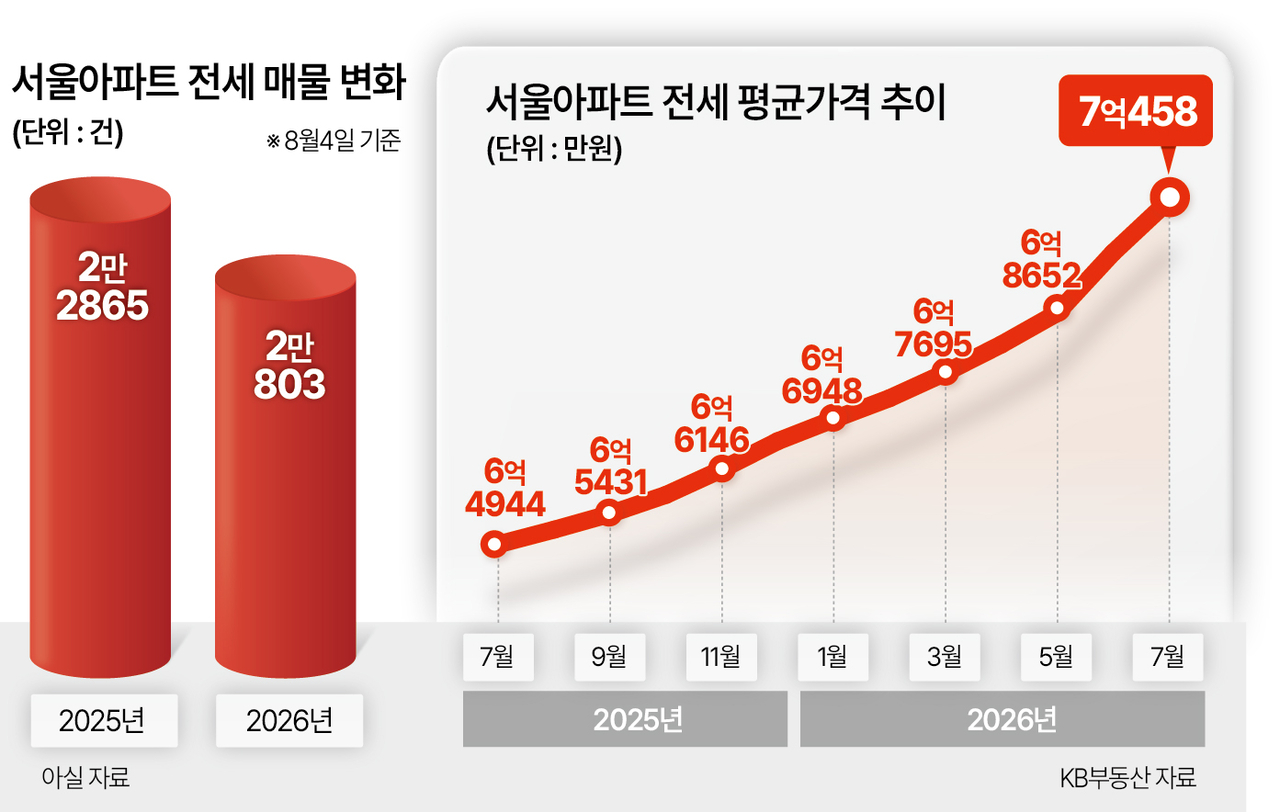
Seoul's jeonse and monthly rental market has already tightened considerably due to owner-occupancy requirements tied to the land transaction permit zone designation. According to real estate data platform Asil, jeonse listings for Seoul apartments stood at 20,803 as of Tuesday — down nearly 2,000 units from 22,865 a year earlier, a drop equivalent to roughly two large apartment complexes. The shrinking supply has pushed rental costs to record levels. The average jeonse price for a Seoul apartment surpassed 700 million won ($507,000) for the first time last month, according to KB Real Estate, while the average monthly rent is on the verge of breaking through the 1.6 million won mark.
The government has raised the monthly rent tax credit ceiling from 10 million won to 12 million won per year to ease the housing cost burden on lower-income households, with young renters eligible for a 17 percent deduction rate for three years regardless of income level. But analysts widely expect the measure to have only a limited effect, as monthly rents have already climbed too steeply. The average monthly rent for a Seoul apartment rose 6.8 percent — from 1.49 million won in December 2025 to 1.59 million won in June — outpacing the cumulative 5.07 percent gain in Seoul apartment sale prices over the first half of this year.
In Nowon-gu, a 41-square-meter unit at Sanggye Jugong Complex 4 illustrates the strain on renters. The current monthly rent stands at 950,000 won with a 20 million won deposit — a 46 percent jump from 650,000 won two years ago, adding 3.6 million won to annual housing costs. Yet even a young renter earning 70 million won a year who takes full advantage of the expanded monthly rent tax credit would see their expected deduction rise by only about 610,000 won, from 1.33 million won to 1.94 million won.
Public rental housing cannot readily fill the gap left by shrinking private rental supply. The Seoul Housing & Communities Corporation managed about 280,000 rental units as of the end of June, but the more sought-after apartment units among them are limited by supply timing and eligibility requirements tied to assets and income. The intense competition for public housing was on display when more than 90,000 applicants vied for spots in SH's first round of Happy Housing recruitment this year — with the 40-square-meter units at Yongsan Central Harrington Square in Yongsan-gu, designated for youth priority under exclusive use area rules, drawing a competition ratio of 2,822 to 1.
Industry insiders say the new tax reform plan points in the opposite direction from the 2017 policy push that activated private rental operators. The latest measures — including reduced benefits for purchased rental apartments and tighter conditions for the mutual-benefit rental housing program — weaken incentives for private landlords to supply units, which experts say will shrink private rental stock further. They agree that additional steps, including measures to revitalize non-apartment rental housing, are needed.
Seo Jeong-yeol, a professor of real estate studies at Youngsan University, said redirecting demand from apartment rentals toward urban-type residential housing and multi-family villas is "at least a realistic alternative given supply timelines." He added that loan regulation measures easing project financing should be introduced to expand private landlords' capacity to supply rental units.
Kwon Dae-jung, an endowed professor of real estate studies at Hansung University, said public rental housing faces "realistic limits in filling the role as private rental supply shrinks." He called for jeonse and monthly rent stabilization measures that strengthen the foundation for operating and supplying quality housing over the long term.
hope@heraldcorp.com
shy@heraldcorp.com