
![[Generated with ChatGPT]](https://wimg.heraldcorp.com/news/cms/2026/08/04/news-p.v1.20260804.2e1378c02a2445dbbaa6074bf0c314b1_P1.png)
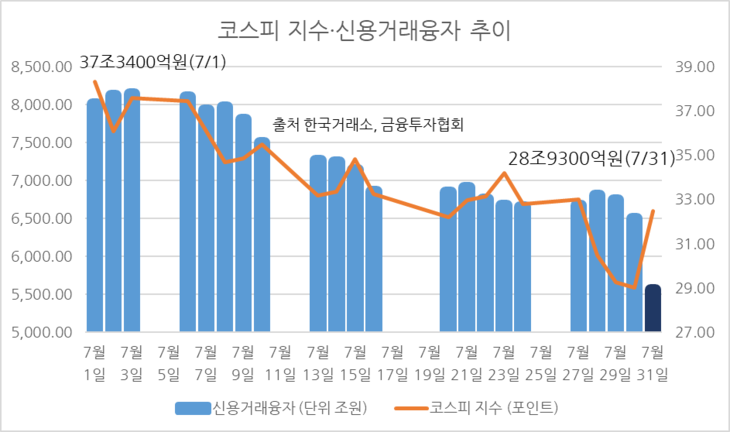
Even on the day the Kospi surged 17.9% in a single session — the last trading day of July — investors were paying down debt rather than taking on new margin positions. The balance of margin loans, a key gauge of leveraged retail investing, fell 3.22 trillion won ($2.25 billion) on that day alone and shrank 8.4 trillion won, or 22.5%, over the course of the month. July's volatile market swings accelerated a broad retreat from high-risk strategies, including margin trading and leveraged products.
According to the Korea Financial Investment Association, the outstanding margin loan balance stood at 28.93 trillion won as of July 31, down from 37.34 trillion won on July 1. Over the same period, the Kospi fell 20.6%, from 8,303.41 to 6,595.45.
Retail investors, who had aggressively net-purchased about 100 trillion won worth of Kospi-listed shares in the first half of the year, sharply slowed their buying in July, with net purchases plunging to around 5.4 trillion won. Investor deposit balances — cash sitting on the sidelines ready to flow into the market — also contracted to around 104 trillion won.
Forced liquidations also increased. Cumulative margin call sell-offs last month exceeded 870 billion won. The final two trading days of the month were particularly severe: forced selling reached 103.8 billion won on July 30 and 122 billion won on July 31, both above 100 billion won for two consecutive sessions and the highest since July 9, when the figure hit 142.2 billion won. The ratio of forced selling to outstanding unsettled receivables also remained elevated, at 8.6% on July 30 and 7.1% on July 31.
Margin loan balances fell sharply among large-cap stocks that had led the market and suffered steep declines. Leveraged exposure to major semiconductor and AI names weakened noticeably. Samsung Electronics shares fell about 20% in July and SK Hynix dropped around 35%, with their respective margin loan balances declining roughly 19% and 11%. Samsung Electro-Mechanics and SK Square, whose share prices fell around 47.7% and 38.8% respectively, saw margin balances shrink 14.9% and 35.7%.
The trend has continued into August. After financial regulators raised the minimum deposit requirement for single-stock leveraged and inverse ETFs to 30 million won, trading volume in those products plunged for two consecutive sessions. From 12.4 trillion won on July 30, volume collapsed to around 3 trillion won on July 31 — the first day the rule took effect — and fell further to around 1.2 trillion won on Monday. Retail investors also turned net sellers of major single-stock leveraged ETFs, pulling back from aggressive leveraged positions.
Market analysts view the recent correction as a process through which excess leverage built up in the market is being substantially unwound.
Lee Jae-man, a researcher at Hana Securities, said the market capitalization of single-stock leveraged ETFs tied to Samsung Electronics and SK Hynix had fallen back to levels seen just after their listings. He added that Samsung Electronics' weighting in the MSCI Emerging Markets index as of last month was 9 percentage points below that of global rival TSMC, the lowest since 2015, suggesting an excessive reduction in its index weight had taken place. "We believe the extreme selling pressure on semiconductors is also past its peak," he said.
Morgan Stanley also upgraded its investment view on the Korean stock market to "overweight" on Monday, saying the recent sharp selloff had been driven mainly by technical factors and that the unwinding of leveraged ETFs, hedge funds and retail margin positions was already more than halfway complete. The bank added that after the rapid deleveraging and reduction in crowded positions, the Kospi had room to rise a further 36% to its target of 9,000.

kacew@heraldcorp.com




