
Incheon logs 4.28 million transit passengers in H1
Korean carriers up 21.6% year-on-year amid geopolitical shifts
Mideast hub closures, K-culture boom drive transfer demand
LCCs push long-haul routes, interline deals to compete
![Travelers crowd the departure hall of Incheon International Airport Terminal 1 on Sunday during the summer holiday season. [Yonhap]](https://wimg.heraldcorp.com/news/cms/2026/08/04/rcv.YNA.20260802.PYH2026080204380001300_P1.jpg)
As Incheon International Airport cements its position as a transit hub in Northeast Asia, South Korean carriers are reaping a growing windfall from transfer passengers. Geopolitical risks — including the US-Iran war and deteriorating China-Japan relations — have reshuffled international air routes, while the global popularity of K-culture has drawn more foreign tourists to travel through South Korea. Full-service carriers, which have traditionally dominated transit traffic, now face competition from low-cost carriers for the same transfer passengers.
Major Mideast hubs blocked as China-Japan direct routes shrink
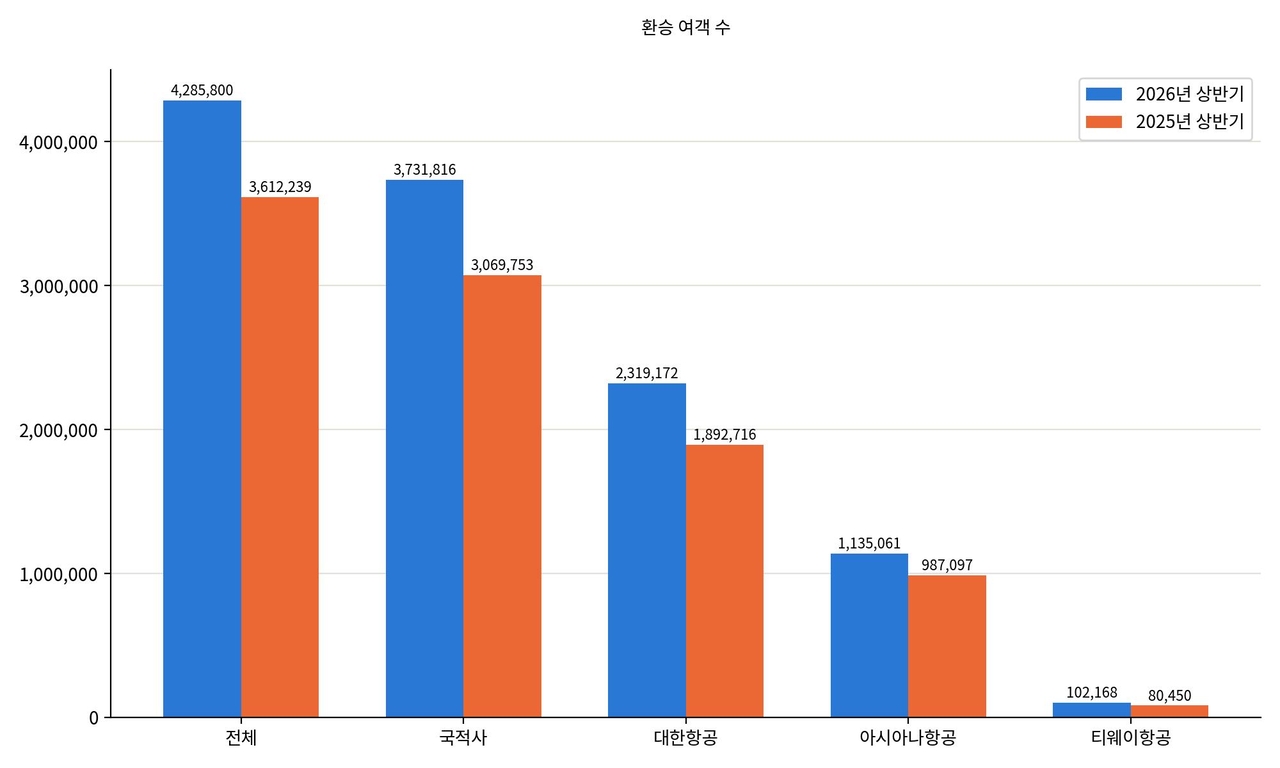
Transit passengers traveling through South Korea reached 4.28 million in the first half of this year, up 18.6 percent from the same period last year, according to the Ministry of Land, Infrastructure and Transport's aviation information portal. Of that total, passengers on Korean carriers numbered 3.73 million, a 21.6 percent increase, showing that domestic airlines have been among the primary beneficiaries of the transit surge.
Industry officials attribute the rise largely to geopolitical spillover. The US-Iran war has pushed travelers who once transited through major Middle Eastern hubs to reroute through Incheon, driven by safety concerns and airline schedule adjustments. A decline in direct flights between China and Japan — stemming from the deterioration in bilateral relations that began last year — has also redirected passengers through Seoul.
The popularity of K-culture and a weaker won are adding further momentum. The Seoul Metropolitan Government said 8.23 million foreign tourists visited Seoul in the first half of this year, up 20 percent from a year earlier. Foreign credit card spending in the city reached 5.62 trillion won ($3.93 billion), a 56.8 percent jump. Incheon Airport surpassed a cumulative 1 billion passengers in July, strengthening its standing as a leading airport in Northeast Asia.
Baggage connectivity and other perks improve as carriers eye more transit growth
![A T'way Air passenger aircraft. [Provided by T'way Air]](https://wimg.heraldcorp.com/news/cms/2026/08/04/news-p.v1.20260521.cf8752386af046c59eabaab8c8959d80_P1.jpg)
Korean carriers are strengthening their transit networks to keep pace with rising demand. Air Premia, which has built a competitive presence on transpacific routes, has been actively leveraging its long-haul network to attract transfer passengers. That strategy has driven its transit numbers up more than fivefold from a year ago. The New York–Incheon–Narita route draws the most transfer traffic, the airline said, with steady growth also coming from routes connecting the United States and Southeast Asia.
Jejuair, whose network is weighted toward short- and medium-haul routes within Asia, is expanding its interline partnerships. Under interline arrangements, partner airlines sell each other's flight segments on a single ticket, with baggage checked through to the final destination depending on the route. Jejuair has interline agreements with Air India, Scoot and Swiss International Air Lines, as well as Air Premia, to improve the transit experience for connecting passengers.
Parata Air plans to launch Japan and Vietnam routes before expanding to transpacific services next year as part of a strategy to build its transit passenger base. T'way Air is also actively using its Incheon–Vancouver route to attract transfer travelers, with transit passengers accounting for about 20 percent of its Incheon-originating traffic.
![A notice for Korean Air's automatic baggage transfer service posted near the baggage claim area at Hartsfield-Jackson Atlanta International Airport. Passengers using the service do not need to re-check their bags when transiting through the United States. [Provided by Korean Air]](https://wimg.heraldcorp.com/news/cms/2026/08/04/news-p.v1.20260730.a2917ead241f424c91950abe28d3dbac_P1.jpg)
Korean Air, which handles the largest share of transit passengers among domestic carriers, is focused on making connections more seamless. Through its joint venture with Delta Air Lines, Korean Air operates an automatic baggage transfer service on routes from Incheon transiting through five US cities — Atlanta, Seattle, Los Angeles, Detroit and Minneapolis — allowing passengers to collect their luggage at their final destination without re-checking it during the layover.
"As geopolitical tensions persist, we expect transit demand to keep growing, and we are adjusting schedules on key routes to attract more connecting passengers," an airline industry official said. "The rising popularity of K-culture is also rapidly increasing the number of travelers who want to combine visits to South Korea, Japan and Southeast Asia in a single trip."
eyre@heraldcorp.com



