
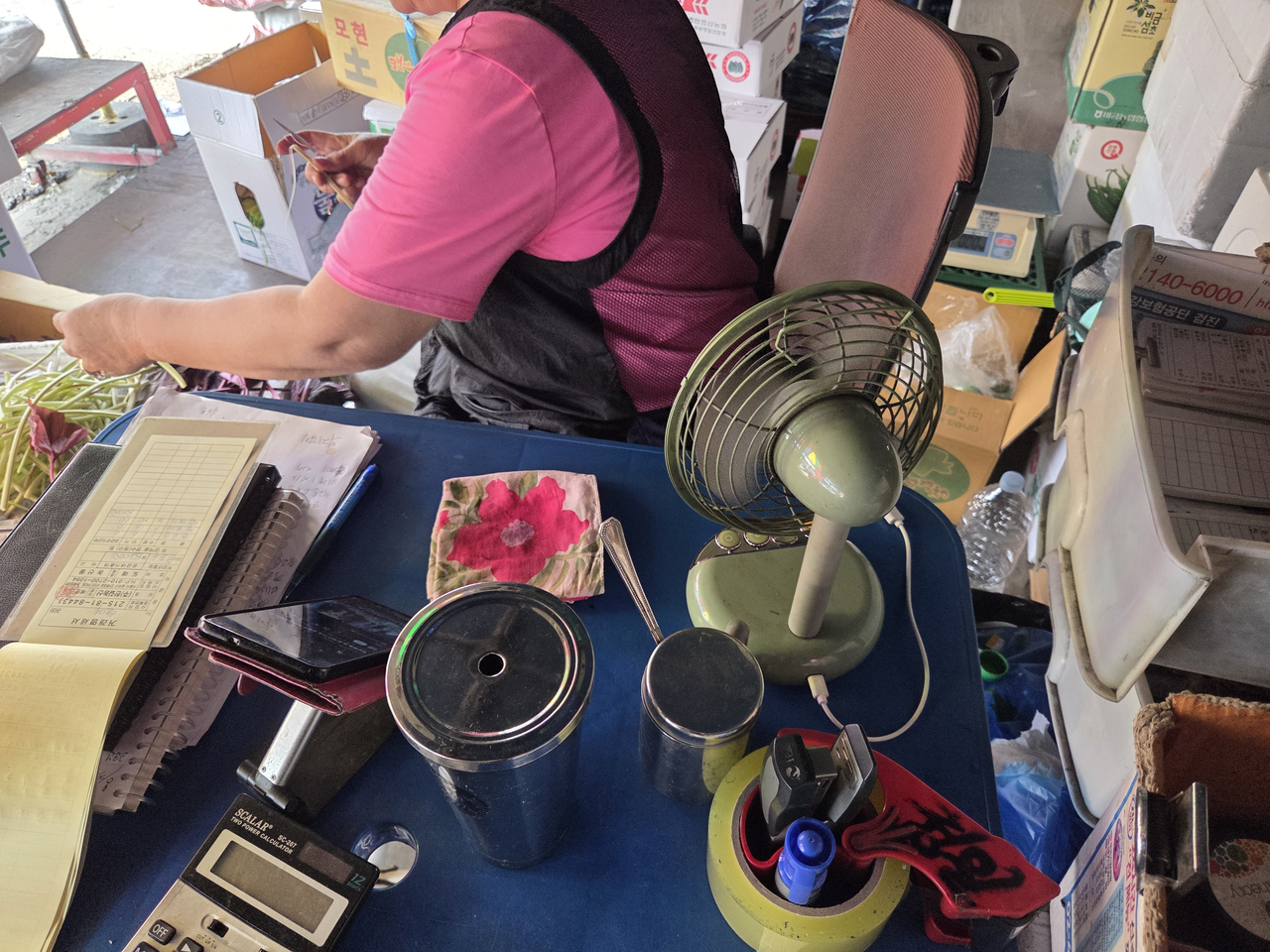
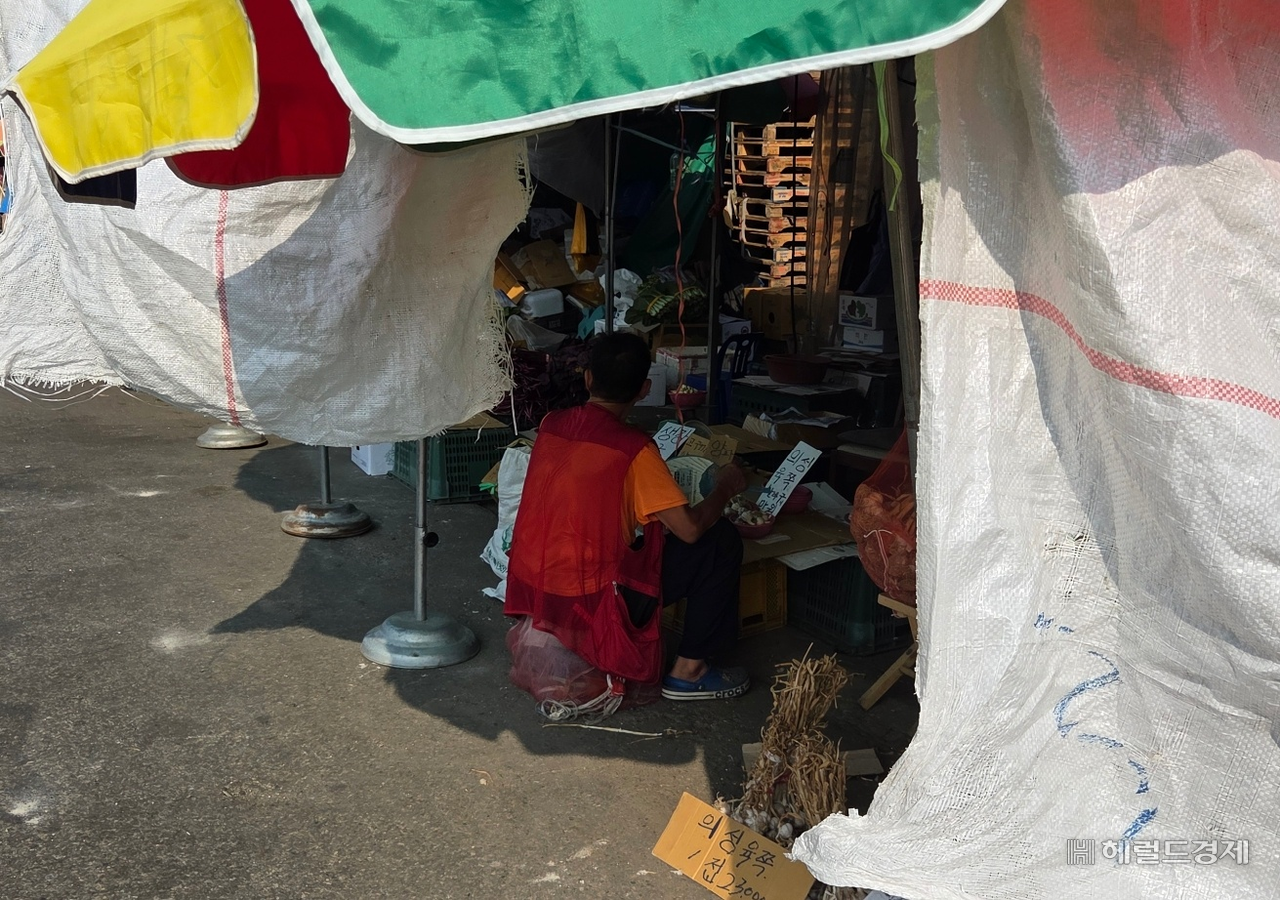
By 8 a.m. Tuesday, the temperature at Garak wholesale market in Songpa-gu, Seoul, had already climbed to 32 degrees Celsius. The open-air alley lined with fruit stalls was, in the vendors' own words, a griddle. Scorching sunlight poured directly onto the roofless market corridor, and heat radiating up from the baked pavement made it nearly impossible to keep one's eyes open.
Vendors who had started work before dawn huddled under parasols, fanning themselves without pause. Workers hauling deliveries were already soaked through with sweat.
The heat wave has slashed sales in half. Vendors said they have no choice but to cut their stock, because produce wilts rapidly in the extreme heat. Their summer strategy: order less, sell fast and close up shop as early as possible.
Kim, 74, who has run a fruit stall at Garak Market for 34 years, said he takes in only half his usual volume during summer. "In spring and fall, daily sales run around 2 million won ($1,400), but in summer it drops to about 1 million won," he said. "If you don't cut back, the produce wilts and you can't sell it."
Yoo, 68, another vendor cooling off in front of a fan, shook his head at the thought of a slow summer day. "In summer, if you can't sell fast, you're in the red," he said. "I come out at 4 a.m. and try to sell everything by 2 or 3 in the afternoon. By then it's so hot you need wet towels and ice rings just to get through it."
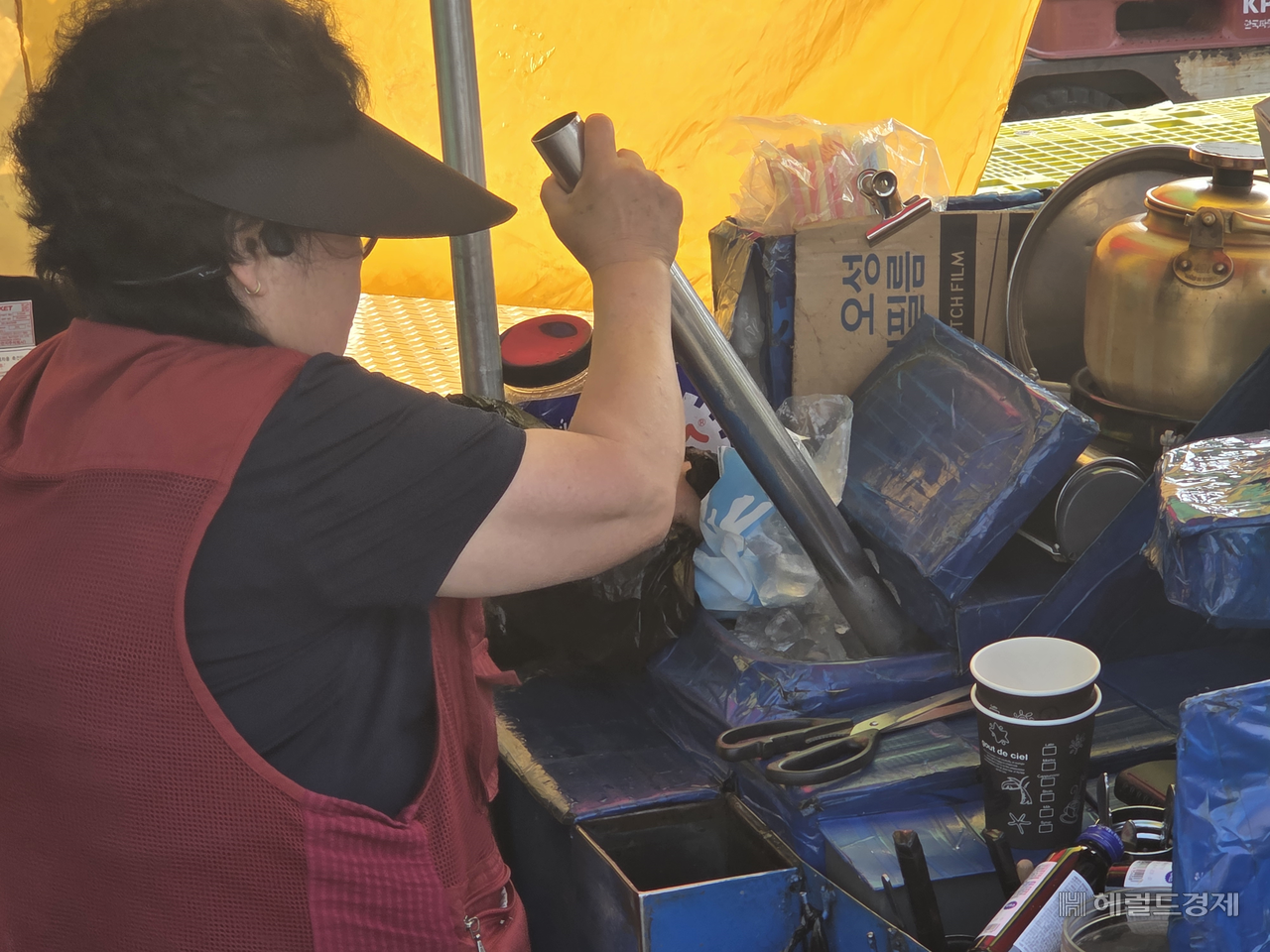
The heat wave spares even those who work through the night. Im, 73, who sells coffee and cold tea at the market, had been at her stall since 8 p.m. Monday and was wrapping up around 9 a.m. Tuesday after an all-night shift.
Before leaving, she packed her ice storage cart to the brim to keep her drinks cold through the day. "If I fill it with ice now, the beverages will stay cold while I'm gone," she said. The cart was stocked with instant stick coffee, sikhye rice punch, sports drinks and other beverages. Business has been brisk: on a good night she takes in around 200,000 won. "The people who come for the auctions are dripping with sweat even at night, so they go through a lot of cold drinks," she said.
Im has sold coffee at Garak Market for more than 30 years, but said this summer stands out. "When I'm brewing coffee in the morning, sweat pours off me, but I can't use electricity out here, so there's no fan or anything," she said. "There's nothing to do but endure it."
Even the market's sanitation workers are fighting the heat. Seo, 60, said he carries salt-glucose tablets and takes one whenever his energy flags. "I try to finish cleaning the open stall alleys — where there's no shade — in the morning, then move to the covered sections in the afternoon," he said.
The Korea Meteorological Administration expanded a major heat wave alert to cover all of Seoul as of 11 a.m. Tuesday. The southwestern and southeastern parts of the city, where the alert had already been in effect since Monday, were already experiencing extreme heat. Data from the Seoul Metropolitan Government's urban sensor network showed that average temperatures across several districts between noon and 6 p.m. Monday exceeded 37 C — Songpa-gu recorded 37.6 C, Gangdong-gu 37.4 C, Gwanak-gu 37.2 C and Gangnam-gu 37.1 C.
It is the first time a major heat wave alert has been issued for Seoul since the country overhauled its heat wave warning system this year. The major alert is the highest tier in the system, issued when a region has recorded a daily maximum apparent temperature of 35 C or above for at least two consecutive days and an extreme high — an apparent temperature of 38 C or above, or an actual high of 39 C or above — is forecast.
The Korea Meteorological Administration said South Korea is currently under the influence of the Tibetan High in the upper atmosphere and the North Pacific High in the mid-to-lower levels, keeping skies clear and sunlight intense. Daytime heat and warm nights are expected to continue for now.
20ki@heraldcorp.com
newday@heraldcorp.com




