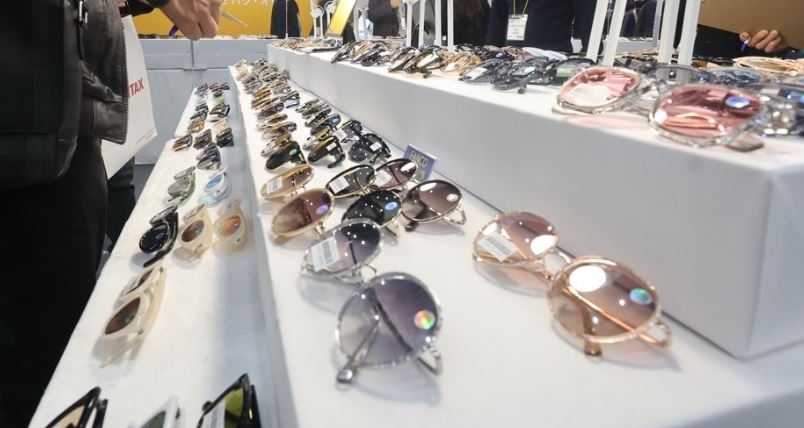
Korean eyewear has become a must-buy item for foreign tourists, lifting the profile of domestic brands — but the manufacturing industry behind them is struggling. As brands increasingly outsource production to China, domestic factories are being left out of the boom.
According to Korea Customs Service trade statistics, imports of eyeglass frames from China rose 21.0 percent from $42.32 million in 2022 to $51.20 million last year. In the first half of this year (January–June), imports reached $32.95 million, up 39.5 percent from $23.62 million in the same period last year. Chinese-made frames accounted for 56.9 percent of total eyeglass frame imports of $57.82 million in the first half.
The same trend holds for optical lenses. Imports of Chinese-made lenses reached $121.37 million in the first half of this year, up 4.7 percent from $115.96 million in the same period last year.
Exports, meanwhile, are on a downward curve. Eyeglass frame exports in the first half of this year fell 7.7 percent to $34 million from $36.85 million a year earlier. Since frame imports surpassed exports in 2023, the gap has widened to a new record each year.
The surge in Chinese frame imports largely reflects a growing number of domestic eyewear brands shifting production to Chinese factories. China offers lower labor costs, cheaper raw materials and large-scale production capacity, making it far easier to stay price-competitive.
Acetate, the material used to make thick-rimmed frames, is particularly costly to produce domestically because of the requirements for managing environmentally regulated substances. In China, regulatory burdens are lower and mass-production systems are in place, allowing manufacturers to procure the material at significantly lower prices.
According to the Korean Optometric Association, domestic brands popular among foreign tourists source 100 percent of their eyewear from China and import it for sale in Korea.
"Daegu's eyewear industry once had a full manufacturing ecosystem — from raw material processing to assembly — but factory closures and an aging workforce have weakened that foundation to the point where meeting production demand has become difficult," an industry official said. "China has a production ecosystem that handles everything from material procurement to processing and assembly in one place, making it very hard for domestic companies to compete on price."
siuu@heraldcorp.com